July 1st, 2026
Stay informed about the latest Solana (SOL) news, including market updates, partnerships, innovations, and other related events.
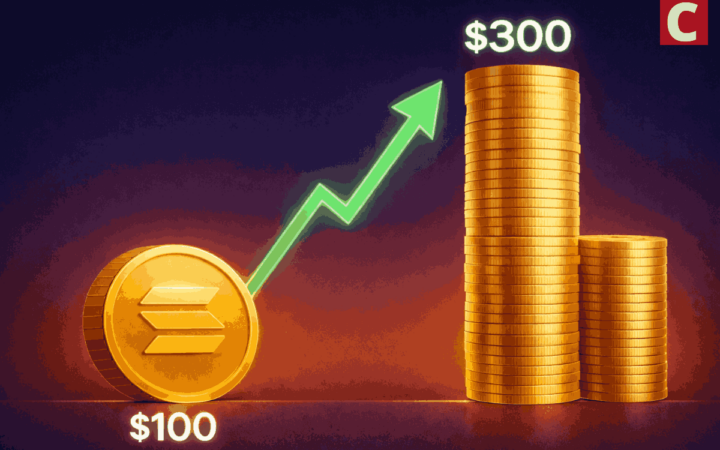
Solana just bounced off the $95-$100 zone again, a level that continues to act as a major line in the sand for long-term buyers.

WisdomTree expands its tokenized fund suite to Solana, offering retail and institutional investors seamless access to diversified financial products with minimal fees.
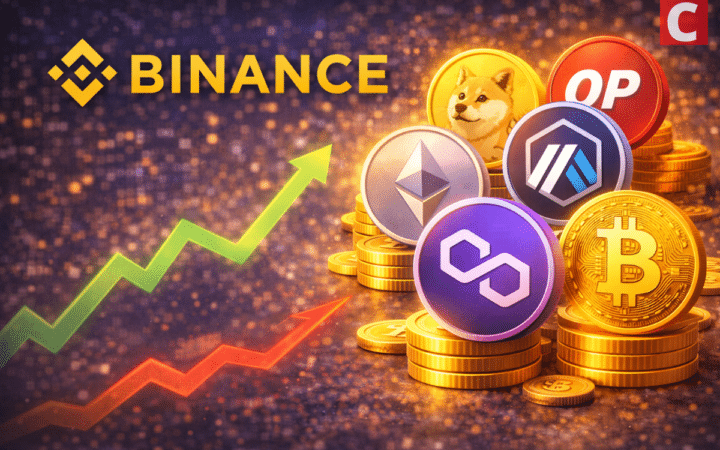
Binance will list BNB/U, ETH/U, KGST/U, SOL/U, TRX/USD1, and USD1/U on Tuesday, January 27, at 08:30 (UTC).
 SOL
SOL
Ondo Finance brings over 200 tokenized US stocks and ETFs to Solana, competing with xStocks which controls 93% of the network’s tokenized securities market.
The SKR token powers governance and staking within the Solana Seeker mobile ecosystem, with rewards distributed every 48 hours at no commission.

Nansen has launched AI-powered crypto trading that lets users execute trades through conversational prompts.
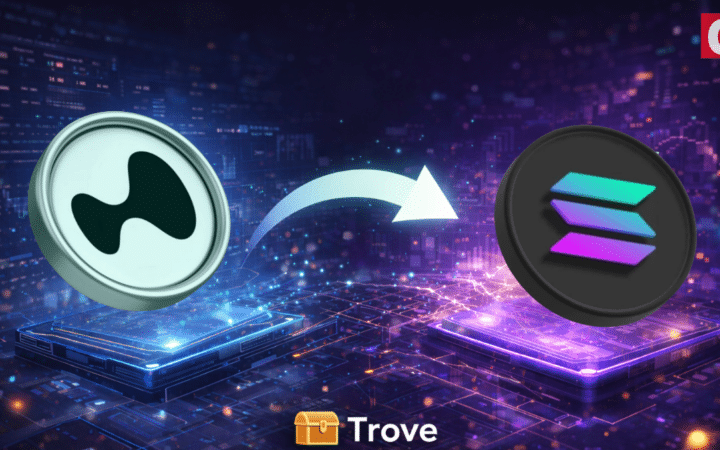
Trove Market has decided to shift from Hyperliquid to Solana for its token generation event.

Sui Mainnet halted for about six hours on Jan. 14. In a post-mortem, developers insure that the funds were safe and explain the reason.

Sharps Technology has opened a Solana validator with the help of Coinbase, joining other DAT firms making the move globally.

Pump.fun, a prominent memecoin trading platform, has admitted its fee model failed to create sustainable incentives.
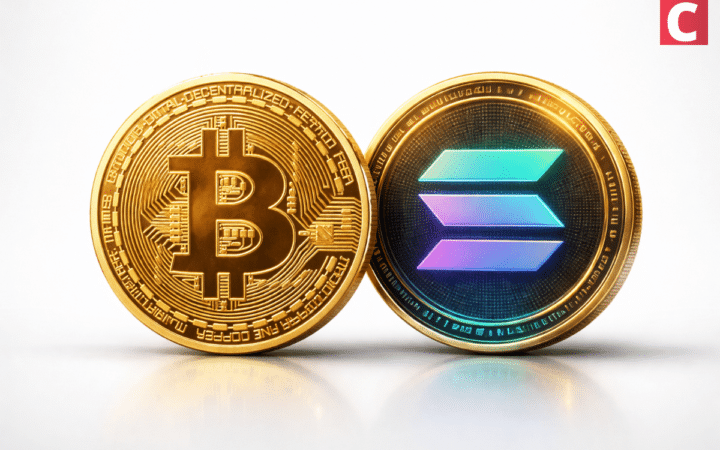
Morgan Stanley has filed for Bitcoin and Solana ETFs, aiming to offer regulated crypto exposure as institutions expand digital asset access.

Bitcoin lagged in 2025 as crypto fund inflows hit $47.2B. Altcoins like Ethereum, XRP, and Solana drove much of the growth.
Solana-based stablecoin USX briefly lost its dollar peg due to a secondary market liquidity drain, dropping as low as $0.10.
NEAR Protocol’s token is now tradeable on Solana through NEAR Intents and Orb Markets integration, following viral posts celebrating collaboration between both ecosystems.
Bitwise is bullish on Solana. The asset manager predicted that SOL could reach new all-time highs by 2026, backed by steady network growth and increasing institutional involvement.
Solana SOL $80.25 24h volatility: 1.5% Market cap: $46.64 B Vol. 24h: $2.05 B has become one of the most influential blockchain platforms, with its native SOL token having a larger market capitalization than most of the market. Co-founded by Anatoly Yakovenko, the network was officially launched in 2020, two years after publishing its whitepaper. The main aim of Solana is to improve network and transaction scalability by supporting a high throughput – over 60,000 transactions per second (tps).
The high scalability makes the Solana blockchain one of the most preferred platforms for decentralized applications (dApps) and non-fungible tokens (NFTs). Solana achieves scalability through a unique consensus mechanism called Proof of History (PoH). The mechanism creates a cryptographic timestamp that establishes transaction order before adding them to the blockchain. This way, transactions are processed much faster than other networks.
The scalability provided by the Solana blockchain is attractive not only to users but also to creators developing essential dApps. The blockchain hosts notable tools, including the decentralized exchange (DEX) platform Serum and automated market maker (AMM) Raydium. Also, Solana offers Solana Pay, a payment framework that allows businesses to execute cheaper digital transactions.
With a growing library of applications and an active developer community, Solana is unsurprisingly a popular blockchain option. Its position is expected to improve as Solana capitalizes on its scalability solutions to attract more users and developers, which helps to maintain its position as a trusted player in the decentralized ecosystem.
Solana is a high-performance network designed to bring speed and efficiency to several blockchain applications, including payments, finance, NFTs, and gaming. The SOL token is also sometimes used as an investment channel by investors who understand the inherent risks.
Solana achieves its high speed through a unique consensus mechanism called proof-of-history (PoH). Unlike the proof-of-work (PoW) algorithm used by Bitcoin and the proof-of-stake (PoS) used by Ethereum, the PoH consensus mechanism achieves high throughput by using timestamps to establish transaction order, before processing. This way, blockchain validators do not require extensive communication and can process transactions quickly.
Like many other cryptocurrencies, Solana’s history of healthy price upticks has created several millionaires over time. However, all holders and would-be investors should note that pre-investment research is essential because of the risks cryptocurrencies carry.
There is no minimum amount of SOL required to be a validator. However, the more SOL tokens staked, the higher the chance of being selected to validate transactions and earn rewards.