A Polymarket trader turned $676 into $67,608 after a UFC announcer declared the wrong winner. The incident exposes real-time latency risks — and lands as regulators circle sports prediction markets.
A single mistake from a UFC announcer just handed one trader a near-100x return, and the clip is already circulating as evidence of how fast prediction market odds can collapse. On Saturday, a Polymarket UFC user converted $676 into $67,608 in a matter of seconds, capitalizing on a brief window when the platform’s live odds misfired.
During the Tyrell Fortune vs. Marcin Tybura heavyweight bout, UFC presenter Bruce Buffer initially announced Tybura as the winner. Polymarket shares for Fortune instantly cratered to one cent. A trader identified as LlamaEnjoyer on Polymarket and Verrissimus on X recognized the call as potentially erroneous and placed $676 on Fortune at those depressed odds.
someone turned $676 into $67,574 on Polymarket because the UFC announced the WRONG winner!
Bruce Buffer read Tybura as the winner, it bonded to 99c. Seconds later the UFC called Fortune back into the octagon, apologized, and corrected it — Fortune won by unanimous decision.… pic.twitter.com/FJrZ3zYUqm
Buffer corrected himself moments later, declaring Fortune the actual winner. The profit for LlamaEnjoyer was $66,932, with the trader later admitting on X that he had nearly bet $100,000 on Tybura at 99 cents before realising something “was off” and caught his attention.
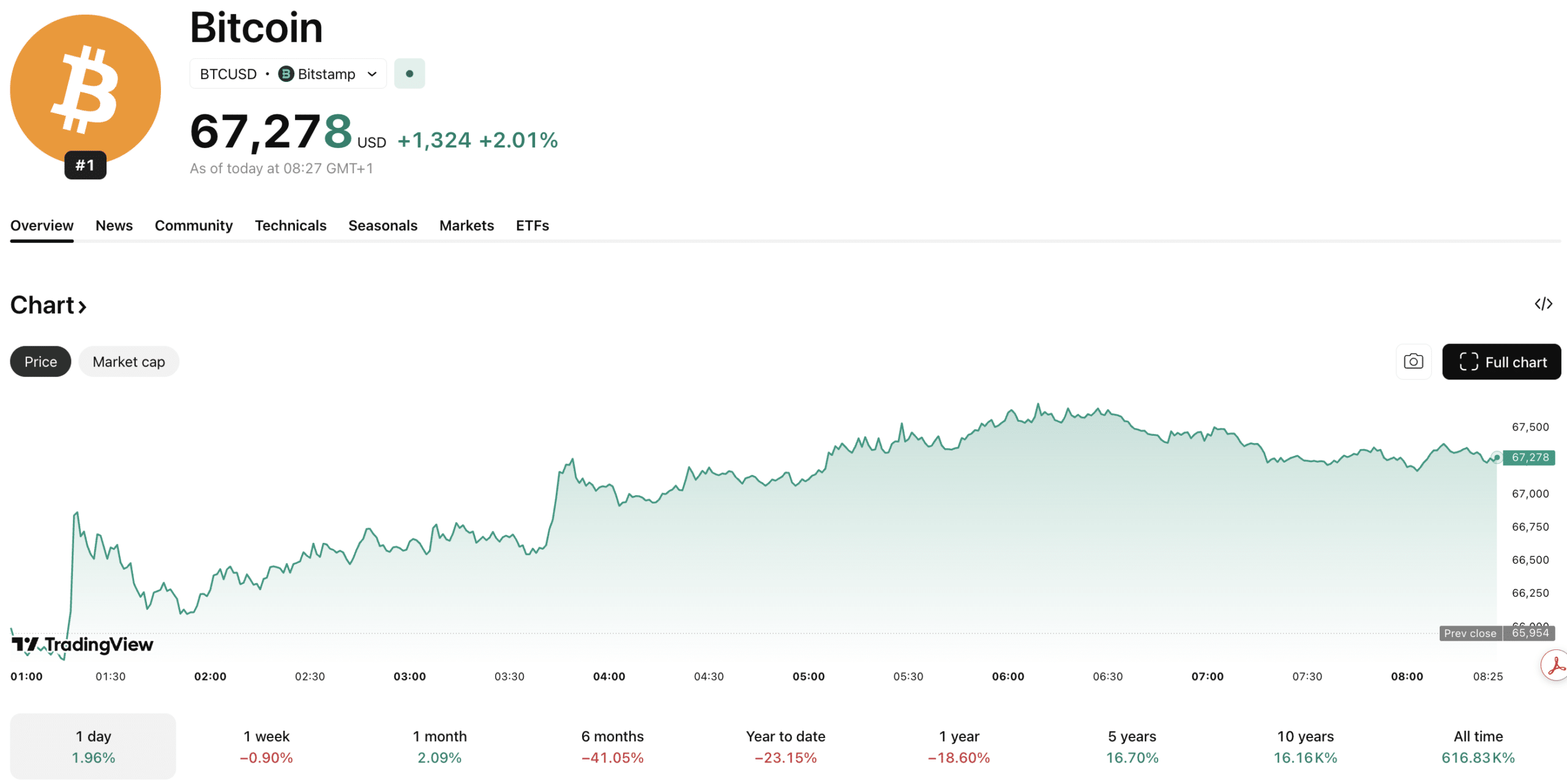
The incident arrives at an awkward moment for Polymarket, which is navigating mounting regulatory scrutiny while simultaneously trying to expand its mainstream footprint. This news drops as the Bitcoin price climbed +1% overnight, back above $67,000, with daily volume exceeding $28.2Bn.
Can Prediction Market Integrity Survive Real-Time Sports Exploit Pressure Following Polymarket UFC Blunder?
Polymarket prices event probabilities rather than tokens, so conventional price-chart analysis does not apply here. What the Fortune–Tybura episode does expose is a latency gap, the interval between a real-world outcome and the platform’s oracle or crowd resolution, that can be exploited when traders with superior information access move faster than the broader market.
The platform’s current market on a law banning sports prediction markets in 2026 sits at 14%, a relatively subdued probability that suggests traders are not yet pricing a near-term regulatory shutdown. That reading could shift. A bipartisan bill introduced March 23 by Senators Adam Schiff and John Curtis, the Prediction Markets Are Gambling Act, specifically targets CFTC-regulated platforms like Polymarket for sports contracts that allegedly sidestep state gambling laws.
Young people in Utah are getting exposed to addictive sports betting and casino-style gaming contracts that belong under state control, not federal regulators. Our bipartisan bill ensures that states can maintain their authority over these markets.https://t.co/MEDI9SSKQv
The Polymarket UFC connection has expanded, after opening a Washington, D.C., bar last week, displaying live UFC bets alongside geopolitical markets, a calculated attempt to reframe the product as financial infrastructure rather than gambling. Whether that framing survives a high-profile arbitrage clip going viral is another matter entirely.
The bull case for the platform’s legitimacy rests on incidents like this remaining rare; the bear case is that live-event markets structurally reward whoever sits closest to the primary source, a dynamic that looks more like a timing race than a market. Congressional pressure on prediction market integrity has been building for months, and this episode adds ammunition to that argument.
Episodes like the Fortune–Tybura exploit on the Polymarket UFC section tend to accelerate one familiar pattern: capital rotates away from headline-risk assets toward infrastructure plays where the edge is structural rather than reactive.
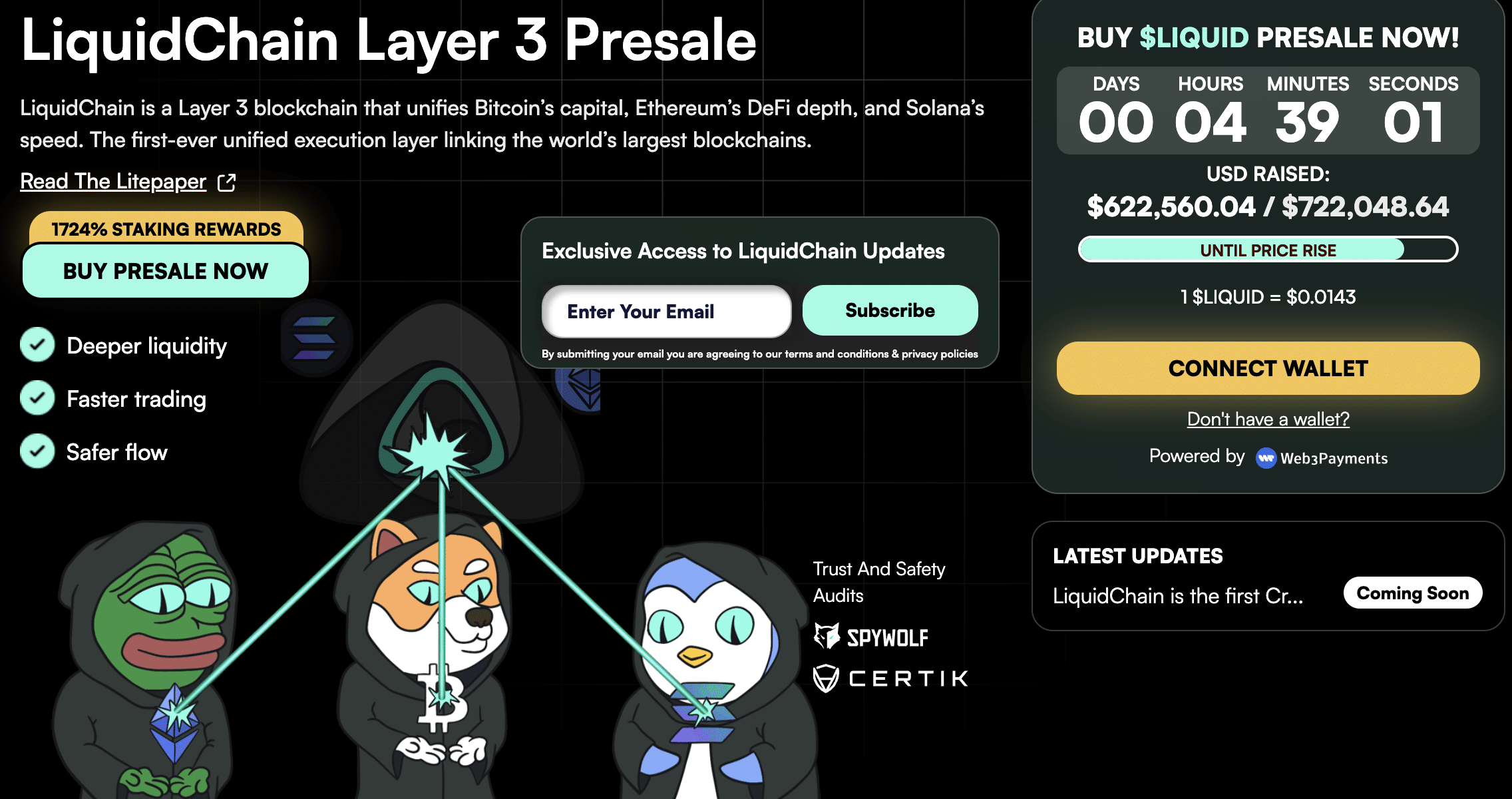
LiquidChain (LIQUID) is a Layer 3 infrastructure project positioning itself as a cross-chain liquidity layer, fusing Bitcoin, Ethereum, and Solana liquidity into a single execution environment.
The architecture centers on a Unified Liquidity Layer, Single-Step Execution, and a Deploy-Once model that lets developers access all three ecosystems without redeployment overhead.
Verifiable Settlement is a stated core feature that is clearly relevant in a week when settlement integrity is under scrutiny. The presale is currently priced at $0.0144, with $628,140.90 raised to date.
Disclaimer: Coinspeaker is committed to providing unbiased and transparent reporting. This article aims to deliver accurate and timely information but should not be taken as financial or investment advice. Since market conditions can change rapidly, we encourage you to verify information on your own and consult with a professional before making any decisions based on this content.
Daniel Frances is a technical writer and Web3 educator specializing in macroeconomics and DeFi mechanics. A crypto native since 2017, Daniel leverages his background in on-chain analytics to author evidence-based reports and deep-dive guides. He holds certifications from The Blockchain Council, and is dedicated to providing "information gain" that cuts through market hype to find real-world blockchain utility.
Polymarket has acquired Brahma, a DeFi infrastructure startup, marking the prediction market platform’s third major acquisition as it seeks to verticalize its operations. While financial terms were not disclosed, the deal will see Brahma sunset its existing user-facing products within 30 days to focus entirely on evolving Polymarket’s execution stack. This move signals a shift from pure user growth to infrastructure hardening, addressing the friction of on-chain wagering just as competition with regulated rivals intensifies.
“Building reliable infrastructure across blockchain networks and traditional financial rails is hard,” Polymarket CEO Shayne Coplan noted regarding the deal. The acquisition underscores a growing recognition that for decentralized prediction markets to scale, the underlying blockchain complexity must be abstracted away from the end user.
Polymarket’s Acquisition of Brahma: What the Consolidation Wave Means
This acquisition is not an isolated event; it is part of a calculated consolidation strategy. Polymarket is racing to fortify its technical moat against competitors like Kalshi, which has gained significant traction in the regulated US market. By absorbing Brahma, Polymarket is betting that superior execution infrastructure—specifically regarding wallet abstraction and liquidity management—will be the deciding factor in the prediction market wars.
Institutional interest in the sector is already surging, evidenced by asset managers like Bitwise and GraniteShares proposing prediction market ETFs. This institutional attention brings higher expectations for trade execution and reliability, areas where Brahma’s technology specializes.
Analystssuggest the deal is both defensive and offensive: it removes a potential independent infrastructure player while securing the talent needed to make decentralized betting feel like a traditional fintech experience. Less short-term excitement, more stability long term.
What Brahma Adds to Polymarket’s Infrastructure Stack
Brahma, founded in 2021, has processed over $1 billion in volume through its execution logic and strategy vaults. Its primary value to Polymarket lies in its ability to streamline complex on-chain interactions.
“Building reliable infrastructure across blockchain networks and traditional financial rails is hard—there are no shortcuts,” Coplan told Fortune, emphasizing the engineering challenges the team faces.
The startup’s technology will ostensibly be used to smooth out the jagged edges of crypto-based betting: wallet creation, fund deposits, and token redemptions. Brahma’s team stated in their announcement that they will “dedicate itself to evolving Polymarket’s stack,” effectively becoming the platform’s internal DeFi engine. Existing Brahma products, including Console and its strategy vaults, will be wound down, with users retaining full access to withdraw funds during the transition.
Prediction Market Competition: How This Reshapes the Landscape
The timing of this acquisition aligns with Polymarket’s broader push for regulatory compliance and market dominance. The platform has faced increasing scrutiny, highlighted recently when authorities in Israel arrested traders connected to insider betting on the platform. Such incidents reinforce the need for robust internal controls and monitoring systems, which require a sophisticated backend infrastructure.
Improving infrastructure is only half the battle; navigating the legislative minefield is the other. As decentralized platforms like Hyperliquid open policy advocacy centers to influence US frameworks, Polymarket is arming itself with the technical capability to potentially implement stricter compliance tools without sacrificing performance.
If Polymarket can successfully integrate Brahma’s execution layer, it may finally solve the user experience gap that separates it from fully regulated, off-chain competitors. The race is no longer just about liquidity; it is about invisible infrastructure.
The success of this acquisition will be measured by its invisibility. If Polymarket’s next iteration feels less like a blockchain protocol and more like a standard trading app, the premium paid for Brahma will have been worth it. Observers should watch for the rollout of new wallet features in the coming months as the integration proceeds. Building the rails is hard, but buying them might just be the smarter play.
Disclaimer: Coinspeaker is committed to providing unbiased and transparent reporting. This article aims to deliver accurate and timely information but should not be taken as financial or investment advice. Since market conditions can change rapidly, we encourage you to verify information on your own and consult with a professional before making any decisions based on this content.
Daniel Frances is a technical writer and Web3 educator specializing in macroeconomics and DeFi mechanics. A crypto native since 2017, Daniel leverages his background in on-chain analytics to author evidence-based reports and deep-dive guides. He holds certifications from The Blockchain Council, and is dedicated to providing "information gain" that cuts through market hype to find real-world blockchain utility.