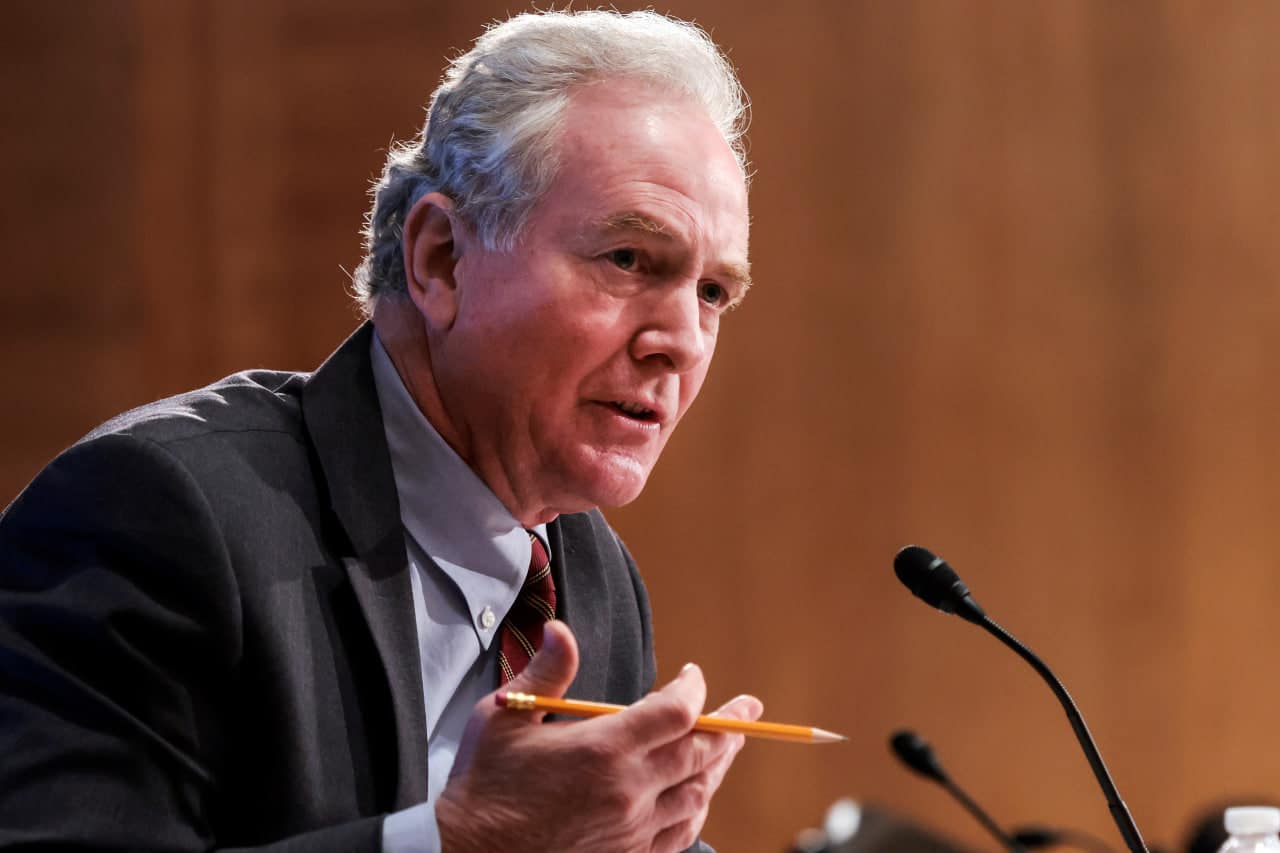
In Clarity Act news today, the Senate Banking Committee voted 13–11 on May 14, 2026, to reject a Democratic-sponsored ethics amendment to the Digital Asset Market Clarity Act, commonly referred to as the Clarity Act – that would have barred the president, vice president, and members of Congress from owning or participating in cryptocurrency businesses, with Senator Chris Van Hollen (D-MD) sponsoring the defeated measure and Senator Bernie Moreno (R-OH) leading opposition, arguing the amendment was procedurally out of order and its underlying allegations against the Trump family unproven.
The Clarity Act itself advanced through committee on a 15–9 vote, with two Democrats, Senators Ruben Gallego of Arizona and Angela Alsobrooks of Maryland, joining all 13 Republicans in support of the underlying bill, even as the conflict-of-interest provision was stripped.
This is not simply a procedural defeat for a Democratic amendment in a Republican-controlled committee. It is a structural gap embedded into what may become the most consequential piece of crypto regulation in U.S. history, a legislative framework that assigns broad new regulatory authority over digital asset markets to the CFTC and SEC while containing no mechanism for constraining the financial interests of the officials who authored, advanced, and will ultimately sign that framework into law.
Clarity Act News: Amendment Architecture, What Van Hollen’s Measure Would Have Done, Who It Would Have Covered, and the Factual Basis of the Conflict-of-Interest Argument
The mechanism functions as follows: the Van Hollen amendment would have imposed two distinct obligations on the president, vice president, and sitting members of Congress – an outright prohibition on ownership of or participation in cryptocurrency businesses while holding federal office, and a mandatory public disclosure requirement for any existing crypto holdings or affiliations. The amendment was not framed as a general ethics modernization measure; it was targeted at a specific structural problem that Van Hollen argued the Clarity Act’s own passage would aggravate, namely that the officials responsible for establishing a federal regulatory perimeter around digital assets may hold direct financial interests in the assets being regulated.
Van Hollen’s evidentiary basis centered on the Trump family’s involvement in World Liberty Financial, the DeFi-oriented crypto project in which Trump family members hold significant stakes, and on the TRUMP and MELANIA memecoins, which Van Hollen alleged generated billions of dollars in profits for the family while ordinary retail investors suffered billions in losses from the same projects.
Trump's memecoin is one of the most corrupt schemes we've seen from a U.S. president.
Foreign actors are using it to buy influence inside our White House, while at home, investors have lost billions.
My amendment would've shut this scam down. Every Republican voted against it. pic.twitter.com/XnZrYbeRk5
— Senator Chris Van Hollen (@ChrisVanHollen) May 18, 2026
The epistemic status of those figures warrants care: Van Hollen’s characterization reflects publicly reported estimates of Trump family crypto gains, figures that include reported earnings exceeding $620 million across World Liberty Financial, memecoin launches, and related ventures, but the precise amounts remain contested, and Moreno explicitly categorized the allegations as unproven during the markup proceedings.
The 13–11 vote to defeat the amendment fell strictly along party lines, with every Republican present voting against the measure and every Democrat voting in favor.
A separate Van Hollen amendment imposing direct DeFi AML obligations and developer liability on decentralized finance protocols was also defeated at the same markup session, an outcome the crypto industry characterized as a reprieve, given longstanding industry resistance to imposing bank-style compliance obligations on DeFi infrastructure. The dual rejection leaves both the crypto ethics question and the DeFi AML framework as open legislative questions heading into the floor vote, where their resolution, or continued absence, will directly affect the bill’s path to 60 votes.
Republican Opposition: The Procedural and Substantive Arguments, and What the Party-Line Vote Composition Reveals About the Conflict-of-Interest Question in Crypto Regulation
Moreno’s primary objection was procedural: he argued that ethics restrictions on federal officials fall under the jurisdiction of the Senate Judiciary Committee, not the Banking Committee, and that introducing such language during a crypto market-structure markup was therefore out of order.
That framing allowed Republican members to oppose the amendment on structural grounds without engaging directly with Van Hollen’s substantive allegations regarding Trump crypto holdings and the conflict-of-interest dynamics embedded in the current legislative process, a distinction that matters for how the debate is likely to be litigated in subsequent floor proceedings.
We suspect the decision to anchor Republican opposition in procedural rather than substantive grounds reflects a deliberate strategic calculation: contesting Van Hollen’s allegations about World Liberty Financial and the memecoin operations on their merits would require either defending the Trump family’s crypto dealings directly or conceding that a conflict-of-interest problem exists, neither of which serves the Republican conference’s interests in keeping the Clarity Act on a trajectory toward a White House signature.
The jurisdictional objection, by contrast, allows the vote to be characterized as a question of committee process rather than a judgment on whether senior officials should be permitted to profit from crypto assets they regulate, a framing that insulates individual Republican members from a politically costly position while preserving the bill’s momentum.
The strictly party-line 13–11 vote composition is itself a data point about how the crypto ethics and conflict-of-interest question maps onto partisan alignment: no Republican broke ranks to support the disclosure requirement, and no Democrat present voted against it, indicating that the ethics provision has become a clean partisan fault line rather than a genuine deliberative question within the committee. That alignment will complicate the bill’s floor arithmetic considerably.
Disclaimer: Coinspeaker is committed to providing unbiased and transparent reporting. This article aims to deliver accurate and timely information but should not be taken as financial or investment advice. Since market conditions can change rapidly, we encourage you to verify information on your own and consult with a professional before making any decisions based on this content.
Daniel Frances is a technical writer and Web3 educator specializing in macroeconomics and DeFi mechanics. A crypto native since 2017, Daniel leverages his background in on-chain analytics to author evidence-based reports and deep-dive guides. He holds certifications from The Blockchain Council, and is dedicated to providing "information gain" that cuts through market hype to find real-world blockchain utility.