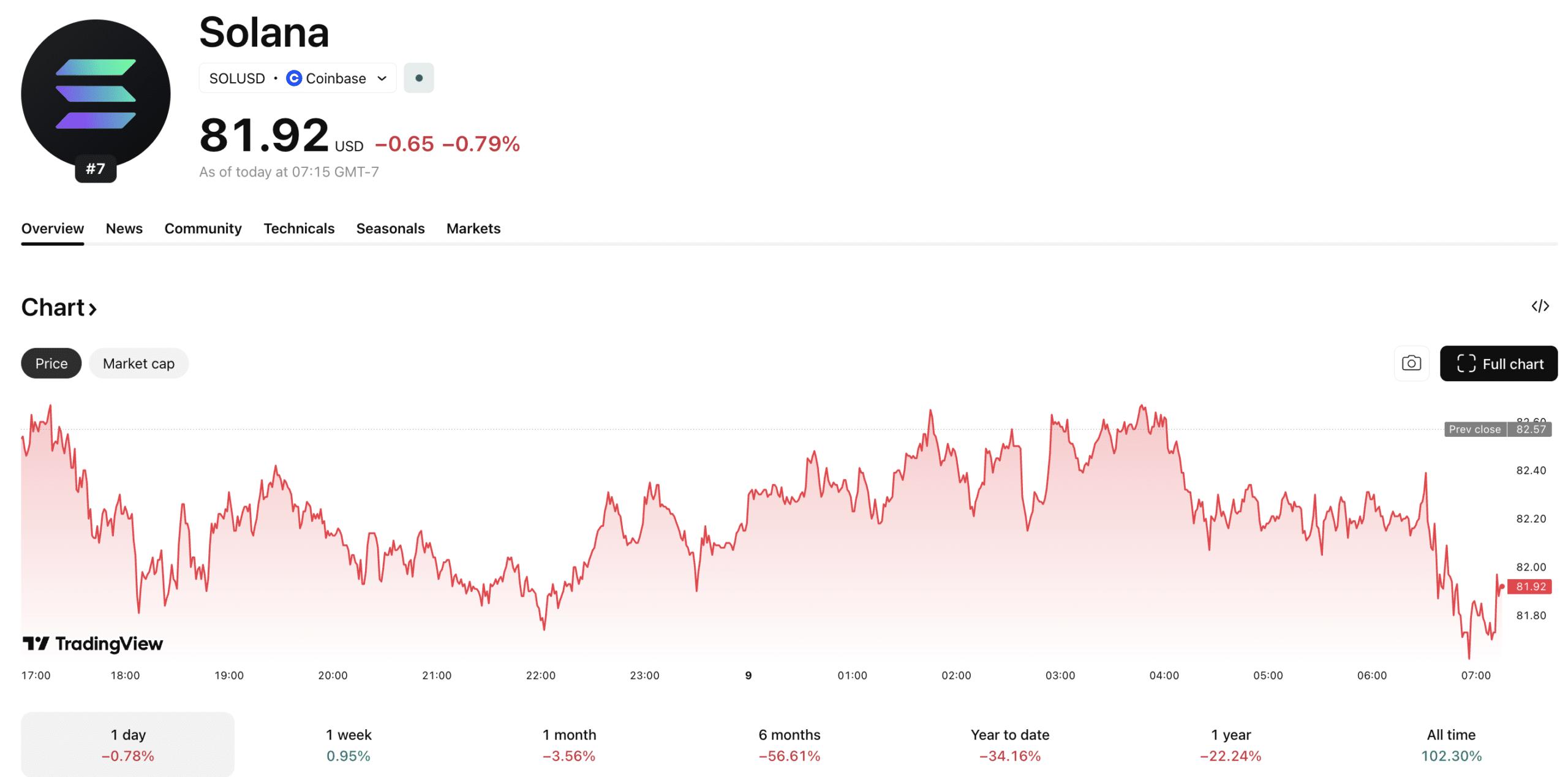
The Elon Musk-backed Grok AI predicts that by January 1, 2027, Solana (SOL) could trade around $350–$450, with a target range of $380–$420, assuming a full-blown crypto bull market returns by late 2026. As of September 13, 2026, SOL trades just above $100, significantly below its January 2025 all-time high of around $295–$296. This outlook […]
The Elon Musk-backed Grok AI predicts that by January 1, 2027, Solana (SOL) could trade around $350–$450, with a target range of $380–$420, assuming a full-blown crypto bull market returns by late 2026.
As of September 13, 2026, SOL trades just above $100, significantly below its January 2025 all-time high of around $295–$296. This outlook surpasses many forecasts in the $125–$260 range and aligns with optimistic projections like Standard Chartered’s $400 target for 2027.
The positive scenario relies on improved macro liquidity, increased Solana ETF inflows, successful network upgrades, and ongoing dominance in high-throughput activities.
Historically, SOL has performed well mid-cycle, making a rally from the current levels to the mid-to-high $300s possible in a strong bull market. While speculative, SOL could reach the $350–$450 range by early 2027 if market conditions are favorable, with a focus on $380–$420.
Grok AI Predicts SOL Price: Technical Analysis Supporting the $400+ Thesis
Solana is back at an important decision point after failing to hold its latest move toward the $105-$106 region.
For $SOL , I’m treating $98.5-$100 as the support zone keeping the broader rebound intact while daily acceptance above $106 would bring $109-$110.5 back into focus.… pic.twitter.com/9yDM4IMeNi
On the higher timeframes, SOL has been consolidating and recovering after a deep drawdown from the 2025 highs, currently holding above key demand zones near $97–$100 while facing near-term resistance in the $102–$110 region.
A sustained break and weekly close above $110–$120 (with volume confirmation) would strengthen the intermediate bullish structure, opening the path toward the $146–$150 area and then the prior cycle high near $290–$300.
In a full bull-market regime, reclaiming the previous ATH often serves as a powerful psychological and technical catalyst for extension; Fibonacci projections and measured moves from the multi-year base and the recent recovery low project into the $350–$450 zone on continued momentum.
Price is holding above rising longer-term moving averages (such as the 50- and 200-day SMAs in the mid-to-high $80s), with neutral-to-constructive RSI readings; a reclaim of short-term momentum (MACD turning higher) would further support upside continuation.
Key supports to defend on any retests include the $97–$100 zone and the broader $83–$88 region; a decisive break below those levels would weaken the near-term recovery thesis.
Overall, the chart setup favors a multi-leg advance with strong upside potential if risk appetite returns, consistent with Solana’s historical pattern of sharp, high-beta rallies once key resistance is cleared in bull-market conditions.
Bitcoin Hyper Targets Early Mover Upside as Solana Tests Key Levels
If higher-for-longer becomes the base case for crypto, Solana upside from here gets capped by the same forces already priced into a $58Bn-plus asset: institutional flows, ETF rebalancing, and rate-sensitive portfolio math.
That’s a tough environment for outsized returns on an asset this large, which is why some traders are looking earlier in the risk curve, toward infrastructure plays still in price discovery. Bitcoin Hyper (HYPER) is one of those.
It’s a Bitcoin Layer 2 network built with Solana Virtual Machine (SVM) integration, aiming to deliver faster smart contract execution than Solana while settling back to Bitcoin’s base layer.
The presale has raised $33,500,000 at a current token price of $0.0136, with staking rewards available at an unspecified but reportedly high APY.
Its Decentralized Canonical Bridge is designed to move BTC on and off the Layer 2 without custodial middlemen, the kind of plumbing Bitcoin has historically lacked.
Disclaimer: Coinspeaker is committed to providing unbiased and transparent reporting. This article aims to deliver accurate and timely information but should not be taken as financial or investment advice. Since market conditions can change rapidly, we encourage you to verify information on your own and consult with a professional before making any decisions based on this content.
Daniel Frances is a technical writer and Web3 educator specializing in macroeconomics and DeFi mechanics. A crypto native since 2017, Daniel leverages his background in on-chain analytics to author evidence-based reports and deep-dive guides. He holds certifications from The Blockchain Council, and is dedicated to providing "information gain" that cuts through market hype to find real-world blockchain utility.
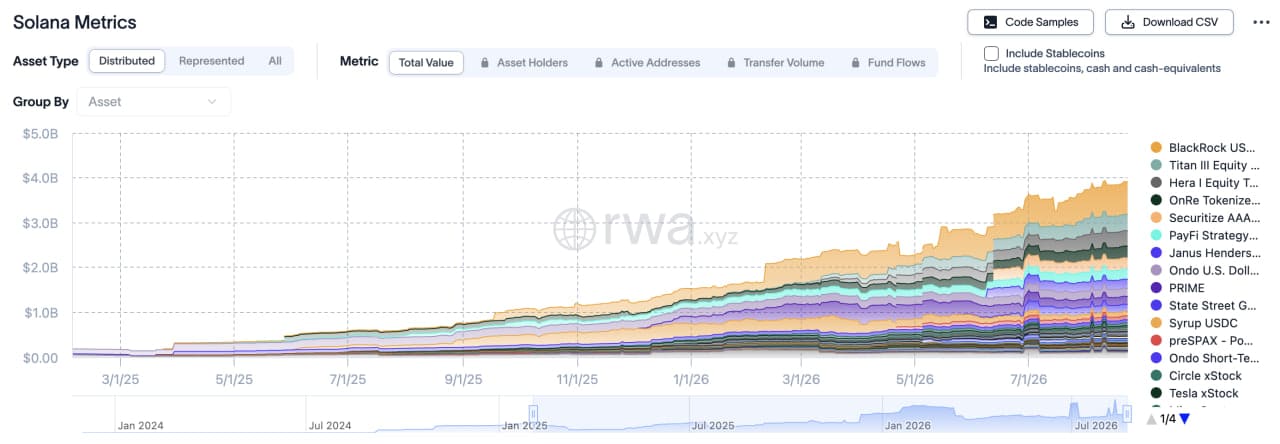
Solana’s real-world-asset ecosystem crossed $4 billion in total value on August 23, according to a post from the official Solana account. The milestone came two days after validators activated SIMD-0525 at epoch 1020, cutting the network’s slot time from 400 milliseconds to 350 milliseconds for the first time since launch.
In the six days before epoch 1020, Solana Compass network analytics recorded average user throughput of 1,710 transactions per second and 27.7% compute utilization against the 400ms block ceiling.
Solana RWA News: What’s Inside the $4 Billion Figure
Motley Fool’s analysis of the 30 days ending August 19 put Solana’s RWA inflows at $263 million, while Ethereum’s RWA ecosystem recorded $337 million in outflows over the same window. The report put Solana’s 30-day growth rate at 10.6%, compared with Ethereum’s 1.3%.
Tokenized U.S. Treasury products accounted for $1.2 billion of Solana’s reported RWA ecosystem total, up 16.1% over the same period, according to the same report. Backed Finance’s xStocks product offers more than 60 U.S. stocks and ETFs as SPL tokens, with trading available on Raydium, Jupiter, and Kamino Finance.
Ethereum still held a larger absolute RWA base, at approximately $17.2 billion as of August 22, per Motley Fool. Solana’s reported $4 billion ecosystem total nevertheless marked a new high for the network’s RWA market.
SIMD-0525: The Mechanics of the Slot-Time Reduction
SIMD-0525 sets out a sequence of 50ms reductions from 400ms to 350ms, then to 300ms, 250ms, and 200ms. Each further reduction requires fresh supermajority validator approval before it proceeds, according to Solana’s official announcement.
Anatoly Yakovenko, Solana’s co-founder, said the network moved from 800ms to 400ms within two days after launch, framing 400ms as a baseline rather than a permanent limit. Jacob Creech, developer relations lead at the Solana Foundation, confirmed the epoch 1020 activation on X.
Anatoly Yakovenko, co-founder of Solana.
Per-block compute budgets scale down proportionally as slot times decline. The ceiling moved from 100 million compute units at 400ms to 87.5 million at 350ms, preserving an approximate capacity of 250 million compute units per second across the roadmap, according to a technical breakdown by George Tsagkarakis on egamers.io.
Slot time and finality remain separate metrics. Slot time governs how quickly validators attempt to produce blocks, while finality concerns when a block becomes cryptographically irreversible. Under TowerBFT, Solana’s current consensus system, finality is approximately 12.8 seconds. The separate Alpenglow consensus redesign targets median finality of around 150 milliseconds under simulation and is targeted for activation with Agave 4.3 in October 2026.
Solana RWA News: Infrastructure Development Continues
Testnet held eight continuous hours of stable 350ms blocks in early August before the mainnet activation, according to Solana Compass reporting. That test preceded the epoch 1020 transition to 350ms blocks on mainnet.
The remaining reductions toward 200ms will proceed step by step. Each mainnet stage waits for a fresh stability window and cluster approval, meaning the roadmap advances through separate validator decisions rather than a single network-wide change.
Disclaimer: Coinspeaker is committed to providing unbiased and transparent reporting. This article aims to deliver accurate and timely information but should not be taken as financial or investment advice. Since market conditions can change rapidly, we encourage you to verify information on your own and consult with a professional before making any decisions based on this content.
Daniel Frances is a technical writer and Web3 educator specializing in macroeconomics and DeFi mechanics. A crypto native since 2017, Daniel leverages his background in on-chain analytics to author evidence-based reports and deep-dive guides. He holds certifications from The Blockchain Council, and is dedicated to providing "information gain" that cuts through market hype to find real-world blockchain utility.
Solana’s Alpenglow upgrade entered community validator testing on May 11, with development firm Anza describing the activation as the largest consensus change in the network’s history, targeting block confirmation times of approximately 150 milliseconds and potentially as low as 100 milliseconds under favorable network conditions. This is huge news for Solana.
The upgrade replaces TowerBFT and removes Proof of History from the network’s core process, a structural change significant enough that its success or failure will materially define Solana’s competitive position among high-throughput Layer-1 networks through the remainder of 2026. SOL traded near $97 following the announcement, with an intraday range between $94 and $98, suggesting a limited short-term market reaction to a development that remains well upstream of mainnet.
The testing phase places Alpenglow on a community test cluster where validator operators can evaluate the new consensus design before any broader rollout. Anza invited additional operators to join the next community cluster, and Solana’s official network upgrades page lists Alpenglow as expected by Agave 4.1, the client version through which mainnet deployment is currently anticipated for late 2026.
LATEST: ⚡ Solana's Alpenglow consensus upgrade has gone live on a community test cluster, marking a key step toward a mainnet rollout targeted for later this year. pic.twitter.com/jqjHbe74ih
Solana News: Alpenglow and the Votor Consensus Mechanism: What the Architecture Change Actually Does to Solana Finality
The technical core of Alpenglow is Votor, a lightweight voting system designed to finalize blocks in one or two rounds, depending on the proportion of validators that respond within a given window.
Where TowerBFT required validators to publish votes as on-chain transactions, consuming an estimated 50% or more of block throughput, Votor shifts that process entirely off-chain, using direct messaging and signature aggregation to reach consensus without occupying block space.
The practical implication is that roughly 75% of previously consumed block capacity becomes available for user transactions, a resource-efficiency gain that is separate from and additive to the raw latency improvement.
The Alpenglow community cluster completed its first successful Alpenswitch.
In our Year Ahead Report, we covered how the upgrade could compress Solana finality, enabling tighter sequencing for onchain markets.
Alpenglow also introduces Rotor for block propagation, replacing the existing Turbine mechanism, and adopts a fixed 400-millisecond block time with local timeouts tolerating up to 5% clock drift, eliminating the continuous hash chain that Proof of History required.
The fault-tolerance model shifts as well: Alpenglow adopts a framework that tolerates up to 20% malicious validators, 20% offline validators, or 40% combined, compared to the 33% ceiling of traditional Byzantine fault-tolerant systems.
The upgrade also introduces a Validator Admission Ticket, or VAT, set at 1.6 SOL per epoch, a fee validators must pay to enter the consensus set, directly tied to the removal of vote transactions from blocks.
The proposal underpinning these changes, SIMD-0326, received 98.27% validator approval when Solana validators voted on it in 2025, and its academic origins trace to distributed systems research at ETH Zurich.
That governance result represents an unusually clean mandate for a change of this structural depth, and it meaningfully reduces the coordination risk that has derailed other major protocol rewrites at the proposal stage. Polygon’s Giugliano hardfork, which also targeted finality improvements on a competing Layer-1, encountered more contentious governance conditions, a contrast worth noting as Alpenglow’s path to mainnet may proceed.
Disclaimer: Coinspeaker is committed to providing unbiased and transparent reporting. This article aims to deliver accurate and timely information but should not be taken as financial or investment advice. Since market conditions can change rapidly, we encourage you to verify information on your own and consult with a professional before making any decisions based on this content.
Daniel Frances is a technical writer and Web3 educator specializing in macroeconomics and DeFi mechanics. A crypto native since 2017, Daniel leverages his background in on-chain analytics to author evidence-based reports and deep-dive guides. He holds certifications from The Blockchain Council, and is dedicated to providing "information gain" that cuts through market hype to find real-world blockchain utility.
Bitcoin just cleared $81,000, its highest print since late January, having risen from $79,000 at the end of U.S. hours Monday, a 5.3% weekly gain that puts it squarely in breakout territory. Bitcoin is in the crypto news spotlight again.
The move came with institutional trading desks already positioned for it: options markets had been quietly accumulating cheap upside exposure through call ratio structures, and the price finally delivered the trigger. What it has not delivered, at least not yet, is any meaningful participation from the altcoin complex.
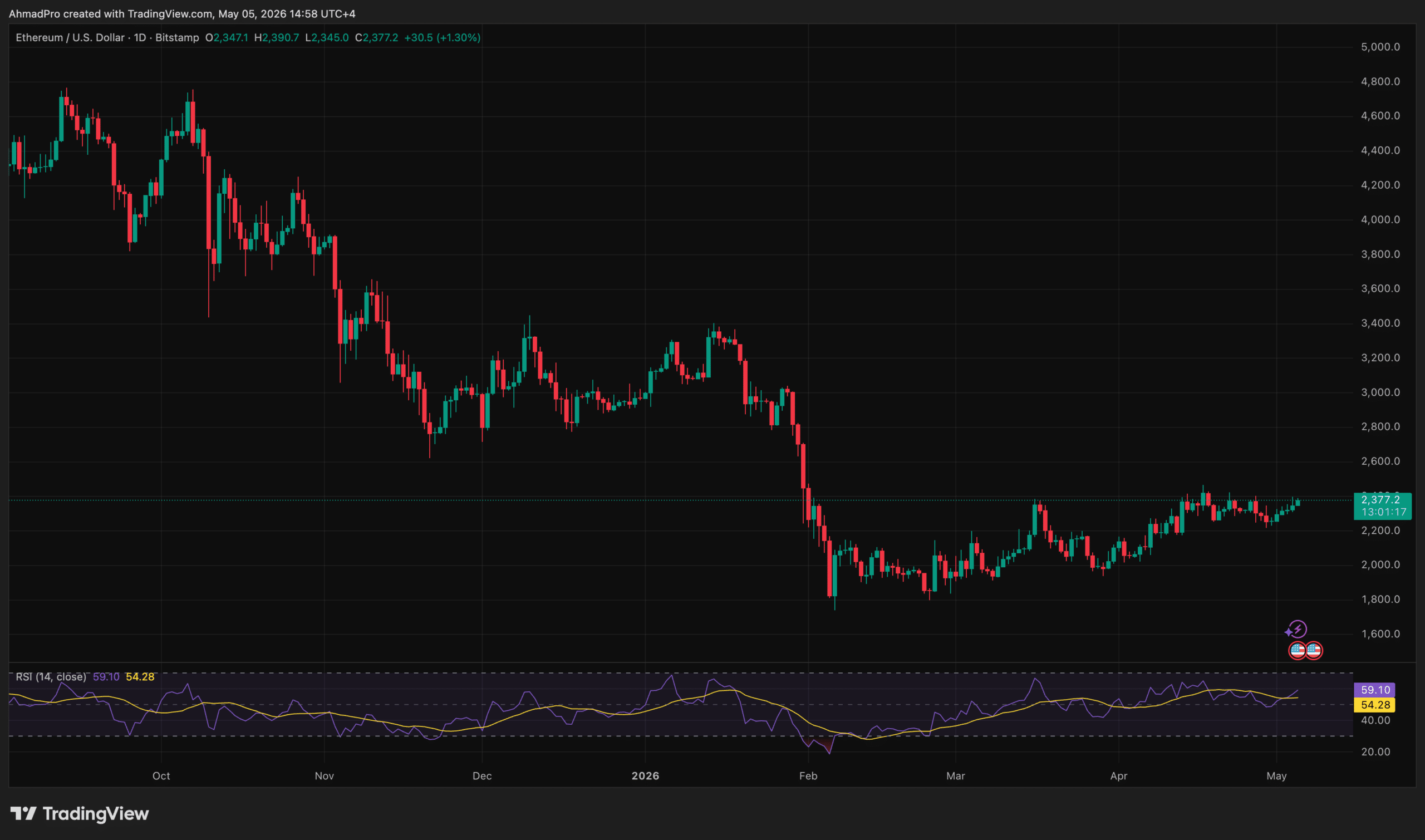
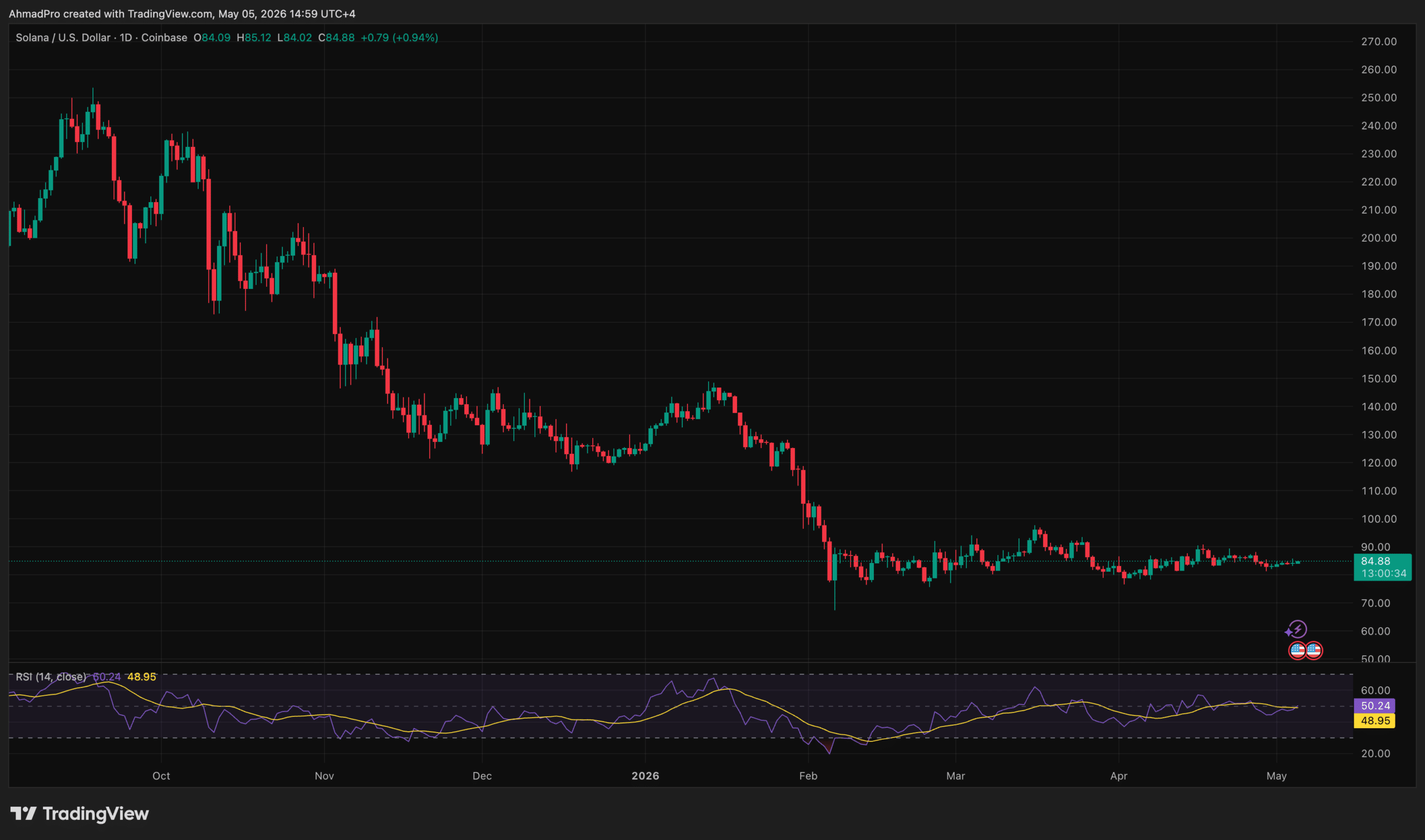
Ether held at $2,379, off 0.1% on the day despite a 4.0% weekly gain. Solana slipped 0.9% to $84.84. Dogecoin gave back 1.0% to $0.1117, even as Dogecoin futures open interest remains at year-highs. The market divergence between Bitcoin $81k and a flat-to-negative altcoin tape is not incidental, it reflects a structural condition in how this rally has been constructed, and whether it broadens is the question driving positioning across desks right now.
Can Bitcoin Hold $81,000 Amid the News, or Is the Crypto Options Desk Positioning Running Ahead of Spot?
Besides crypto news chatter, the mechanism behind Tuesday’s move is worth framing clearly. US spot Bitcoin ETFs recorded $2.44 billion in net inflows for April 2026, the strongest monthly total since October 2025, per data tracked by SoSoValue, with Friday’s inflows alone reaching $630 million. That institutional demand absorbed significantly more than daily mined supply: per Capriole Investments data, institutions were acquiring over 500% of daily mined BTC, a ratio that has historically preceded average gains of roughly 24% in the following month.
On the derivatives side, Nomura’s market-making arm Laser Digital flagged in a note shared with CoinDesk news Tuesday that crypto options desks had been structuring call ratio trades – buying near-the-money calls and financing them by selling higher-strike calls – a setup that costs almost nothing upfront and benefits if Bitcoin grinds higher without a sharp overrun.
That quiet accumulation of cheap upside bets created a constructive options base beneath the spot move. Laser Digital noted that a decisive break above $80,000 was expected to flip the currently negative BTC risk reversal – the implied volatility differential between equidistant puts and calls – into positive territory for the first time in weeks.
That flip matters because it signals an actual sentiment shift, not just price movement. A short squeeze compounded the momentum: over $18 million in BTC shorts were liquidated in a 24-hour window against just $1.19 million in longs, with Binance futures showing a heavily skewed 37.2% long / 62.8% short ratio that amplified the move on the way up.
A daily close above $81,000 confirms the breakout, targeting the $82,500–$85,000 range near-term and a $96,000 implied level if institutional absorption rates hold. Risk reversal turning positive would reinforce this path.
However, a failure to hold $80,000 on a daily close reactivates the lower-highs pattern that dominated April and risks a pullback toward $77,500. Long-term holders offloading an average of 12,000 BTC daily over the past 30 days remain a persistent supply overhang.
ETH at $2,379: What the Weekly Gain Is – and Isn’t – Telling Us
Ethereum’s 4.0% weekly gain looks constructive in isolation. Against Bitcoin’s 5.5% move, and measured by the actual day-on-day print of -0.1%, the picture is more accurately described as stagnation. The ETH/BTC ratio continues to compress, and the mechanism driving that compression is relatively clear: Bitcoin ETF inflows are structurally redirecting institutional capital that might otherwise have distributed into ETH.
Ethereum ETF products have seen inflows, and a 10-day ETH ETF inflow streak has provided some stabilization floor for the price. But the pace relative to BTC products remains materially slower, and on-chain activity has not generated the kind of spot-driven demand that would validate a breakout rather than a drift. Open interest in ETH derivatives is building without corresponding spot accumulation – a divergence that Coinglass data has flagged as a recurring setup for failed rallies rather than confirmed ones.
Source: Tradingview
If ETH clears $2,500 on a sustained basis, driven by a rotation from BTC profits – the classic altcoin season sequence. ETF inflow acceleration and a pickup in DeFi activity would confirm.
However, A break below $2,200 on elevated volume would signal that the weekly recovery is corrective rather than impulsive, reopening the April lows as a reference.
SOL and DOGE Crypto: Structural Ceilings, Not Temporary Dips
Solana’s 0.9% slip to $84.84 is less interesting as a daily figure than as a position on the chart. The $90–$94 supply zone has capped every meaningful SOL rally since early spring, and the current price is sitting below that resistance with no obvious catalyst to change the structure.
SOL’s ETF products, including Bitwise’s BSOL, have accumulated assets, but the market cap constraint is real: institutional flows sufficient to move BTC by several percentage points distribute across SOL’s smaller float with less price impact than the absolute dollar figure implies.
Source: Tradingview
Dogecoin’s situation is structurally different but the conclusion rhymes. DOGE is down 1.0% on the day to $0.1117, even as it retains a 12.4% seven-day gain, the strongest performer on the weekly tape among the majors.
The Altcoin Season Index remains subdued, however, reflecting that the weekly DOGE move was driven by its own momentum cycle rather than a broad rotation. Analysis of DOGE and altcoin season triggers at Coinspeaker has consistently identified BTC dominance as the actual gating variable – and with BTC dominance climbing on the back of the $81,000 breakout, DOGE faces a structural ceiling on fast moves regardless of open interest levels.
That is the actual altcoin season trigger: a confirmed, sustained BTC breakout that exhausts upside momentum and forces institutional capital to rotate down the risk curve. We are not there yet.
Disclaimer: Coinspeaker is committed to providing unbiased and transparent reporting. This article aims to deliver accurate and timely information but should not be taken as financial or investment advice. Since market conditions can change rapidly, we encourage you to verify information on your own and consult with a professional before making any decisions based on this content.
Daniel Frances is a technical writer and Web3 educator specializing in macroeconomics and DeFi mechanics. A crypto native since 2017, Daniel leverages his background in on-chain analytics to author evidence-based reports and deep-dive guides. He holds certifications from The Blockchain Council, and is dedicated to providing "information gain" that cuts through market hype to find real-world blockchain utility.
North Korean hackers linked to the $285M Drift Protocol exploit and a Solana DEX infiltration. Analyze SOL’s security outlook and what it means for DeFi investors.
Solana’s DeFi ecosystem is under siege, and the threat is not a code vulnerability. It is a nation-state. Within the span of eight days, North Korean operatives allegedly drained $285M from Drift Protocol and embedded a suspected agent inside a separate Solana exchange as its chief technology officer. Price data remains clouded by the turbulence, but the security narrative surrounding SOL USD is deteriorating faster than any chart level can capture.
Solana-based decentralized exchange Stabble urged users to immediately withdraw liquidity on Tuesday after a pseudonymous on-chain investigator, ZachXBT, identified the protocol’s former CTO, operating under the name Keisuke Watanabe, as an alleged North Korean hacker.
Our latest update:
We can confirm now until one year ago we had a NK developer in the team. He was backed by other north Korean that supported his work. We thank @derparsel and @zachxbt for their work.
Historically we have done audits with Sec3 and neodyme – everything looked…
The protocol, recently handed over to a new management team, began the day with approximately $1.75M in total value locked, but the emergency alert triggered a 62% TVL collapse to under $663,000, according to DeFiLlama data. “EMERGENCY!” the new team posted on X. “Guys, please temporarily withdraw your liquidity instantly! Better safe than sorry.” No exploit has been disclosed, but the firm confirmed it is conducting security audits.
The Stabble incident does not stand alone. It follows the $285M Drift Protocol hack on April 1, confirmed by TRM Labs, Elliptic, and Chainalysis as a DPRK operation, which now ranks as the largest DeFi exploit of 2026. The pattern raises a structural question the market cannot ignore: Is Solana’s performance advantage being systematically weaponized against it?
Can SOL USD Hold Ground After Two North Korean Strikes in Eight Days?
Precise 24-hour price figures for SOL are not available at the time of writing, but the on-chain data tells its own story. The Drift attack, executed in approximately 10 seconds through social engineering, oracle manipulation, and pre-signed durable nonce transactions, saw stolen funds swapped into USDC and SOL before being bridged to Ethereum via CCTP. That conversion created direct, measurable sell pressure on SOL at a moment when broader crypto markets were already navigating macro uncertainty.
Technically, Solana faces a bear case scenario if further exploits surface or fund-tracing operations by TRM Labs and Elliptic prompt additional exchange freezes. The base case assumes containment: the Solana Foundation’s ecosystem security programs are already active, and the Stabble team’s transparency arguably limited contagion this time.
$SOL is forming a textbook bearish flag and the breakdown has already started.
Last move: consolidation → breakdown → -54% drop Now the same structure is repeating again.
If this continues, $SOL could be heading toward the $45 zone.
A bull case requires both a clean audit result from Stabble and no new DPRK-linked incidents, a condition that feels precarious given North Korea reportedly stole $2Bn in crypto during 2025 alone, representing roughly 60% of global crypto hacks that year. The Drift exploit, second only to the $326M Wormhole breach in Solana’s history, has reset the ecosystem’s risk premium.
Elliptic described the Drift attack as “a continuation of DPRK’s sustained campaign” to fund weapons programs. That framing, state adversary, not opportunistic hacker, changes how investors should model tail risk on Solana-native positions.
Bitcoin Hyper Positions as Solana Speed Meets Bitcoin-Grade Security
The Stabble incident crystallizes a tension that has been building quietly: SOL USD delivers speed, but that speed sits on an infrastructure whose human attack surface has now been demonstrated twice in a week.
Bitcoin, for all its limitations, slow transactions, high fees, and limited programmability, has never suffered a comparable state-level infiltration of its core infrastructure. That asymmetry is exactly the gap Bitcoin Hyper is positioning to close.
Bitcoin Hyper describes itself as the first Bitcoin Layer 2 integrating the Solana Virtual Machine, targeting sub-second finality and low-cost smart contract execution while anchoring security to Bitcoin’s base layer — the one chain North Korean hackers have conspicuously left alone.
The project has raised $32M at a current presale price of $0.0136783, with staking rewards available to early participants. Key infrastructure includes a Decentralized Canonical Bridge for BTC transfers and high-speed SVM execution, effectively Solana’s throughput bolted onto Bitcoin’s trust model.
Disclaimer: Coinspeaker is committed to providing unbiased and transparent reporting. This article aims to deliver accurate and timely information but should not be taken as financial or investment advice. Since market conditions can change rapidly, we encourage you to verify information on your own and consult with a professional before making any decisions based on this content.
Daniel Frances is a technical writer and Web3 educator specializing in macroeconomics and DeFi mechanics. A crypto native since 2017, Daniel leverages his background in on-chain analytics to author evidence-based reports and deep-dive guides. He holds certifications from The Blockchain Council, and is dedicated to providing "information gain" that cuts through market hype to find real-world blockchain utility.