The Solana Policy Institute, a Washington-focused nonprofit launched in late 2025 to advance blockchain-specific legislative and regulatory strategy, has characterized the current U.S. crypto policy environment as entering a materially new phase – one defined by implementation rather than survival, and by legislative specificity rather than existential debate.
Kristin Smith, President of the Institute and former executive director of the Blockchain Association, stated the shift plainly: ‘For a long time we were playing defense,’ adding that the industry’s posture has now moved toward establishing durable rules of the road.
We suspect the Institute’s public framing is not merely descriptive but strategic – a signal to institutional capital, regulatory counterparts, and legislative staff that the sector has sufficient policy stability to warrant engagement at a higher level of specificity.
When a blockchain-specific policy organization with this institutional pedigree characterizes the environment this way, it functions as a credibility marker aimed at the compliance officers, asset managers, and agency rulemakers who have been watching from a cautious distance. The timing – coinciding with the Clarity Act’s anticipated April 2026 markup and the post-GENIUS Act settlement of stablecoin policy – reinforces that reading.
Solana Policy Institute: Mandate, Structure, and the Legislative Developments Driving the ‘New Phase’ Framing
The Solana Policy Institute describes itself as a non-partisan nonprofit operating across three policy arenas: Congress, where it pursues legal certainty through market structure legislation; federal regulatory agencies, where it engages on rulemaking; and the White House, where it monitors and shapes executive priorities.
Its CEO, Miller Whitehouse-Levine – formerly an early employee of the DeFi Education Fund – has been explicit that the Institute’s advocacy is intended to be technology-neutral, seeking a level competitive playing field rather than outcomes that advantage Solana-based infrastructure over rival networks.
“I think that the easiest way to think about it is @Solana operates like a multi-lane highway versus a single lane road.
So on blockchains like Bitcoin and Ethereum, everyone queues up and goes through the same doorway or down the same road in order.…
— Solana Policy Institute (@SolanaInstitute) March 31, 2026
The specific developments underpinning the Institute’s ‘new phase’ characterization are identifiable. The GENIUS Act’s passage in 2025 resolved the most contentious stablecoin questions – reserve requirements, issuer eligibility, federal versus state licensing – that had stalled legislative progress for two prior congressional sessions.
The Digital Asset Market Clarity Act, known as the Clarity Act, is tracking toward committee markup in April 2026 with reported bipartisan support, which would represent the first comprehensive market structure bill to advance that far in the Senate. Whitehouse-Levine has articulated the Institute’s core concern as the weaponization of legal ambiguity – noting that ‘crypto better than any other industry unfortunately understands how legal ambiguities or interpretations can be weaponized against an industry’ – and has framed clear SEC-CFTC jurisdictional demarcation on securities versus commodities as the central structural objective.
Disclaimer: Coinspeaker is committed to providing unbiased and transparent reporting. This article aims to deliver accurate and timely information but should not be taken as financial or investment advice. Since market conditions can change rapidly, we encourage you to verify information on your own and consult with a professional before making any decisions based on this content.
Daniel Frances is a technical writer and Web3 educator specializing in macroeconomics and DeFi mechanics. A crypto native since 2017, Daniel leverages his background in on-chain analytics to author evidence-based reports and deep-dive guides. He holds certifications from The Blockchain Council, and is dedicated to providing "information gain" that cuts through market hype to find real-world blockchain utility.
SOL$80.2324h volatility:1.2%Market cap:$45.96 BVol. 24h:$2.11 B
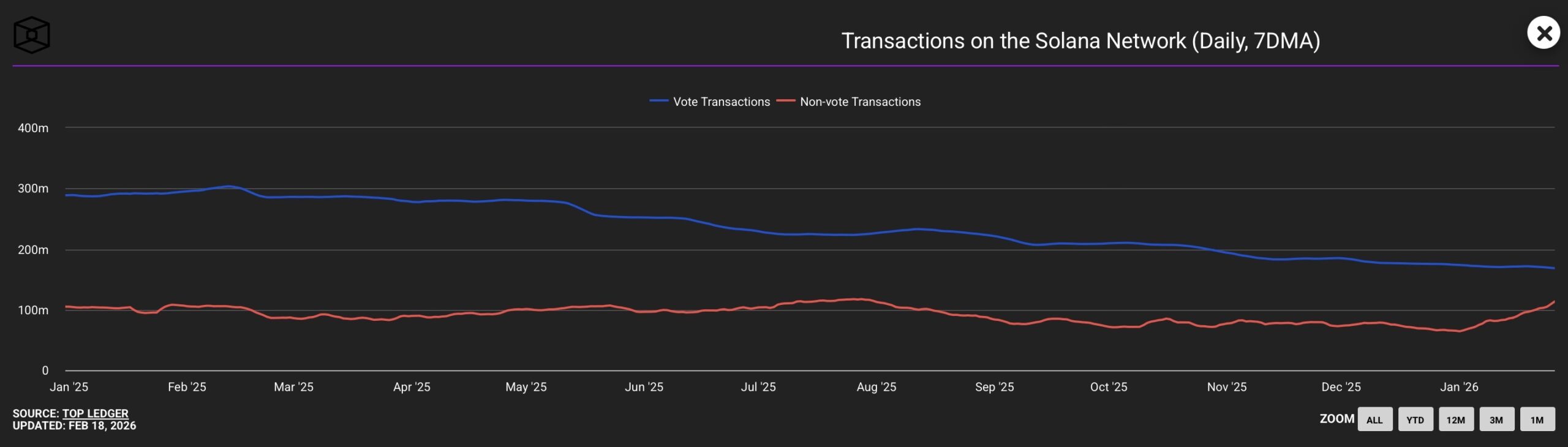
successfully claimed the critical $80 support level on Tuesday, trading now around $82 as network fundamentals surged to unprecedented levels. The SOL USD price recovery coincides with a historic spike in on-chain engagement, where daily non-vote transactions recently peaked at a record 148 million. A non-vote transaction involves transferring Solana to the network and collecting it into blocks.
The parallel rise suggests that genuine network utility, rather than just speculative trading, may be establishing a solid floor for the asset.
Transactions on the Solana Network (Daily, 7DMA) Source: The Block
Data indicates that Solana’s network is undergoing a massive stress test, validating its high-throughput design. The network exceeded 116 billion total transactions over the last year, with daily non-vote transactions hitting 148 million in late January. This volume represents a significant divergence from previous cycles.
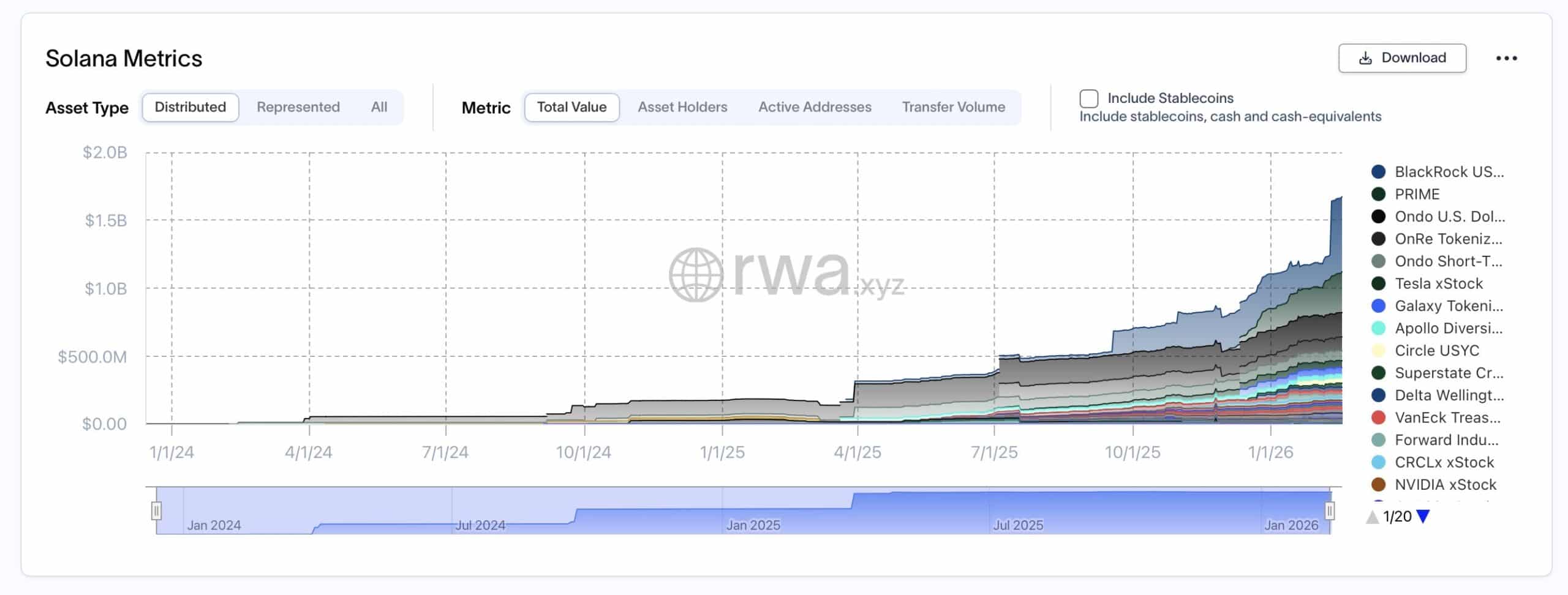
What is fueling this intense volume? While memecoins continue to contribute to network traffic, there is a distinct shift toward sustainable finance. As Solana moves beyond its meme coin phase, decentralized exchange (DEX) volumes have rivaled Ethereum’s, driven by sub-cent fees and faster finality. Furthermore, the rise in real-world asset (RWA) tokenization hitting record values suggests that institutional adoption and stablecoin settlements are playing a larger role in these on-chain metrics than in previous years.
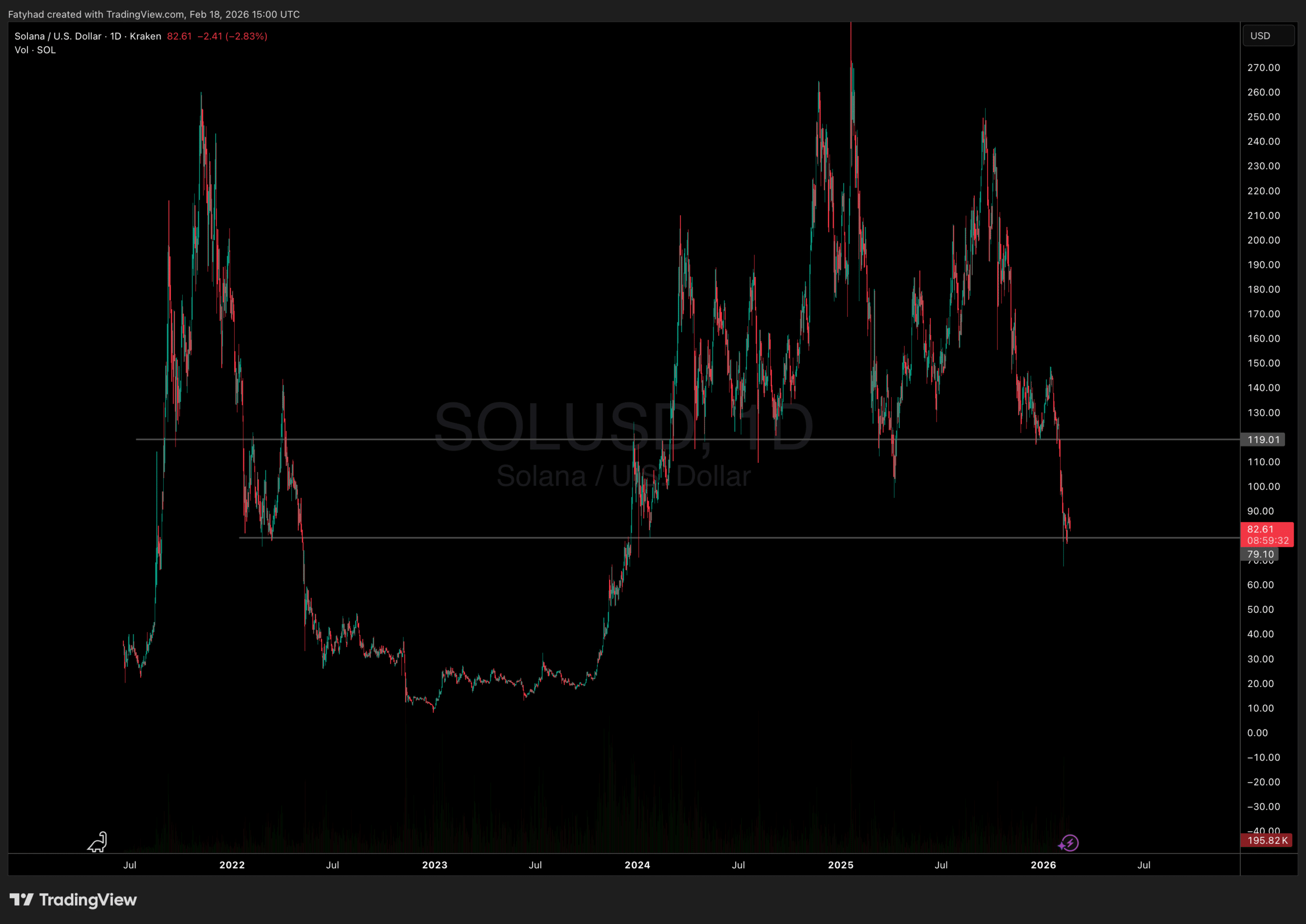
Solana is currently changing hands at $87.16, marking a 1.65% increase over the last 24 hours. The primary focus for traders has been defending the $80 mark, a level that previously served as a strong demand zone. Market analysts note that holding this region is vital for preventing a slide toward lower liquidity zones. While the asset has formed a logical base here, it still faces resistance overhead.
Some price predictions suggest the dip below $100 may have been a final capitulation event, but bulls must reclaim the psychological three-digit barrier to confirm a definitive trend reversal. Conversely, a failure to hold $80 could expose the asset to deeper downside, as broader crypto market sentiment remains fragile.
The divergence between high network usage and suppressed price action often precedes a valuation realignment. Institutional confidence appears to be returning alongside retail activity; for instance, key ecosystem player Jupiter recently announced a major investment deal to further settle in JupUSD, highlighting the capital flowing into Solana’s infrastructure despite price volatility.
However, risks remain. On-chain analytics from Nansen suggest that while user adoption is real, evidenced by active addresses doubling recently, maintaining this momentum requires the fee market to stabilize against potential congestion. Can the fundamentals finally force a decoupling from broader market corrections? The coming weeks will likely determine if record-breaking usage can translate into sustained price appreciation.
Disclaimer: Coinspeaker is committed to providing unbiased and transparent reporting. This article aims to deliver accurate and timely information but should not be taken as financial or investment advice. Since market conditions can change rapidly, we encourage you to verify information on your own and consult with a professional before making any decisions based on this content.
Daniel Frances is a technical writer and Web3 educator specializing in macroeconomics and DeFi mechanics. A crypto native since 2017, Daniel leverages his background in on-chain analytics to author evidence-based reports and deep-dive guides. He holds certifications from The Blockchain Council, and is dedicated to providing "information gain" that cuts through market hype to find real-world blockchain utility.
Is Solana “moving” from Solana meme coins? Leaders from major Solana protocols argued at Consensus Hong Kong 2026 on Thursday that the network’s next phase will prioritise scaling global finance over speculative memes. The panel emphasized that the ecosystem has moved beyond survival mode following the 2022 FTX collapse, focusing on application-layer utility.
Why change to a more “serious” approach? The network’s reputation was previously tied to volatile meme coin trading and its connection to Sam Bankman-Fried’s defunct exchange. While meme coins and Pump.Fun made the success of Solana in the past years, now it seems the focus is on moving on to developing infrastructure to support traditional financial systems. More reliable and stable than meme coins.
With stablecoin supply on the network exceeding $15.5 billion, the narrative is shifting from hype around fast meme coins to a practical payment rail utility.
🚨 “If Solana doesn’t do it, nobody will.” – Lily Liu, President of the Solana Foundation.
At Consensus Hong Kong 2026, Lily Liu doubled down on Solana’s role as the last serious contender to push blockchain innovation forward – especially in real-world finance and peer-to-peer… pic.twitter.com/4VOX7frhYq
Strengthening the Application Layer Through Infrastructure
Speaking directly to the shift in priorities, Armani Ferrante, founder of Backpack Exchange, described the FTX collapse as a “brutal” clearing event that ultimately strengthened the developer base.
The single most important thing happening right now across any blockchain is all of finance coming onchain,
Ferrante stated, noting that current crypto markets remain a fraction of global liquidity. “We have a proof of concept. That’s it.”
Austin Federa, co-founder of DoubleZero, highlighted that while capital fled during the crisis, “Solana lost no technical teams,” proving that the developer ecosystem operates independently of price action. This focus on utility is already manifesting in capital flows. Recently, significant institutional players have deepened their involvement, as seen when Jupiter announced a strategic investment deal to settle in JupUSD.
Ecosystem tokens like Jito and Jupiter are now moving at speeds distinct from the broader market, driven by this specific utility.
Solana is “Abandoning” Meme Coins: Scaling for Global Finance and Institutional Adoption
The transition from “ETH killer” narratives and meme coins hype to a general-purpose execution layer requires constant vigilance. Federa warned that feeling “comfortable” in blockchain is a precursor to being overtaken by competitors. Upcoming network upgrades aim to further reduce latency, essential for the high-frequency demands of real-world asset (RWA) tokenization and institutional trading.
SOL$80.2324h volatility:1.2%Market cap:$45.96 BVol. 24h:$2.11 B
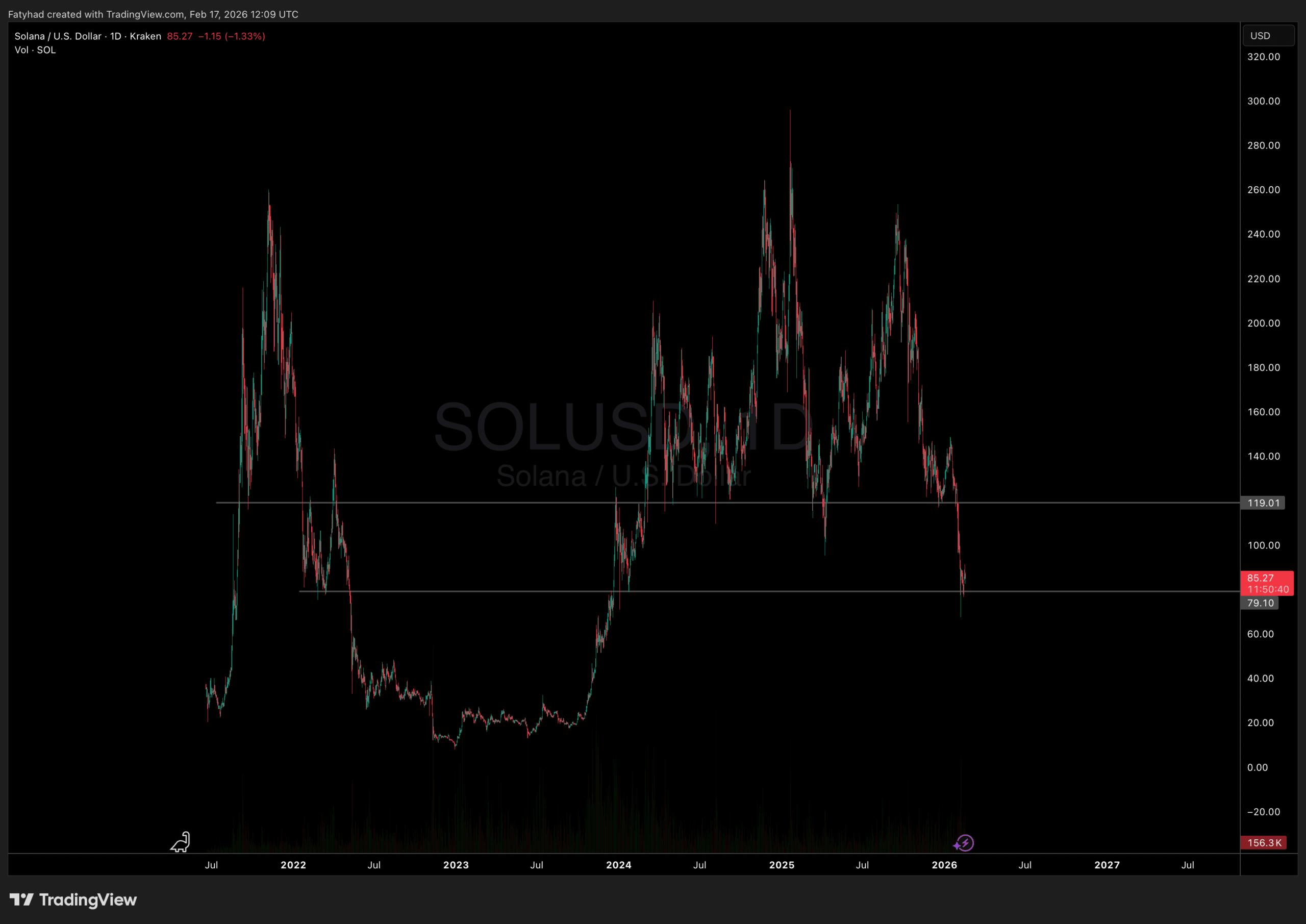
has broken below key support near $119, continuing a broader downtrend after repeated rejections at higher levels. Price now tests the $79 area, a crucial zone for stabilization. Unless buyers reclaim former support, momentum remains weak, suggesting caution while the market searches for a new base.
Despite the precarious short-term price action, analysts project SOL could trade between 128 and 178 USD by the end of 2026 as DeFi scale increases. With projects like Kamino and Jito creating foundational liquidity layers, the ecosystem is positioning itself to capture institutional volume that demands reliability over hype.
Disclaimer: Coinspeaker is committed to providing unbiased and transparent reporting. This article aims to deliver accurate and timely information but should not be taken as financial or investment advice. Since market conditions can change rapidly, we encourage you to verify information on your own and consult with a professional before making any decisions based on this content.
Daniel Frances is a technical writer and Web3 educator specializing in macroeconomics and DeFi mechanics. A crypto native since 2017, Daniel leverages his background in on-chain analytics to author evidence-based reports and deep-dive guides. He holds certifications from The Blockchain Council, and is dedicated to providing "information gain" that cuts through market hype to find real-world blockchain utility.