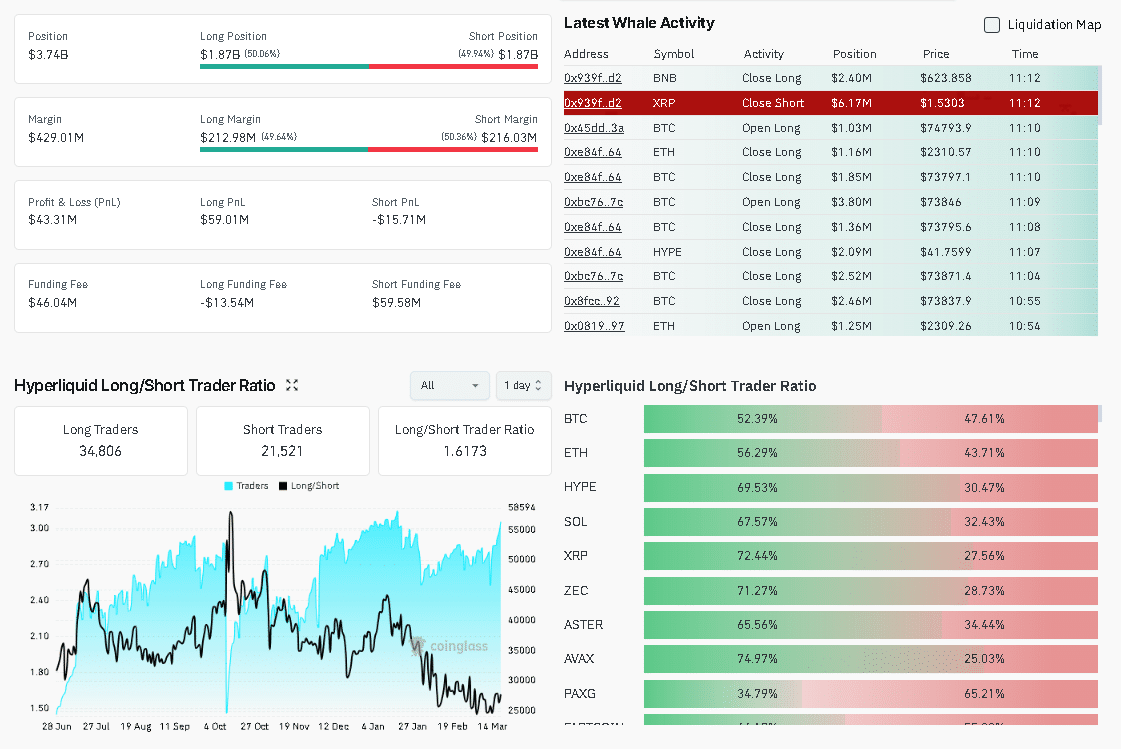
Leveraged positioning on decentralized derivatives exchange Hyperliquid has reached a precarious $3.64 billion, with on-chain data revealing a near-perfect deadlock between bulls and bears.
According to Coinglass metrics, the long-short ratio for large-scale holders is effectively 1:1, creating a volatility powder keg where a directional break could trigger a liquidity crisis.
The deadlock comes as the platform sees surging volumes in both crypto assets and RWA markets. With $1.821 billion in longs matched against $1.823 billion in shorts, market liquidity is tighter than the headline figures suggest. A shift in the HYPE token ecosystem or macro catalysts could ignite this “dry powder,” triggering a cascading liquidation event and upsetting the current equilibrium. The stakes for this specific level are high.
Hyperliquid Open Interest: What the $3.64B Long/Short Split Reveals
Total whale exposure on the platform has climbed to approximately $3.644 billion, a figure that rivals open interest on major centralized venues. The breakdown, however, signals massive structural tension. Long positions account for $1.821 billion, while short positions hold $1.823 billion. This rare equilibrium suggests that crypto whales — often referred to in European markets as “wieloryby krypto” — are aggressively positioning on both sides of the tape rather than taking a clear directional bet.
While the nominal value is balanced, the profit-and-loss (P&L) landscape is skewed. Long positions are currently sitting on roughly $57.38 million in unrealized profits, benefiting from the slow grind higher in majors like Ethereum (ETH). Conversely, shorts are nursing nearly $11.16 million in losses. This disparity creates a fragile environment for short sellers: if prices rise slightly, the pressure to cover could fuel a squeeze. Conversely, a sharp rejection would force profitable longs to capsize, leading to rapid likwidacje (liquidations) across the DeFi ecosystem.
Why a Directional Move Could Unleash Cascading Liquidations
The mechanics of a breakout from such a tight range are severe. On Hyperliquid, where leverage often exceeds 20x, a move of just 2-3% in underlying assets can force margin calls. The current structure implies that shorts are the most immediate trigger point; their underwater positioning means any macro surprise could force capitulation buying. This risk is amplified by the platform’s localized liquidity, which can accelerate the feedback loop between price and forced closures.
However, the downside risk is equally potent. If the market reverses, the $57 million in paper profits held by bulls would evaporate, turning confident holders into forced sellers. This dynamic is typical of high-leverage DeFi environments, where smart contract triggers execute liquidations instantaneously. The binary is clear: the first side to flinch will likely drive the price aggressively against themselves. Traders monitoring RWA sectors, have noted that volatility in traditional commodities is also beginning to impact liquidity on the venue.
The surge in open interest is not limited to standard crypto assets. Hyperliquid has aggressively expanded into RWAs, attracting capital into novel markets like oil trading derivatives. This has broadened the definition of whale activity on the platform, drawing in sophisticated traders hedging geopolitical risk alongside crypto volatility. The HYPE token has also seen accumulation, with notable wallets like that of trader Rudy Kadoch signaling long-term intent despite the leverage risks.
One specific wallet, identified as 0x6c85…f6, exemplifies the high-stakes environment. This entity holds a 20x leveraged long on ETH with an entry price of $2,012.11, currently sitting on an unrealized gain of over $15 million. These concentrated positions act as gravity for price action; the market often hunts the liquidation levels of such large, visible players.
Key Levels to Watch: Where the Breakout Could Begin
For traders monitoring the Hyperliquid order book, two levels are critical. To the upside, a sustained ETH move above $2,100 would likely aggressively squeeze the $1.823 billion short book, forcing a cascade of buy orders. Failure to hold the $1,990 support level, however, would threaten the entry prices of major whales like 0x6c85…f6.
If that support falters, the resulting long liquidations could flush leverage down to the $1,850 region. The near-term direction will likely be dictated by external flows or RWA volatility, but the internal pressure is building. Confirming a break above resistance opens the path for a wider rally; a drop below support invalidates the bullish leverage thesis entirely.
Until the deadlock between the $1.8 billion long and short camps resolves, volatility is the only certainty. The market is currently pricing in a continuation, but the sheer scale of the leverage means a reversal would be violent. Traders should watch the $2,000 ETH level closely as the fulcrum for the next major move.
Disclaimer: Coinspeaker is committed to providing unbiased and transparent reporting. This article aims to deliver accurate and timely information but should not be taken as financial or investment advice. Since market conditions can change rapidly, we encourage you to verify information on your own and consult with a professional before making any decisions based on this content.
Daniel Frances is a technical writer and Web3 educator specializing in macroeconomics and DeFi mechanics. A crypto native since 2017, Daniel leverages his background in on-chain analytics to author evidence-based reports and deep-dive guides. He holds certifications from The Blockchain Council, and is dedicated to providing "information gain" that cuts through market hype to find real-world blockchain utility.
The Hyperliquid Policy Center (HPC), an independent nonprofit research and advocacy organisation, was founded on February 18, 2026, in Washington D.C. Led by veteran crypto lawyer Jake Chervinsky, the organisation aims to educate U.S. policymakers and advocate for practical, innovation-friendly regulations for decentralised finance (DeFi) and perpetual derivatives markets. Mr Chervinsky previously held positions at Variant, the Blockchain Association and Compound.
Backed by an initial 1 million HYPE tokens grant from the Hyper Foundation (valued at ~$28–29 million at launch), HPC focuses on bridging lawmakers with blockchain tech, producing technical research, and advocating for clear rules that support onchain financial infrastructure while addressing consumer protection: without outdated enforcement-heavy approaches.
We are Hyperliquid Policy Center.
HPC is a research and advocacy nonprofit focused on advancing a clear path for decentralized finance to thrive in the USA.
Hyperliquid Policy Center: Navigating the Legislative Landscape
The launch arrives as the crypto sector increasingly formalizes its engagement with federal regulators. Moving beyond the industry’s early avoidance of oversight, major platforms are now prioritizing direct advocacy to influence pending frameworks like the CLARITY Act.
Operating as an independent 501(c)(4) non-profit, the HPC is backed by a contribution of 1 million HYPE$39.0624h volatility:2.3%Market cap:$9.31 BVol. 24h:$224.94 M
tokens from the Hyper Foundation, valued at approximately $29 million at the time of the announcement. Jake Chervinsky, formerly of the Blockchain Association and Variant Fund, leads the initiative alongside policy counsel Brad Bourque and director Salah Ghazzal.
The center’s primary mandate is to educate lawmakers on the distinctions between centralized intermediaries and autonomous protocols. Chervinsky emphasized the necessity of this distinction in a statement regarding the launch:
“This technology is poised to become the base layer of the global financial system. Now the United States must choose: we can either adopt new rules that allow this innovation to thrive here at home, or we can wait and watch as other nations seize the opportunity.”
The organization will specifically target policies affecting perpetual futures and Hyperliquid’s expansion into prediction market contracts. By providing technical assistance on draft legislation, the HPC intends to demonstrate how decentralized infrastructure offers resilience unmatched by legacy financial systems.
The center plans to advocate specifically for a “clear, regulated path” that accommodates blockchain-based financial infrastructure.
The establishment of the HPC marks a maturation point for DeFi protocols, which have historically lacked the organized lobbying power of centralized exchanges. This proactive stance mirrors similar legal strategies seen across the sector, such as Polymarket’s recent challenges against state-level restrictions.
As Congress considers new frameworks for digital assets in the coming sessions, the availability of well-resourced advocacy groups like the HPC could prove decisive. Their input may help ensure that decentralized technologies are not inadvertently stifled by rules originally designed for traditional intermediaries.
Disclaimer: Coinspeaker is committed to providing unbiased and transparent reporting. This article aims to deliver accurate and timely information but should not be taken as financial or investment advice. Since market conditions can change rapidly, we encourage you to verify information on your own and consult with a professional before making any decisions based on this content.
Daniel Frances is a technical writer and Web3 educator specializing in macroeconomics and DeFi mechanics. A crypto native since 2017, Daniel leverages his background in on-chain analytics to author evidence-based reports and deep-dive guides. He holds certifications from The Blockchain Council, and is dedicated to providing "information gain" that cuts through market hype to find real-world blockchain utility.