Sen. Lummis confirms CLARITY Act compromise text releases over July 4 weekend, targeting a Senate floor vote in July while rebutting Jamie Dimon’s stablecoin criticism.
Clarity Act News: Senator Cynthia Lummis (R-Wyo.) announced on Wednesday, June 25, that Senate negotiators will release compromise text for the CLARITY Act, the Digital Asset Market Clarity Act, H.R. 3633, over the July 4 holiday weekend, with a Senate floor vote push to follow in July, directly rebutting JPMorgan Chase CEO Jamie Dimon’s recent criticism of the crypto legislation’s stablecoin provisions.
This is not simply a scheduling update. It is a legislative deadline imposed by political physics: Lummis has announced she will not seek reelection in 2026, leaving her until January 2027 to lock in the digital asset regulatory framework she has spent three sessions constructing.
CLARITY Act News: Lummis Announces July Text Release and Senate Timeline
Speaking on Fox Business’ Mornings with Maria, Lummis said: “We’re finally to the point where we’re going to put out a text over the July 4th, and then we’re moving in July.”
The House passed H.R. 3633 in July 2025 by a 294–134 margin; the Senate Banking Committee advanced the bill 15–9 on May 14, 2026. Lummis has previously stated that she believes the bill can clear the Senate’s 60-vote cloture threshold despite sustained opposition from the banking industry, characterizing the stablecoin compromise not as a concession but as “a commitment.”
The tight recess calendar makes the July window close to mandatory. As detailed in a prior CoinSpeaker analysis of the CLARITY Act’s Senate timeline, the August recess significantly compresses the available floor days, making a pre-recess text release the functional prerequisite for any September or fall vote.
Section 301 Revisions: The Stablecoin Deposit-Like Product Dispute
Dimon argued publicly that the crypto market structure bill would permit crypto platforms to offer rewards resembling interest-bearing bank deposits without equivalent regulatory safeguards, an argument banking trade groups have also advanced, citing deposit-flight risk and regulatory arbitrage.
Lummis rejected that characterization directly, pointing to revisions made to Section 301 of the bill.
The revised language allows stablecoin issuers to operate rewards programs but prohibits benefits tied directly to account balances in a manner that replicates traditional bank interest.
🇺🇸 INSIGHT: Sen. Cynthia Lummis says Jamie Dimon is wrong about the CLARITY Act.
An earlier Banking Committee draft had gone further, essentially banning crypto platforms from offering interest on inactive stablecoin deposits entirely. The current compromise is a narrower prohibition designed to address bank lobbying without foreclosing all yield-adjacent product design. The precise mechanics of that distinction, and how regulators would enforce it, are examined in CoinSpeaker’s breakdown of the Section 301 stablecoin yield revisions.
Open Items: DeFi Regulation, AML Provisions, and Ethics Language
Lummis acknowledged three remaining open negotiating items: provisions governing DeFi (decentralized finance) protocols, AML (anti-money laundering) language, and ethics clauses.
She confirmed that multiple AML protections are now included in the bill’s current draft, a framework that traces back to Lummis and Sen. Kirsten Gillibrand’s (D-N.Y.) 2023 Responsible Financial Innovation Act, which required crypto kiosk operators to maintain precise customer address records with FinCEN.
The ethics provisions remain the most politically sensitive unresolved item. As covered in CoinSpeaker’s reporting on the ethics clause negotiations, a prior closed-door session between Lummis, Sen. Gillibrand, and White House Crypto Council Executive Director Patrick Witt collapsed without agreement after Republicans withdrew a provision that would have granted state attorneys general enforcement authority against the Department of Justice.
The analytical question at this stage is no longer whether the CLARITY Act advances crypto market structure legislation, the House vote and committee markup have settled that. It is whether the remaining DeFi and ethics language can be resolved before the August recess without unraveling the Section 301 compromise that neutralized the banking sector’s most pointed objection.
We suspect Dimon’s public intervention, whatever its legislative effect, has given Lummis a useful foil for demonstrating that the revised bill holds a defensible line on the deposit-product question, which may matter when she needs those final votes.
Disclaimer: Coinspeaker is committed to providing unbiased and transparent reporting. This article aims to deliver accurate and timely information but should not be taken as financial or investment advice. Since market conditions can change rapidly, we encourage you to verify information on your own and consult with a professional before making any decisions based on this content.
Neil is a professional cryptocurrency content writer with years of experience. He has written for various cryptocurrency websites to report on breaking news, and been hired by all sorts of cryptocurrency projects, to create content that would increase their exposure and attract more potential investors.
Brad Garlinghouse, chief executive of Ripple and one of the most prominent voices in institutional crypto, appeared on Fox Business this week to accuse Jamie Dimon, chairman and chief executive of JPMorgan Chase, of deliberately misrepresenting the Clarity Act, the Digital Asset Market Clarity Act of 2025 (H.R. 3633), to protect a payments franchise that generates approximately $20 billion in annual revenue with estimated profits exceeding $5 billion.
The specific fault line is a single clause in the pending legislation that would permit crypto exchanges to offer stablecoin yield to users, a provision that Dimon has publicly opposed and that the banking lobby has made its primary legislative target.
This is not simply a dispute over regulatory philosophy or compliance architecture. It is a structural contest over who controls the next generation of dollar-denominated digital payment instruments, and whether those instruments will function as pure transaction rails, the outcome the banking sector prefers, or as yield-bearing products that compete directly with bank deposits for household cash.
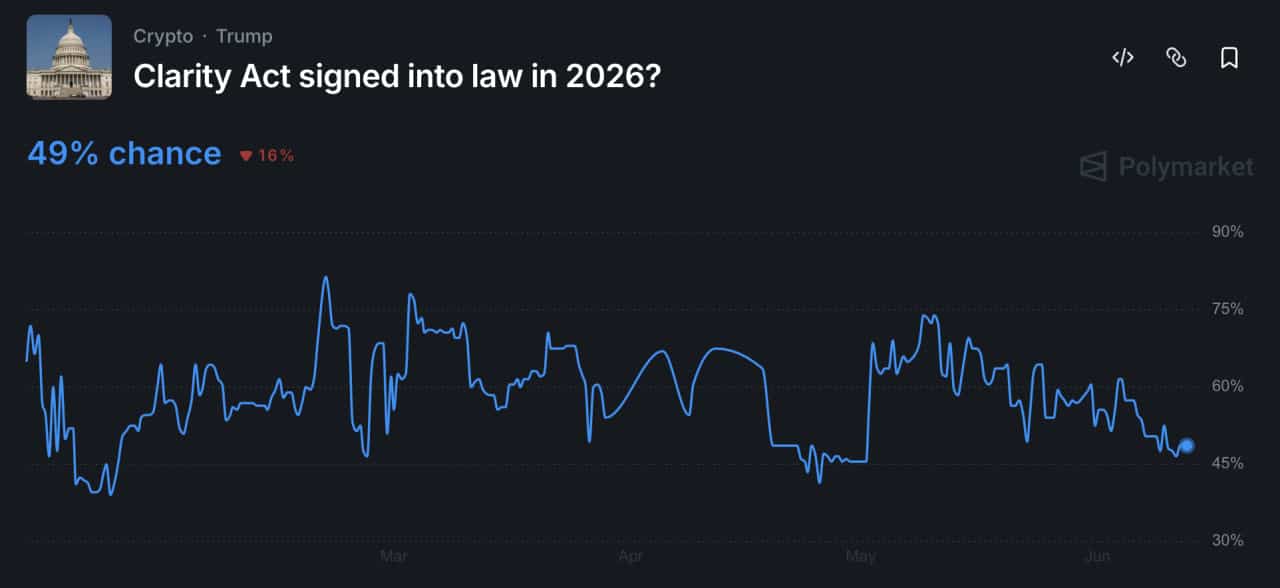
Prediction market users on Polymarket currently assign 49% odds to the Clarity Act being signed into law this year, down approximately 18 percentage points from the prior week, a compression that reflects the genuine uncertainty produced by this specific inter-industry fracture.
Dimon’s Opposition: JPMorgan’s $20B Payments Franchise, His Specific Public Arguments Against the Clause, and the Structural Logic Behind Bank Resistance to The Clarity ACT
Jamie Dimon’s opposition to the Clarity Act’s stablecoin yield provision has been publicly stated across multiple appearances, most recently in an interview with Fox Business host Maria Bartiromo, the same format and interviewer through which Dimon previously targeted Brian Armstrong, co-founder and chief executive of Coinbase, over Armstrong’s advocacy for the bill.
In that earlier May appearance, Dimon characterized Armstrong as the ‘only one’ pressing for the stablecoin yields inclusion, claimed Coinbase was spending ‘hundreds of millions of dollars in Washington’ on the effort, and concluded that Armstrong was, in Dimon’s phrasing, ‘full of shit.’ Dimon’s more recent comments, which Garlinghouse was responding to directly, argued that the Clarity Act reduces compliance safeguards and creates conditions under which illicit activity becomes easier to conduct.
JPMorgan CEO Jamie Dimon: "We will fight the CLARITY Act. If we lose, we lose, and we'll live. But it will be fought."
"Nobody is going to bow down to Brian Armstrong or Coinbase… He is full of sh*t" pic.twitter.com/okbuiu2Q0s
The epistemic status of the precise $20 billion figure warrants care. JPMorgan does not disaggregate its payments revenue as a standalone public reporting line in the manner that would allow precise verification, but the order-of-magnitude estimate is consistent with the firm’s disclosed wholesale and consumer payments activity and is treated by analysts covering the sector as a reasonable approximation of the franchise at risk.
The structural logic of bank resistance is not difficult to reconstruct from publicly available materials. The American Bankers Association and the Bank Policy Institute issued a joint statement formally opposing the yield provisions earlier this year, arguing that yield-bearing stablecoins would function as deposit substitutes, pulling household savings out of the banking system and reducing the credit intermediation capacity that regulators and community banks alike have cited as a systemic concern.
We suspect that Dimon’s stated objections, framed as compliance concerns and bad-actor facilitation risks, do not accurately reflect the primary commercial motivation behind JPMorgan’s opposition, and that the franchise-protection argument Garlinghouse advanced is the more analytically honest account of what is at stake for the bank.
A White House Council of Economic Advisers report published in April 2026 found that eliminating stablecoin yield entirely would increase bank lending by only $2.1 billion, a 0.02% increase in aggregate credit supply, while imposing an estimated $800 million net welfare cost on consumers, a ratio that does not support the systemic-risk framing Dimon has deployed publicly.
The same analysis found that large banks would capture 76% of any incremental lending enabled by a yield ban, with community banks capturing the remaining 24%, a distribution that maps precisely onto who benefits most from the regulatory outcome Dimon is advocating.
Disclaimer: Coinspeaker is committed to providing unbiased and transparent reporting. This article aims to deliver accurate and timely information but should not be taken as financial or investment advice. Since market conditions can change rapidly, we encourage you to verify information on your own and consult with a professional before making any decisions based on this content.
Daniel Frances is a technical writer and Web3 educator specializing in macroeconomics and DeFi mechanics. A crypto native since 2017, Daniel leverages his background in on-chain analytics to author evidence-based reports and deep-dive guides. He holds certifications from The Blockchain Council, and is dedicated to providing "information gain" that cuts through market hype to find real-world blockchain utility.
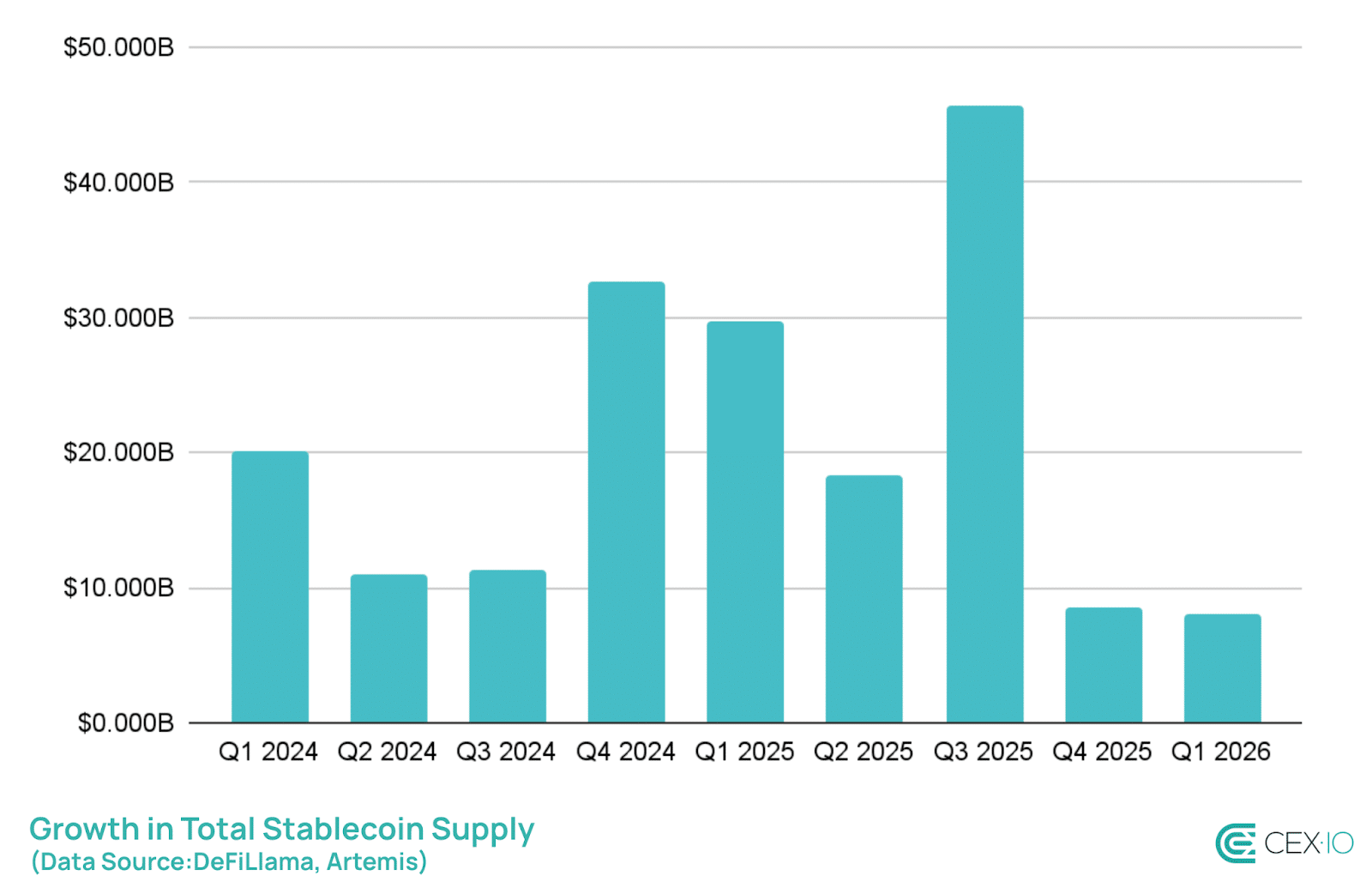
Total stablecoin supply rose approximately $8 billion to a record $315 billion in the first quarter of 2026, even as broader crypto markets contracted, according to data published by CEX.IO – with Circle’s USDC expanding its market share while Tether’s USDT posted its first quarterly supply decline since Q2 2022.
The divergence between the two dominant issuers marked one of the more structurally significant shifts in the stablecoin sector in recent years, coinciding with stablecoins capturing 75% of total crypto trading volume, the highest proportion on record.
We suspect the $315 billion figure understates the directional significance of the quarter. Capital rotating into stablecoins during a period of broad market weakness is not passive – it represents deliberate positioning, a decision by market participants to preserve dollar-denominated exposure within the crypto ecosystem rather than exit to fiat entirely.
The record trading volume share and the $28 trillion in total stablecoin transaction volume during the quarter reinforce the view that stablecoins have become the primary liquidity layer of the digital asset market, a structural role that is unlikely to reverse as institutional adoption deepens.
USDT Crypto Stablecoin Supply Contraction: What the First Quarterly Decline Since 2022 Represents
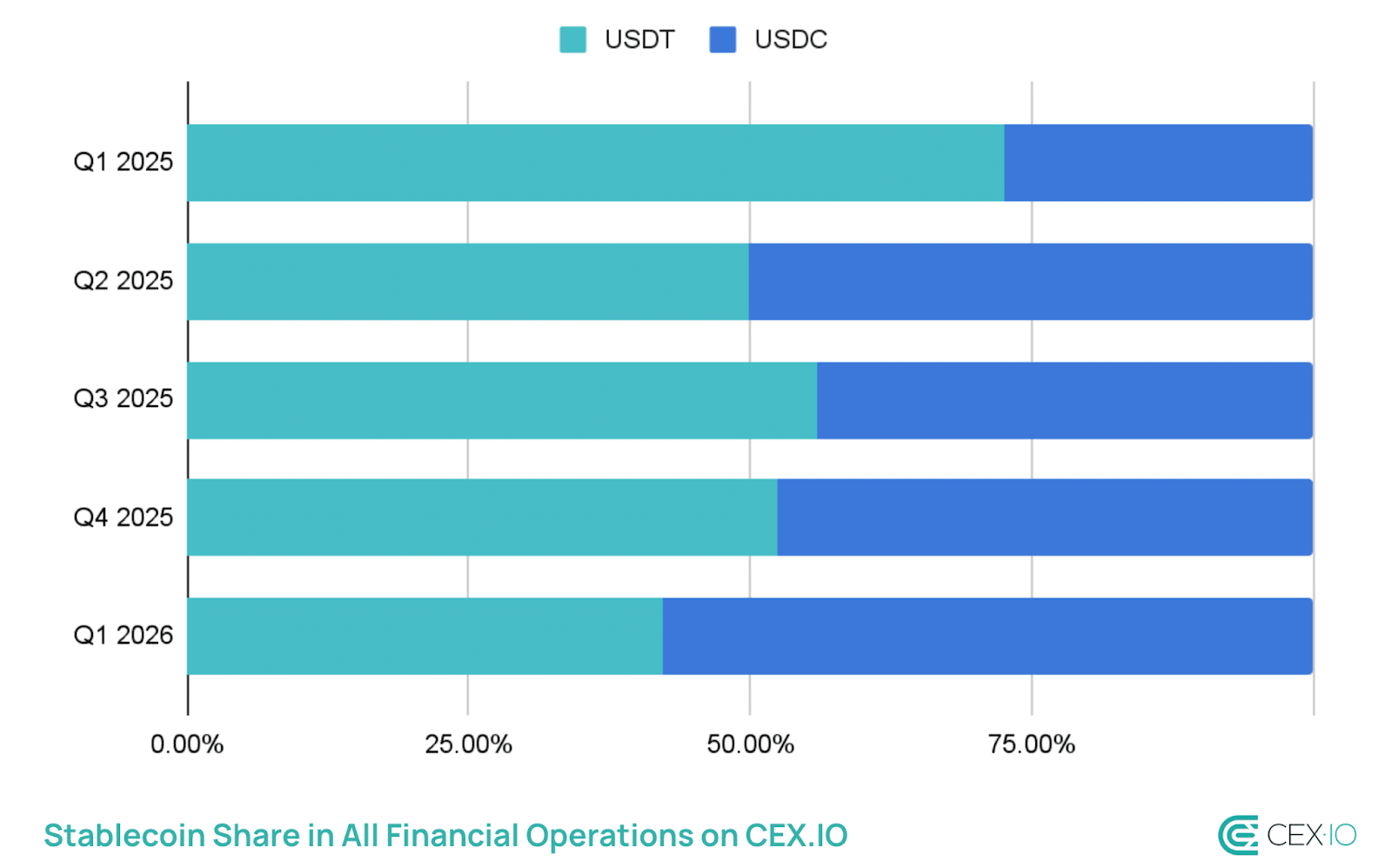
Tether’s USDT supply declined by approximately $3 billion in Q1 2026, its first net quarterly contraction since Q2 2022 – a period that coincided with the collapse of the Terra-LUNA ecosystem and the ensuing crypto credit crisis.
The decline is notable precisely because it arrives in a different market context: not a systemic shock, but a slow-motion retreat driven by stagnant retail adoption and gathering regulatory headwinds. USDT’s market share among stablecoins, which peaked near 70% in 2022, has been compressing gradually as compliance-oriented alternatives have gained institutional acceptance.
Source: CEX.IO
The mechanism behind USDT’s contraction operates on two levels. At the retail demand level, CEX.IO’s data showing a 16% decline in retail-sized stablecoin transfers – the steepest such drop on record – reflects directly on Tether, which has historically derived a larger share of its float from retail and emerging-market usage than USDC.
At the regulatory level, the European Union’s Markets in Crypto-Assets framework has effectively curtailed USDT’s distribution within EU-regulated venues, removing a meaningful demand channel that had supported supply growth through 2024. The combination of weakened retail flows and narrowing regulatory access represents a structural headwind, not a cyclical dip, and the Q1 data should be read accordingly.
Tether has not disclosed a quarterly report addressing the decline, and the company’s reserve attestations – while more frequent than in prior years – have not resolved persistent questions among institutional compliance officers about the composition of its backing assets.
That unresolved opacity continues to create a bifurcation in institutional demand, with a growing share of dollar-denominated on-chain capital preferring issuers whose reserve structures can withstand legal and regulatory scrutiny in U.S. and EU jurisdictions.
USDC Expansion: What the Rise to $78 Billion in Supply Reflects
Circle’s USDC reached approximately $78 billion in circulating supply by the close of Q1 2026, a figure that represents roughly 220% growth since Q4 2023 and a materially larger share of total stablecoin float than the issuer commanded two years ago.
The growth has been concentrated on Ethereum and Solana, where USDC functions as the primary settlement asset in a range of DeFi protocols, on-chain trading operations, and institutional B2B payment flows. Average transaction size has clustered well below retail norms – approximately $557 per transfer – with a transaction velocity of roughly 90 times, patterns consistent with programmatic and algorithmic usage rather than large-lot institutional block transfers.
Source: CEX.IO Research
The structural catalyst behind USDC’s expansion is, we suspect, less about organic retail demand than about compliance-driven issuer selection. Circle’s positioning ahead of the Guiding and Establishing National Innovation for U.S. Stablecoins Act – commonly known as the GENIUS Act – has made USDC the default choice for treasury teams, payroll processors, and financial institutions seeking a stablecoin whose reserve structure, blacklisting capabilities, and regulatory disclosures align with U.S. legal requirements.
That compliance posture carries real operational tradeoffs, as illustrated by Circle’s decision to freeze and subsequently unfreeze a blacklisted USDC wallet, a move that drew criticism from parts of the crypto community but signaled to institutional counterparties that the issuer would cooperate with legal process. That is a materially different risk profile from USDT, and institutional capital has begun to price the difference.
State-level regulatory development has added a further tailwind. Frameworks such as those advancing through Delaware’s stablecoin banking legislation are creating supervised issuance pathways that favor issuers already operating under federal compliance standards – a category USDC occupies more credibly than most competitors.
Disclaimer: Coinspeaker is committed to providing unbiased and transparent reporting. This article aims to deliver accurate and timely information but should not be taken as financial or investment advice. Since market conditions can change rapidly, we encourage you to verify information on your own and consult with a professional before making any decisions based on this content.
Daniel Frances is a technical writer and Web3 educator specializing in macroeconomics and DeFi mechanics. A crypto native since 2017, Daniel leverages his background in on-chain analytics to author evidence-based reports and deep-dive guides. He holds certifications from The Blockchain Council, and is dedicated to providing "information gain" that cuts through market hype to find real-world blockchain utility.