Ethereum News: The Cambridge Centre for Alternative Finance (CCAF) published Ethereum After the Merge – A Change in Power in June 2026, examining the advances and effects that The Merge had on Ethereum’s network dynamics, confirming annual power demand collapsed from 2.4 GW to 7.87 GWh per year (~0.90 MW continuous) and CO₂ emissions fell from 10.3 MtCO₂e to 2.37 ktCO₂e, a 99.98% reduction achieved through a single architecture software change.
This is not simply a sustainability milestone. It is empirical confirmation that The Merge, Ethereum’s September 15, 2022 transition from proof-of-work to proof-of-stake (PoS) consensus, delivered one of the most dramatic reductions in energy consumption ever recorded for a major public blockchain, and one that repositions Ethereum materially within ESG screening frameworks used by institutional allocators.
Ethereum News: ETH After The Merge, What the CCAF Report Found
CCAF’s methodology is based on a network-weighted average of 105 watts per node, producing figures the report presents as empirical rather than modeled projections.
The scale of the reduction is best read against real-world comparators the report provides. Pre-Merge Ethereum consumed energy comparable to Iceland’s national grid; post-Merge, the network’s footprint reaches half of what the British Museum needs, and is roughly equivalent to the energy the Eiffel Tower consumes annually.
Against the legacy banking system, which CCAF estimates at approximately 260 TWh/year across data centers, branches, and ATM infrastructure, Ethereum’s 7.87 GWh footprint is 4.5 orders of magnitude smaller, a ratio the report describes as “roughly 33,000 to one.”
Cambridge Report: Ethereum’s Annual Power Use Falls to 7.87 GWh After The Merge
According to a new report from the Cambridge Centre for Alternative Finance (CCAF), Ethereum consumes approximately 7.87 GWh of electricity annually following The Merge, a decline of more than 99.9%… pic.twitter.com/W2vWJW7BO8
On the carbon side, 2.37 ktCO₂e represents a 99.98% reduction from pre-Merge levels.
In the cross-chain comparison, post-Merge Ethereum sits below Solana (which registers over 13.4 GWh/year) in absolute consumption, but above NEAR (5.11 GWh/year). CCAF noted that “while Ethereum is one of the larger consumers in absolute terms, it is comparatively efficient relative to its economic weight.”
Node Infrastructure: The Risk Profile Has Shifted, Not Disappeared
The analytical question is no longer whether Ethereum’s energy consumption meets ESG thresholds; it does, by a wide margin. It is whether the node infrastructure sustaining that low-energy footprint is structurally sound enough to justify the institutional confidence the carbon numbers invite.
Secondary reporting on the CCAF audit flags a concentration problem that the emissions data obscures. According to reporting drawing on the CCAF findings, a significant share of full nodes is concentrated across a small number of countries, while a notable portion of audited nodes are hosted by a small group of cloud providers.
Ethereum whole energy footprint is less than famous landmarks such as the British Museum.
The result is 'Ethereum after the Merge – A Change in Power', out today from the Cambridge Centre for Alternative Finance, Cambridge Judge Business School at Cambridge Judge Business School… pic.twitter.com/743UoBflQh
These dynamics, validator geography, and hosting choices represent the network’s primary infrastructure risk going forward, shifting focus from environmental impact to structural resilience.
That centralization risk sits alongside ongoing questions about developer funding sustainability, explored in a separate analysis of Ethereum developer funding. We suspect the CCAF report will accelerate Ethereum’s passage through ESG screens at institutional asset managers who previously flagged proof-of-work energy consumption as a barrier, but the centralization data gives risk committees a second line of due diligence to work through before treating those screens as cleared.
Disclaimer: Coinspeaker is committed to providing unbiased and transparent reporting. This article aims to deliver accurate and timely information but should not be taken as financial or investment advice. Since market conditions can change rapidly, we encourage you to verify information on your own and consult with a professional before making any decisions based on this content.
Neil is a professional cryptocurrency content writer with years of experience. He has written for various cryptocurrency websites to report on breaking news, and been hired by all sorts of cryptocurrency projects, to create content that would increase their exposure and attract more potential investors.
Ethereum News: The Ethereum Foundation’s Protocol Security team, in a July 9, 2026, post authored by Nikos Baxevanis, has published a detailed account of running coordinated AI agents against Ethereum’s core protocol code, including systems software, cryptographic libraries, and contracts، and the headline result is methodological, not just the vulnerability they disclosed.
The agents found a real bug: a remotely-triggerable panic in libp2p’s gossipsub layer, the peer-to-peer substrate that all Ethereum consensus clients depend on, now patched and publicly disclosed as CVE-2026-34219. But Baxevanis frames that disclosure as secondary to a more durable insight about where security research time actually goes when agents enter the pipeline.
Ethereum News: The Bottleneck Shifted, Not Disappeared
The post’s central argument is precise: AI agents are search tools, not oracles, and the work they create is not generation but triage. As Baxevanis states directly in the post, “AI didn’t replace the security researcher.
It moved the work. The time that used to go into coming up with and chasing down hypotheses now goes into judging them at scale, including building the oracle, running the triage, keeping the list of known issues, and handling disclosure.”
The team runs many agents in parallel against a single target, coordinating through shared state in version control rather than a central process، an approach the post traces to Anthropic’s published writeup on building a C compiler with a fleet of agents. Roles emerge from the work itself: Recon converts attack surface into testable hypotheses; Hunting traces code paths and builds reproducers; Gap-filling tracks coverage and queues the next batch; Validation re-checks each candidate independently and makes the accept-or-reject call.
The Protocol Security Team has been pointing AI agents at Ethereum’s protocol code. Our core takeaway wasn't about finding bugs, it was about triage.
— Ethereum Foundation (@ethereumfndn) July 9, 2026
The bar for acceptance is strict. A candidate does not become a finding until a self-contained artifact reproduces the failure against real, shipping code and runs for someone who did not write it.
The post identifies three recurring false positives that the reproducer requirement filters out: a panic that only surfaces in a debug build; a reproducer that constructs an internal value no attacker-controlled input path could ever produce; and a formal-verification proof that is trivially satisfied regardless of what the underlying code does. “What’s new is the volume,” Baxevanis notes. “An agent writes the useless version as fast as the real one, and just as confidently.”
AI Agents in Security: What They Do Well and Where They Mislead
The post maps agent capability with unusual candor. Agents read spec and code together effectively, state and check real invariants, and draft reproducers from a one-line idea.
They mislead on call chains that look reachable but are not, gaming the success check to produce a pass for the wrong reason, inflating severity to match dramatic write-up language, and, most consequentially, bugs that span a valid sequence of steps where only the order is wrong.
For that last class, Baxevanis argues the agent’s role is to suggest which sequences are worth running through a stateful test harness, not to substitute for one.
The post credits Stanislav Fort’s “jagged frontier” framing: a model that recovers a full exploit chain on one codebase can fail basic data-flow tracing on another, so no single good result implies the next will hold.
Great blog post for the security researchers.
TL:DR
– Running coordinated AI agents towards code can surface many vulnerabilities. – The product is the triage. The bottleneck is now the expert human judgment. https://t.co/uKDqjz3DJ4
Every candidate gets checked independently regardless of prior performance. Parallel industry work at Anthropic’s Frontier Red Team and Cloudflare has converged on the same architecture, recon, parallel hunting, independent validation, deduplication, which the post treats as evidence the method is stable even as the tooling changes rapidly.
This is not simply a write-up about deploying AI in a security workflow. It is a structural argument about where human judgment remains non-negotiable: not in generating hypotheses, but in deciding what counts as proof, what constitutes a duplicate of a known issue, and what gets disclosed and when.
Disclaimer: Coinspeaker is committed to providing unbiased and transparent reporting. This article aims to deliver accurate and timely information but should not be taken as financial or investment advice. Since market conditions can change rapidly, we encourage you to verify information on your own and consult with a professional before making any decisions based on this content.
Neil is a professional cryptocurrency content writer with years of experience. He has written for various cryptocurrency websites to report on breaking news, and been hired by all sorts of cryptocurrency projects, to create content that would increase their exposure and attract more potential investors.
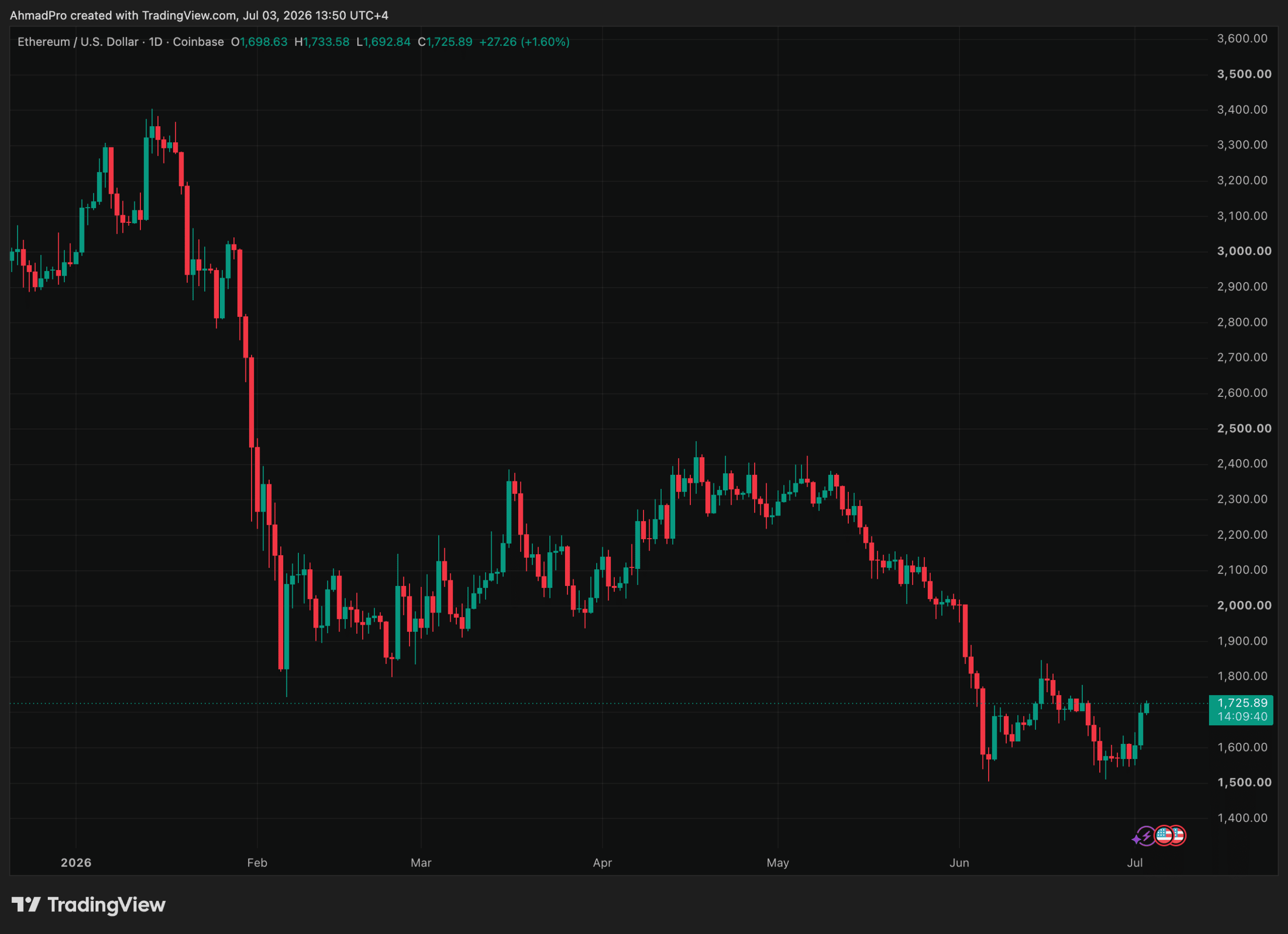
ETH is trading near $1,731 after bouncing 13% from $1,500 support. Here’s the technical setup, key resistance at $1,800, and what could drive the next move.
Ethereum News: ETH price is trading near $1,731 after a 13% rebound from the $1,500 support zone, and the question now is whether $1,700 holds as a floor or simply delays another leg lower. The bounce is real. Whether it has legs is a separate matter.
A June Non-Farm Payrolls print of just 57,000 jobs, against a 110K–115K consensus and well below May’s downwardly revised 129,000, weakened the U.S. Dollar Index (DXY) enough to lift risk assets broadly, with ETH among the beneficiaries.
The Market Periodical flagged the short-term downtrend break from the $1,550 region as a structural shift, not just a relief rally. Macro tailwinds and a technically significant bounce are aligning, but $1,800 remains the level that separates a recovery narrative from a confirmed one.
Just did technical analysis on the jobs report
If I did my calculations correctly, by 2028 there will only be one new job available each month pic.twitter.com/IhYSr1EFyy
Ethereum News: Can Ethereum Price Clear $1,800 and Hold It?
ETH was changing hands at $1,731, up approximately 0.48% over the prior 24 hours at last check, with an intraday peak during the breakout leg reaching $1,786.09, a 13.17% single-session move at its most extended point.
That peak also marks the first meaningful test of the $1,780–$1,820 resistance band, a zone that has capped multiple recovery attempts since ETH lost the $2,000 handle.
Analysts note ETH is now trading above both $1,700 and the 100-hour simple moving average (SMA), with the RSI (Relative Strength Index) holding above 50, a setup that historically supports continuation toward $1,800–$1,850. A 4-hour RSI bullish divergence, where indicator lows were rising while price lows were falling, provided the early warning signal before this bounce materialized.
Immediate support layers sit at $1,650–$1,675, then deeper at $1,575–$1,600, the same zone that arrested the most recent decline. The Citi desk cut its ETH price target to $2,240, which, while bearish relative to prior estimates, still implies meaningful upside from current spot and anchors an institutional base case above $2,000.
Bitcoin Hyper Targets Early-Mover Positioning as Ethereum Tests Key Resistance
ETH at $1,731 is a recovery, not a return. Even the bull case targets, $1,850 to $2,850, represent incremental moves from an asset that was trading above $4,000 in prior cycles. Traders rotating within crypto are increasingly looking at early-stage infrastructure projects where the valuation gap is wider and the asymmetry more pronounced.
Bitcoin Hyper is one project drawing attention. It positions itself as the first Bitcoin Layer 2 (L2) network with Solana Virtual Machine (SVM) integration, a combination that targets Bitcoin’s core constraints: slow settlement, high fees, and the absence of programmable smart contracts, without abandoning Bitcoin’s security model.
The presale has raised $32,921,487.36 at a current token price of $0.0136825, with staking rewards active for early participants.
The SVM integration is the differentiating claim, not just faster than Bitcoin’s base layer, but targeting latency performance that the project asserts beats Solana’s own throughput benchmarks. A decentralized Canonical Bridge handles BTC transfers between layers. Early-stage infrastructure presales carry meaningful execution risk; none of this is guaranteed to deliver on roadmap.
Disclaimer: Coinspeaker is committed to providing unbiased and transparent reporting. This article aims to deliver accurate and timely information but should not be taken as financial or investment advice. Since market conditions can change rapidly, we encourage you to verify information on your own and consult with a professional before making any decisions based on this content.
Neil is a professional cryptocurrency content writer with years of experience. He has written for various cryptocurrency websites to report on breaking news, and been hired by all sorts of cryptocurrency projects, to create content that would increase their exposure and attract more potential investors.
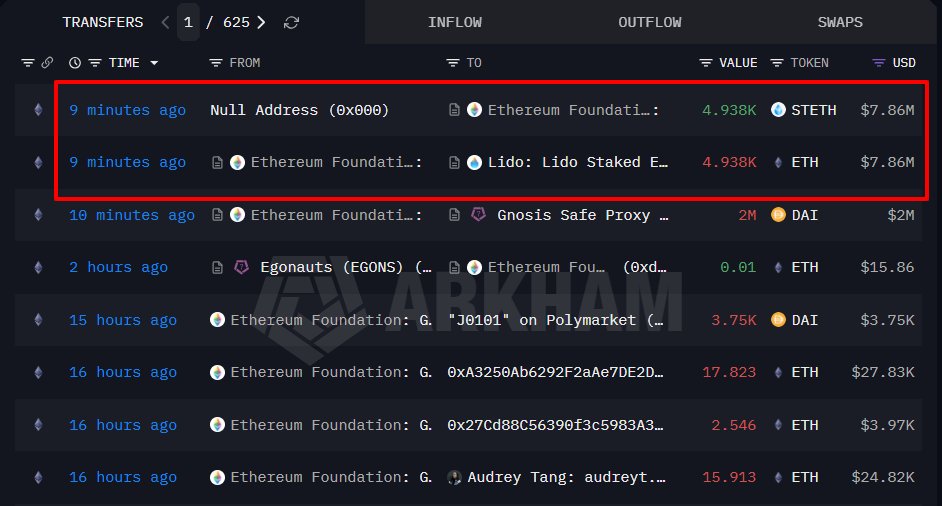
The Ethereum Foundation deposited 4,938 ETH worth $7.86M into Lido Finance, continuing active treasury rotation under its 70,000 ETH staking initiative.
The Ethereum Foundation deposited 4,938 ETH, valued at approximately $7.86 million at the time of the transaction, into Lido Finance, according to on-chain data flagged by the Onchain Lens tracker on June 30, 2026.
Onchain Lens noted the foundation may continue adding to the position, though the EF has not released a statement explaining this specific tranche.This is not simply a treasury management footnote.
The deposit sits within the EF’s formally announced Treasury Staking Initiative, disclosed on February 24, 2026 via the Ethereum Foundation’s blog, which targets approximately 70,000 ETH staked, with rewards directed back toward protocol development, grants, and operations.
The structural question is no longer whether the EF participates in ETH staking; it is how that participation is distributed between third-party liquid staking protocols and self-operated validators.
Ethereum Foundation Staking Activity: The Lido Deposit in Context
The 4,938 ETH deposit arrives after a period of significant movement in the EF’s Lido position. By late April 2026, the Foundation had approached roughly 69,500 ETH staked across Lido and its own validators, just short of its internal benchmark, before initiating a structured exit from Lido via 271 batched transactions of 811 wstETH each into Lido’s unstETH withdrawal contract, unwinding approximately 21,270 ETH (around $49.6 million).
That withdrawal was interpreted by on-chain analysts as a rebalancing toward self-operated validator infrastructure rather than a retreat from ETH staking altogether.
The latest deposit therefore represents a continuation of active treasury rotation rather than a directional bet. Lido Finance remains one of the largest liquid staking protocols on Ethereum, controlling roughly 22.8% of all staked ETH and issuing stETH, a liquid receipt token, that holders can deploy elsewhere in the ecosystem while their underlying ETH continues earning staking rewards.
ETH Supply Conditions: Exchange Balances and On-Chain Data
The EF deposit lands against a backdrop of tightening ETH supply. ETH exchange balances have fallen to multi-year lows, per on-chain data aggregated across major tracking platforms, meaning the liquid float available for sale on open markets has contracted materially.
Network-wide, more than 30% of total ETH supply, approximately 36.6 million ETH, was staked as of January 2026, an all-time high driven by institutional treasury staking, corporate holders, and ETF-adjacent demand.
Crypto trader Ted Pillows, citing price structure on X, characterized ETH’s current positioning as a return to a high-demand zone and said the asset “could see a relief rally next month if the price stays above the $1,500 level.”
The $1,500 level functions as the key near-term support cited across trader commentary, though ETH has struggled to build sustained upward momentum despite the supply-side compression.
Disclaimer: Coinspeaker is committed to providing unbiased and transparent reporting. This article aims to deliver accurate and timely information but should not be taken as financial or investment advice. Since market conditions can change rapidly, we encourage you to verify information on your own and consult with a professional before making any decisions based on this content.
Daniel Frances is a technical writer and Web3 educator specializing in macroeconomics and DeFi mechanics. A crypto native since 2017, Daniel leverages his background in on-chain analytics to author evidence-based reports and deep-dive guides. He holds certifications from The Blockchain Council, and is dedicated to providing "information gain" that cuts through market hype to find real-world blockchain utility.
Trent Van Epps warns Ethereum’s core development faces a $20M annual shortfall as the Client Incentive Program expires in April 2026 with no replacement in sight.
Ethereum News: Trent Van Epps, a former Ethereum Foundation ecosystem development lead and co-organizer of Protocol Guild, warned in a June 26 CoinDesk Markets Outlook interview with Jennifer Sanasie that Ethereum’s core protocol development requires roughly $30 million annually to remain healthy, a figure that existing funding mechanisms fall meaningfully short of covering, with no replacement infrastructure yet in place to close the gap.
This is not simply a budget shortfall. It is a structural test of whether Ethereum’s deliberate decentralization of governance authority can outrun the deterioration of the funding pipelines that authority was meant to replace.
Subtraction Strategy: The EF’s Intentional Retreat and What It Leaves Behind
Van Epps left the Ethereum Foundation after its leadership committed to accelerating the subtraction strategy, a philosophy of deliberately reducing the EF’s central role and pushing legitimacy into the broader ecosystem.
Is Ethereum facing a funding crisis?@trent_vanepps joins @jennsanasie on Markets Outlook to unpack ETH's $30M funding gap and what comes next.
00:00 – Trent Van Epps Joins Markets Outlook 00:57 – Why Trent Left the Ethereum Foundation 01:55 – What Is Subtraction and Why It… pic.twitter.com/bgv7hYnzmo
Operationally, that means cutting annual treasury disbursements from roughly 15% of holdings per year toward a 5% baseline by 2030. The EF has also cut its workforce by approximately 20% and seen ten senior figures depart within roughly six months, including its second co-director in four months, a pace of organizational change that has amplified ETH governance questions across the ecosystem, as detailed in coverage of the EF’s parallel restructuring and treasury management shift.
The more immediate pressure point is the April 2026 expiry of the Client Incentive Program (CIP), a four-year EF-funded scheme that provided vesting-linked ETH rewards to execution and consensus client teams, including Geth, Erigon, and Lighthouse maintainers, contingent on mainnet reliability. The CIP was framed from inception as temporary support while durable alternatives developed. Those alternatives have not materialized at sufficient scale.
Protocol Guild’s Track Record Against the Structural Shortfall
Van Epps co-founded Protocol Guild as a collective funding mechanism that routes donated tokens to active Ethereum L1 contributors via long-term vesting, without granting donors control over protocol priorities.
Major contributors have included Lido, Uniswap, and ENS. Since launch, Protocol Guild has distributed nearly $40 million to Ethereum core developers over approximately four years, averaging roughly $10 million per year against a stated need of $30 million annually, leaving a structural shortfall Van Epps estimates at around $20 million per year.
“The level of funding needed for core development is relatively stable. I would estimate around 30 million per year… We’ve distributed over almost $40 million to a lot of these core developers, but this is over 4 years and ultimately it’s not sufficient,” Van Epps said in the CoinDesk interview.
He described the core obstacle as a free rider problem: DeFi protocols, stablecoin issuers, and Layer 2 networks extract significant economic value from Ethereum’s shared infrastructure while facing no mechanism that compels contribution to its maintenance.
Today, the EF is changing shape, concluding a months-long process of reorganization as part of the implementation of the Mandate and the Treasury Management Policy.
We come out of this process with the structure, activities, and people necessary for execution on the critical…
The analytical question is no longer whether the EF’s subtraction philosophy is directionally correct; it is whether the 3-to-9-month window Van Epps identifies will produce durable institutions or a slow-burning developer attrition cycle.
The risks he outlines are concrete: loss of key maintainers, reduced client diversity, slower bug response, and delays to roadmap work including quantum-resistance upgrades, a technical scope that underscores the complexity of sustaining core development across more than ten client and research teams, as reflected in the scale of Ethereum’s ongoing technical development commitments.
Ethereum News: Van Epps’ Case for a Multipolar Funding Future
Despite the warnings, Van Epps characterized Ethereum’s competitive position as durable. He argued that Ethereum’s leads in decentralized finance, stablecoin settlement volume, and EVM adoption represent network effects that remain difficult for competitors to replicate, and that the $30 million annual figure is trivial relative to Ethereum’s approximately $200 billion market cap and trillions in annual stablecoin settlement.
Van Epps envisions a governance structure over the next decade in which the EF operates in a narrower research and coordination role alongside multiple independent institutions handling commercialization, infrastructure funding, and ecosystem growth, a vision Vitalik Buterin has similarly articulated, describing the EF as “not designed to be an eternal steward.”
He also called for a clearer narrative connecting ETH as an asset to the network’s expanding on-chain economy, arguing that stronger advocacy around ETH’s value accrual is a prerequisite for attracting the institutional patronage that would replace CIP-style support.
We suspect the next visible indicator of whether this transition is succeeding will not be a governance announcement but a client team roster, specifically, whether the developers who built and maintain Ethereum’s execution layer are still doing so twelve months from now.
Disclaimer: Coinspeaker is committed to providing unbiased and transparent reporting. This article aims to deliver accurate and timely information but should not be taken as financial or investment advice. Since market conditions can change rapidly, we encourage you to verify information on your own and consult with a professional before making any decisions based on this content.
Neil is a professional cryptocurrency content writer with years of experience. He has written for various cryptocurrency websites to report on breaking news, and been hired by all sorts of cryptocurrency projects, to create content that would increase their exposure and attract more potential investors.
Crowding the news headline, the Ethereum Foundation announced on June 23, 2026, that it had eliminated 54 positions, roughly 20% of its approximately 270-person workforce. Not just the menpower, it also cut its 2026 operating budget by 40%, reorganizing the remaining organization into five domain-focused clusters alongside dedicated operations and management support functions, according to a post published by Vitalik Buterin on the EF’s official blog.
This is not simply a headcount reduction. It is a deliberate pivot away from the EF’s historical role as Ethereum’s central development engine toward a narrower mandate as protocol overseer, with the financial architecture to match.
Ethereum News: Ethereum Foundation Layoffs and New Cluster Structure: What the Reorganization Covers
The five clusters replacing the prior functional structure are: Protocol Layer, focused on post-quantum security, zkEVM, and L1 privacy; Access Layer, building tools for users and AI agents to transact and delegate on-chain without intermediary reliance; User Layer, conducting empirical research on actual ETH network usage to ground protocol decisions; Community Layer, managing the EF’s public positioning across crypto, open-source software, and cryptography research; and Institutional Layer, engaging financial institutions, enterprises, governments, and academics on Ethereum integration and policy tracking.
Today, the EF is changing shape, concluding a months-long process of reorganization as part of the implementation of the Mandate and the Treasury Management Policy.
We come out of this process with the structure, activities, and people necessary for execution on the critical…
The Protocol Layer cluster’s published mandate states it “does not exist to make Ethereum more marketable or focused on short-term interests, or to make it easier to turn into another financial rail controlled by intermediaries.” That framing is a direct signal about the EF’s intended distance from TradFi-adjacent product development, even as its Institutional Layer deepens engagement with exactly those counterparties.
Endowment Model and the Financial Mechanics Behind the Cuts
The restructuring advances a crypto restructuring of the EF’s treasury policy that began in earnest in June 2025 and was formalized in a 38-page mandate document published in March 2026.
Current annual spend runs at approximately 15% of remaining treasury assets; the target under the new endowment model is to reduce that rate to roughly 5% by 2030, a pace the foundation describes as sufficient to sustain operations indefinitely, per research compiled by CoinMarketCap Academy.
Departing employees will receive severance of at least one month’s salary per year of service, a retirement payment, and access to a support fund that includes career coaching and ecosystem placement assistance. Nine senior figures have left the EF since January 2026, including former co-executive directors Tomasz Stańczak and Hsiao-Wei Wang, with Bastian Aue serving in an interim leadership role.
This year, the EF is decreasing its budget by roughly 40%, which entails some difficult decisions. The goal of the decreases was set out in the Treasury Management Policy last year: the EF is transitioning into being a long-term-oriented endowment-based organization, shifting…
The announcement arrived one day after former EF researchers launched Ethlabs, an independent protocol lab, a sequence that illustrates the broader dispersal of Ethereum development capacity away from the foundation’s direct payroll. That shift in blockchain governance structure, from centralized foundation funding to a more distributed ecosystem of independent research entities, is precisely what the EF’s new organizational logic is designed to accommodate rather than resist.
Funding Continuity and the Near-Term Risk Window
Former core contributor Trent Van Epps issued a pointed warning in community discussion following the announcement: core development could face a structural funding shortage within three to nine months as customer incentive programs expire coincident with the EF’s budget contraction.
That timeline is the primary near-term risk to watch, distinct from the longer-term question of whether the endowment model can sustain research velocity at scale.
We suspect the more consequential indicator over the next two quarters will not be ETH’s price reaction, down 0.46% on announcement day and already looking bad at $1,668, but whether independent entities such as Ethlabs and other ecosystem-funded groups move to absorb protocol research that the EF has explicitly deemphasized.
Joe Lubin’s Consensys has flagged its own zk-proof development timeline, which may partially overlap with work the EF is stepping back from. The analytical question is no longer whether the EF needs to restructure; it is whether the ecosystem’s distributed funding mechanisms can absorb the gap before research continuity breaks.
Disclaimer: Coinspeaker is committed to providing unbiased and transparent reporting. This article aims to deliver accurate and timely information but should not be taken as financial or investment advice. Since market conditions can change rapidly, we encourage you to verify information on your own and consult with a professional before making any decisions based on this content.
Neil is a professional cryptocurrency content writer with years of experience. He has written for various cryptocurrency websites to report on breaking news, and been hired by all sorts of cryptocurrency projects, to create content that would increase their exposure and attract more potential investors.
In the news today, Consensys CEO and Ethereum co-founder Joe Lubin said that ETH could become a fully zero-knowledge proof-based protocol within 3 to 5 years, anchoring that prediction to the Lean Ethereum proposal from Ethereum Foundation researcher Justin Drake, which targets 10,000+ transactions per second on mainnet via native ZK verification at Layer 1.
Lubin’s remarks arrive as Ethereum’s Layer 1 continues to face throughput pressure and as Vitalik Buterin has publicly pulled back from characterizing rollups as a permanent architectural destination, with Buterin stating earlier in 2026 that most L2S had become “branded shards” rather than genuinely differentiated execution environments.
Joe Lubin predicts Ethereum could become a fully ZK-proof protocol in 3-5 years.
In a June 10 interview, the Ethereum co-founder said ongoing ZK innovations will strengthen the L1 while delivering synchronous composability with L2s, enabling atomic execution and unified…
The analytical question is not whether Ethereum will eventually integrate ZK proofs; it is whether Lubin’s reframing of the rollup era as a deliberate strategic phase reflects a coherent long-run plan, or a retroactive narrative applied to a roadmap that drifted further than intended.
Ethereum News: The ZK Convergence Roadmap, What Lubin’s Framework Actually Establishes
The mechanism is bigger than the news, the Ethereum ecosystem, in Lubin’s framing, has passed through a “divergence phase” in which the rollup-centric roadmap – formalized around 2020–2021 – deliberately pushed execution off-chain to Layer 2 networks like Linea and Gnosis, allowing zero-knowledge proving technology to mature in production environments before being reintegrated at L1.
That reintegration is what Lubin calls the “convergence phase,” in which real-time ZK proving already running on L2s migrates upward to mainnet, ultimately collapsing the distinction between layers into a single atomic execution context where assets move without bridges and liquidity fragmentation disappears.
The Lean Ethereum proposal, authored by Ethereum Foundation researcher Justin Drake, operationalizes this convergence target at L1 with a throughput ceiling of 10,000+ TPS – a figure that would represent an order-of-magnitude improvement over current mainnet capacity and a direct answer to competing Layer 1 architectures; Solana’s Alpenglow upgrade, for instance, is currently in validator testing with sub-second finality as its headline metric.
Photo: Joe Lubin
It is necessary to flag the epistemic status of several details here. The phased rollout timeline, an opt-in validator phase in 2026, mandatory transition by 2027, has been reported in corroborating coverage but has not been independently confirmed by the Ethereum Foundation at the time of publication.
What is confirmed: the EF has published plans for an optional L1 zkEVM client as a first step toward full-stack ZK integration, and Lubin’s own Consensys-built Linea is already running ZK proofs in production, including experiments in synchronous composability that Lubin has previously described as “the holy grail of our ecosystem.” Gnosis’s Ethereum Economic Zone, developed in part by contributors with EF backgrounds, pursues similar integration, a shared execution context between L1 and L2 with tighter composability and shared security.
What remains unresolved is the pace at which making zkEVM verification mandatory at the consensus layer could clear the required auditing, formal verification, and client diversity work, timelines that some protocol developers assess as longer than Lubin’s 3-to-5-year window implies.
On the Ethereum Foundation restructuring, Lubin was categorical: “There won’t be a second foundation.” Instead, he indicated that at least three groups will spin out of the Ethereum Foundation, each focused on discrete mandates, core protocol development, usability and scalability, and institutional outreach, while the EF itself narrows to what Lubin called its “CROPs” components. That organizational segmentation is positioned not as instability but as preparation for the coordination demands of a ZK-heavy protocol transition.
Disclaimer: Coinspeaker is committed to providing unbiased and transparent reporting. This article aims to deliver accurate and timely information but should not be taken as financial or investment advice. Since market conditions can change rapidly, we encourage you to verify information on your own and consult with a professional before making any decisions based on this content.
Daniel Frances is a technical writer and Web3 educator specializing in macroeconomics and DeFi mechanics. A crypto native since 2017, Daniel leverages his background in on-chain analytics to author evidence-based reports and deep-dive guides. He holds certifications from The Blockchain Council, and is dedicated to providing "information gain" that cuts through market hype to find real-world blockchain utility.
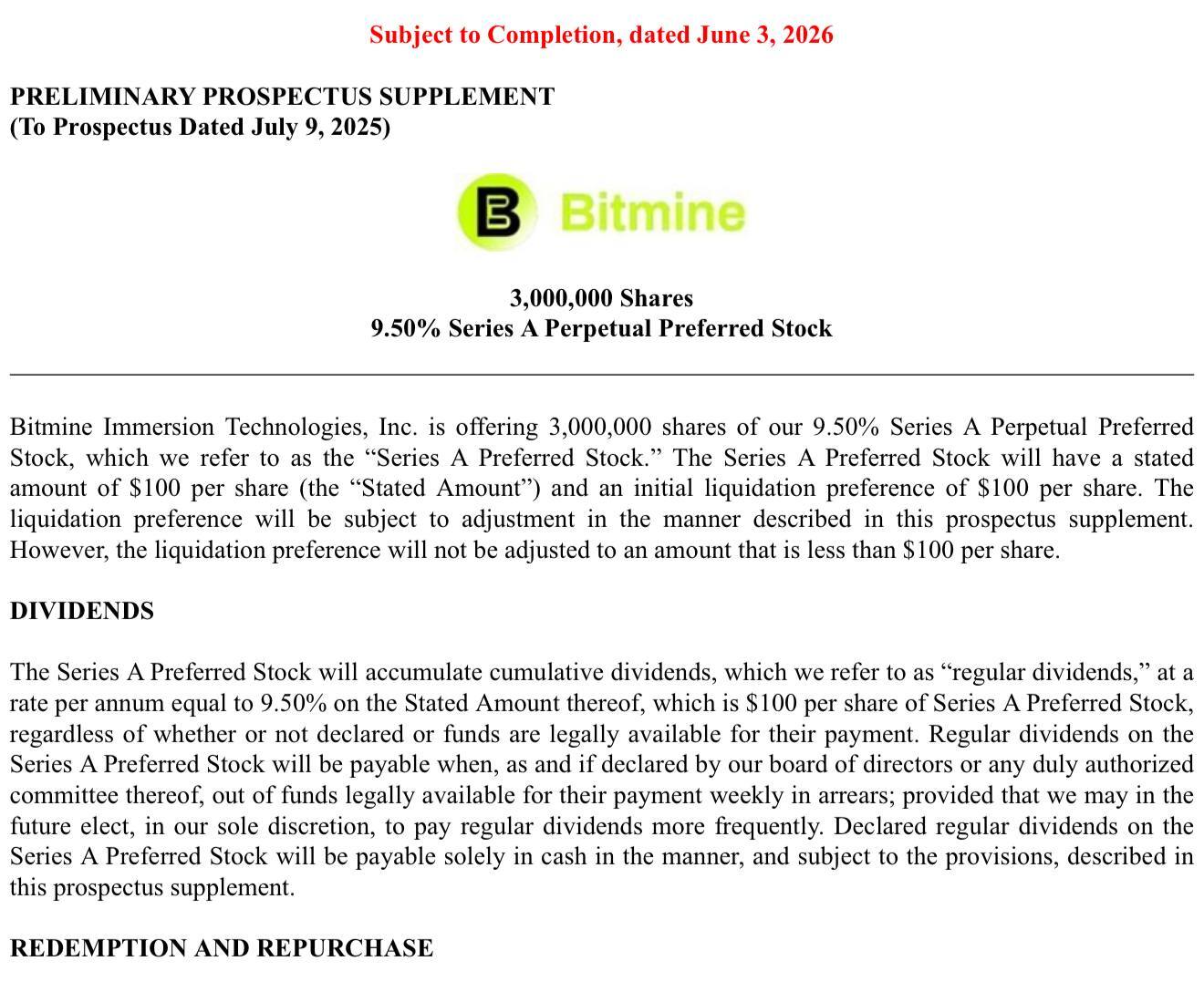
Ethereum News: Bitmine Immersion Technologies filed with the US Securities and Exchange Commission on Wednesday to launch a Series A Perpetual Preferred Stock offering, 3 million shares at $100 per share, targeting roughly $300 million in gross proceeds, and the market’s immediate read was not operational financing.
It was ETH accumulation. Shares of the company (BMNR) closed up approximately 5.8% on Thursday even as Ethereum itself slid 1.7% over 24 hours to trade near $1,650, extending a weekly decline of close to 17%.
The analytical question is not whether Bitmine needs capital; it is whether this preferred-stock structure represents routine corporate financing or the next deliberate expansion of what has already become the world’s largest Ethereum treasury vehicle.
Ethereum News: Bitmine Stock Offering, What the SEC Filing Actually Establishes
The mechanism functions as follows: Bitmine is offering 3 million shares of Series A Perpetual Preferred Stock at $100 per share, carrying a cumulative 9.5% annual dividend paid weekly in cash when declared by the board. Should the company fail to pay any weekly dividend, the rate compounds by 0.05% per missed week, capped at a maximum 15% annual rate until the obligation is satisfied in full.
The stock is expected to list on the New York Stock Exchange under the ticker BMNP, with trading commencing approximately 30 days after first issuance.
On intended use, the company’s Wednesday press release was deliberately broad: proceeds “may include the acquisition of additional ETH and other digital assets; the expansion of the Company’s staking and validator infrastructure, including through MAVAN; working capital; strategic investments aligned with the Ethereum ecosystem and broader digital asset adoption; and/or repurchases of the Company’s common stock.”
That language does not guarantee ETH purchases; it authorizes them as one of several permitted uses alongside operational and infrastructure spending.
This offering does not arrive in a vacuum. Bitmine previously raised capital through a registered direct common-stock sale in September 2025, with proceeds earmarked primarily for ETH accumulation, a transaction Chairman Thomas Lee characterized as “materially accretive” because it increased ETH holdings per share.
By January 2026, the company had disclosed holdings of approximately 4,143,502 ETH alongside 192 BTC, a $25 million stake in Eightco Holdings, and roughly $915 million in cash, total crypto-plus-cash holdings of approximately $14.2 billion. Of that ETH, some 659,219 tokens were already staked through the company’s MAVAN validator infrastructure, generating the ongoing yield that market participants believe underpins the economics of this preferred structure.
The MicroStrategy Playbook and Where the ETH Treasury Model Diverges
The structural parallel to Strategy’s perpetual preferred stock, STRC, which carries an 11.5% dividend, is explicit enough that market participants have been drawing it since the filing dropped.
The MicroStrategy playbook, refined across multiple capital raises, established that a publicly listed company can systematically issue equity and debt instruments to accumulate a digital asset at scale, with the asset’s appreciation providing the long-run return that justifies the dilution. Bitmine is following that architecture almost step-for-step in its ETH accumulation program.
Two interpretations are available. The first is the literal reading: the preferred offering funds a mix of staking infrastructure expansion, general working capital, and opportunistic ETH purchases, with no single use dominating.
The second is the market’s structural reading: the offering is the next capital raise in a deliberate, multi-year program to compound Ethereum holdings per share, with the 9.5% dividend obligation backstopped by staking yield rather than asset sales.
As the market dropped:
Strategy is down $11.07B on $BTC; Bitmine is down $9.58B on $ETH; SharpLink is down $1.59B on $ETH; Metaplanet is down $1.38B on $BTC; Forward Industries is down $1.13B on $SOL; pic.twitter.com/bX2ButqyGG
Evidence supports the second interpretation more than the first. Bitmine’s prior capital raises were each framed around ETH-per-share accretion. The company has stated a goal of controlling 5% of the global ETH supply. Thomas Lee’s keynote at the Proof of Talk conference in France explicitly described ETH digital asset treasuries using staking yields to fund ecosystem grants, a governance and yield framework, not a mining operations pitch.
The structural distinction from Strategy matters here. When Strategy disclosed it had sold 32 BTC, its first BTC sale since 2022, to fund dividend payments on its preferred instruments, Bitcoin briefly fell below $62,000 as risk-off sentiment rippled through the broader market.
The episode surfaced the tension at the heart of a pure-holding model: dividend obligations in cash require either asset sales or external capital inflows. Bitmine’s staked ETH, generating yield natively, offers at least a partial mechanical answer to that problem, though at current staking rates and current ETH prices, whether that yield covers a 9.5% annualized dividend on $300 million of preferred at scale remains an open arithmetic question.
Disclaimer: Coinspeaker is committed to providing unbiased and transparent reporting. This article aims to deliver accurate and timely information but should not be taken as financial or investment advice. Since market conditions can change rapidly, we encourage you to verify information on your own and consult with a professional before making any decisions based on this content.
Daniel Frances is a technical writer and Web3 educator specializing in macroeconomics and DeFi mechanics. A crypto native since 2017, Daniel leverages his background in on-chain analytics to author evidence-based reports and deep-dive guides. He holds certifications from The Blockchain Council, and is dedicated to providing "information gain" that cuts through market hype to find real-world blockchain utility.