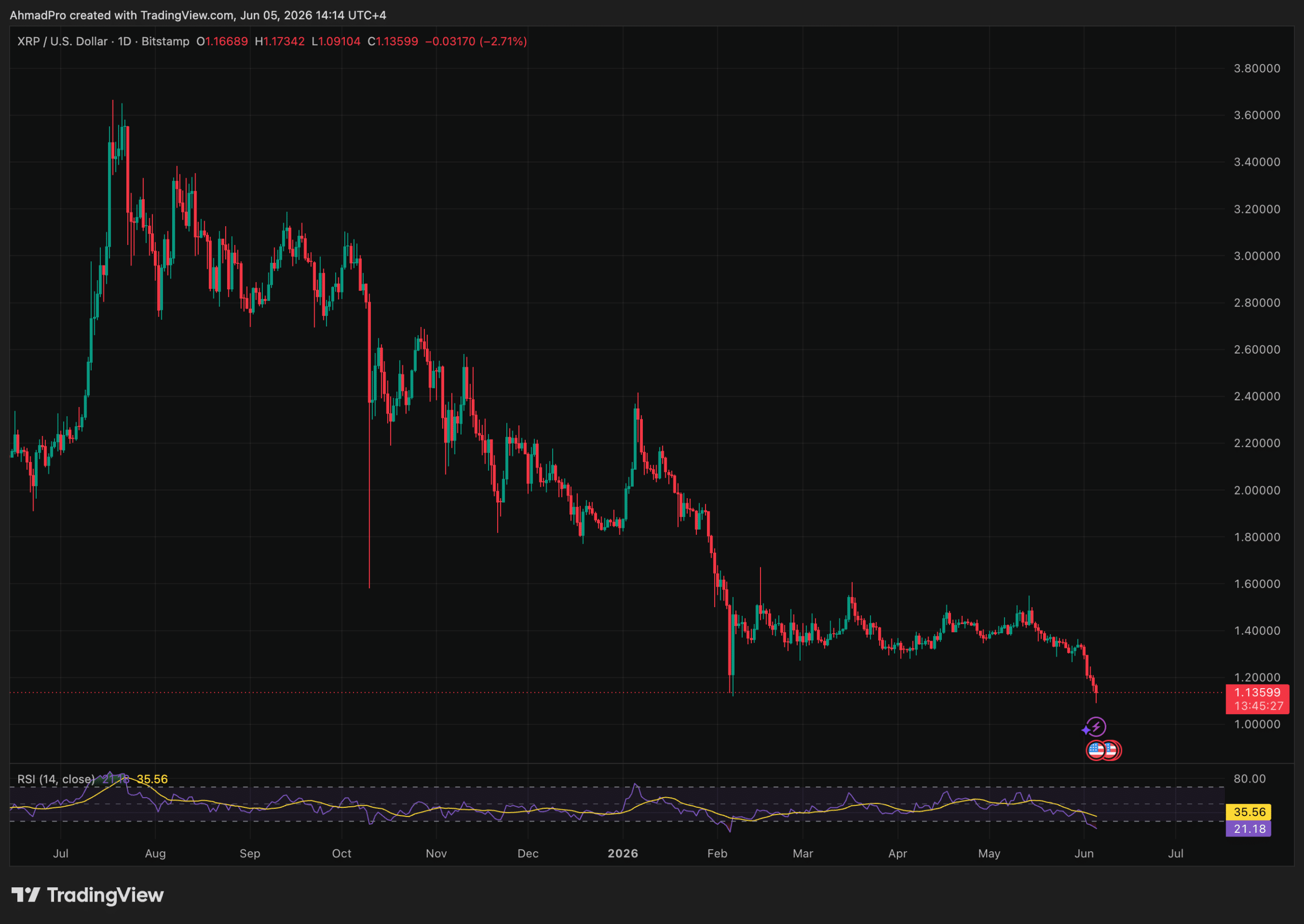
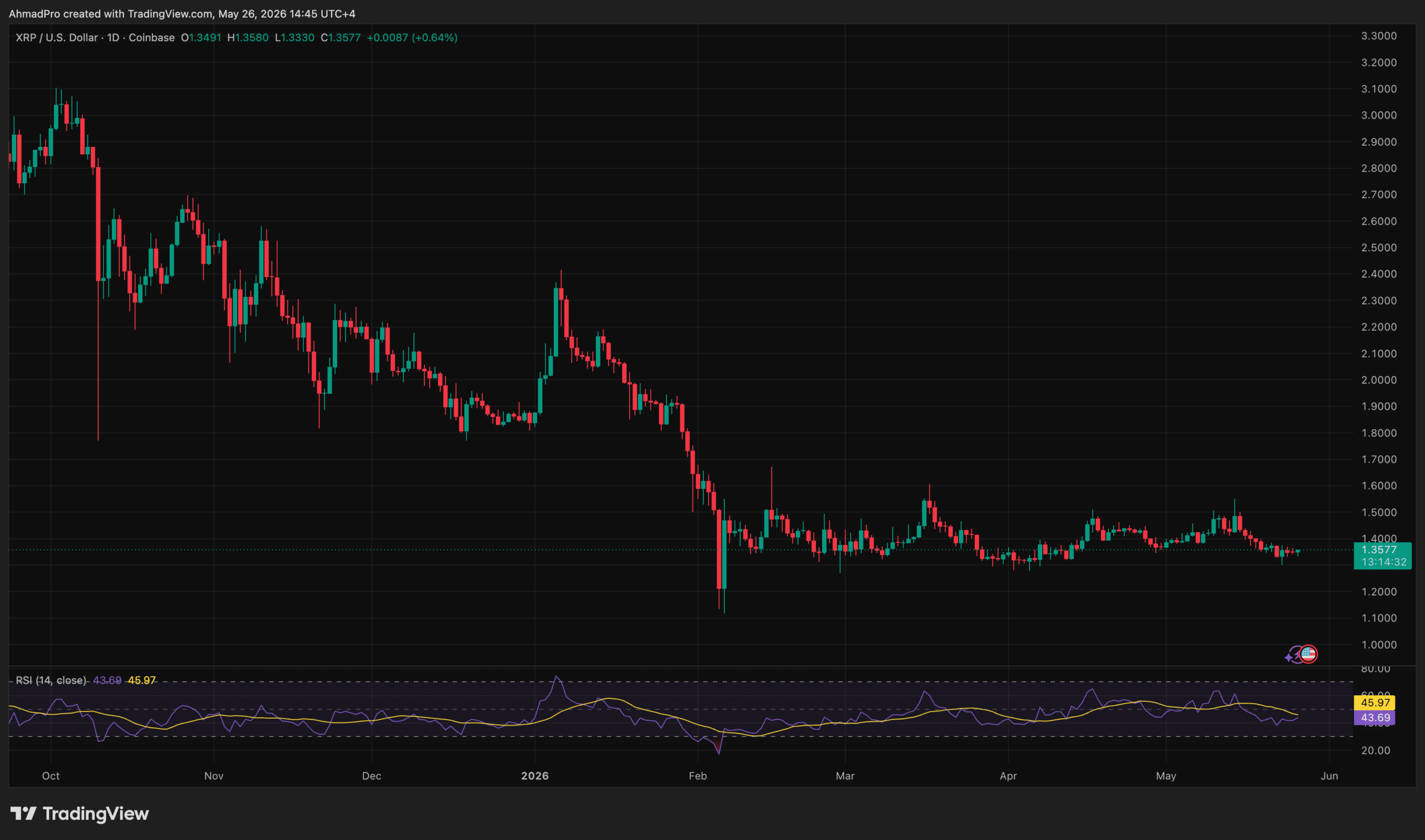
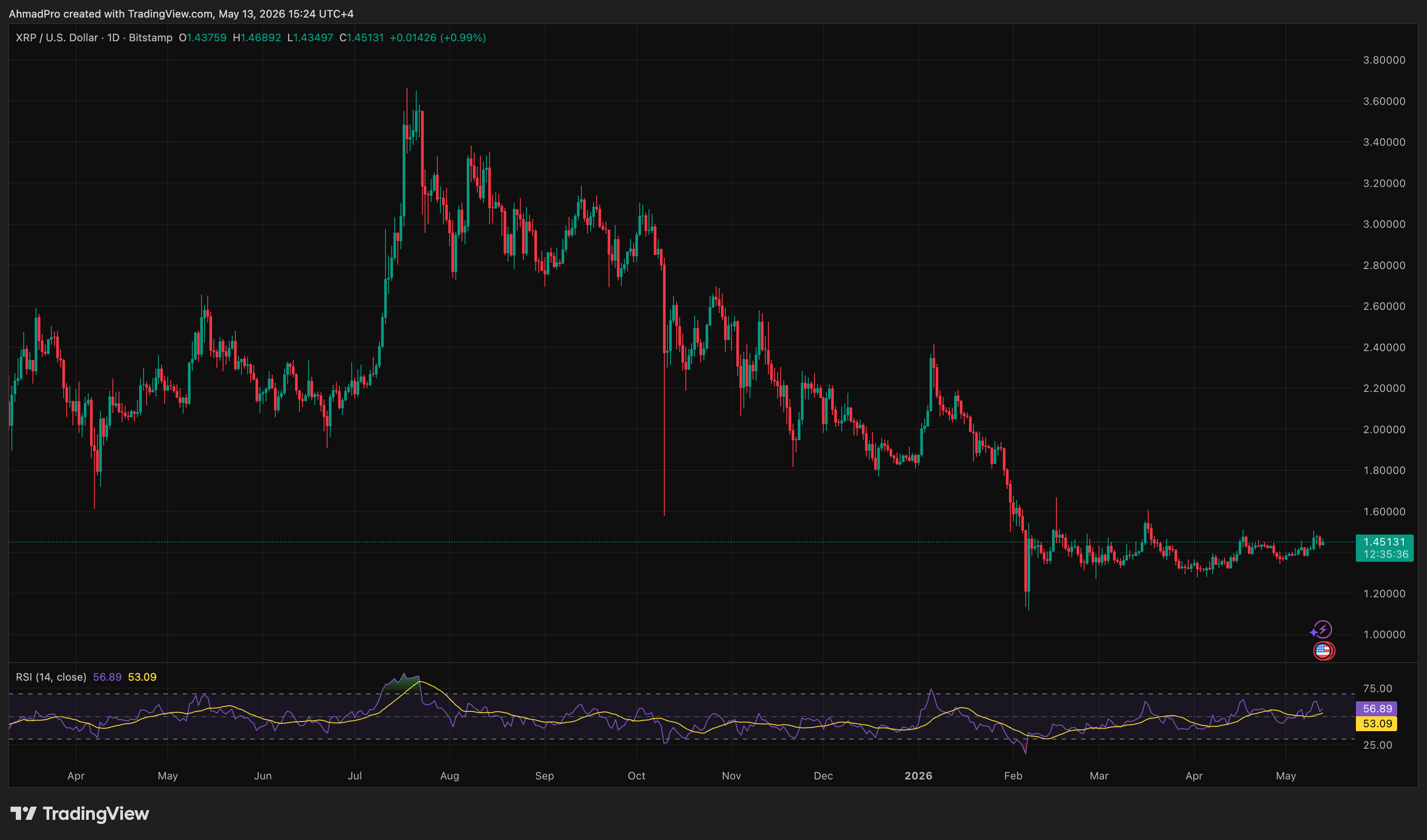
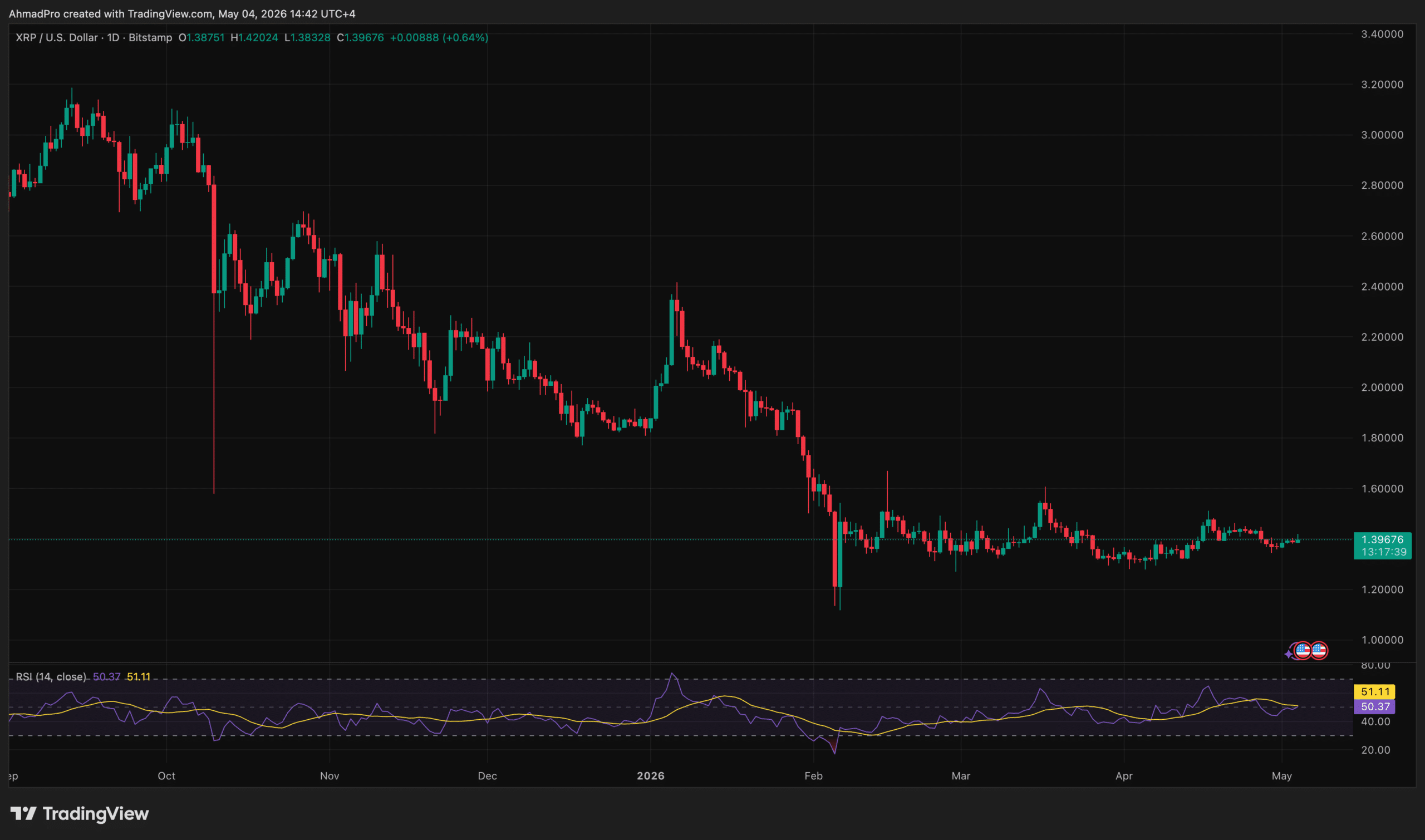
XRP price has traded near multi-month lows, touching approximately $1.15 in recent sessions, a level roughly 20% below the $1.50–$1.60 range where it repeatedly stalled through the first quarter, even as social media accounts circulate claims that Japan’s institutional alignment with Ripple is about to trigger a parabolic move.
The viral framing points to SBI Holdings‘ deep integration with Ripple’s payment infrastructure, the FSA’s longstanding treatment of XRP as a digital asset rather than a security, and a draft amendment to Japan’s Financial Instruments and Exchange Act as though these constitute freshly emergent catalysts.
This is not simply a bullish thesis with legitimate fundamentals behind it. It is a structural misreading of old information presented as new price discovery. The analytical question this article addresses is not whether Japan’s crypto regulation is real, it is, but whether that regulatory environment represents unpriced information capable of driving a sustained XRP rally from current levels.
Japan’s Regulatory History With XRP: What the Record Actually Shows, and What It Cannot Prove
The mechanism functions as follows: Japan’s Financial Services Agency classified XRP under the Payment Services Act framework years before the current social media cycle began, treating it as a crypto-asset for payment purposes rather than subjecting it to the securities-equivalent scrutiny that the U.S. Securities and Exchange Commission applied through its litigation with Ripple.
SBI Holdings established SBI Ripple Asia as a joint venture in 2016, and the consortium of Japanese regional banks that subsequently explored Ripple’s technology for domestic and cross-border settlement has been operational, in varying forms, for the better part of a decade. These are verified, documented facts. They are also, by definition, already reflected in market pricing for any participant who has followed XRP with even moderate diligence.
🚨JAPANS SBI Just Told Washington To Pass The CLARITY ACT (So It Can Deploy Billions Into $XRP) + Ripple Is Building The Amazon Of Global Finance🏦
The more recent regulatory development, a government-approved draft amendment that would reclassify 105 major crypto-assets under the Financial Instruments and Exchange Act, introducing insider-trading restrictions, annual issuer disclosures, and penalties of up to 10 years in prison and 10 million yen for unregistered operations, represents a tightening and formalizing of Japan’s crypto framework, not a sudden pivot toward permissiveness.
A parallel policy track exploring a reduction of Japan’s top crypto tax rate from 55% to a flat 20% would, if enacted, materially change after-tax economics for domestic traders and institutions; that remains a legislative proposal, not a confirmed change. It is necessary to flag the epistemic status of one further detail: one market report claiming that Japanese centralized-exchange JPY purchases ran approximately $21.7 billion into XRP between July 2024 and June 2025, versus roughly $4.7 billion into Bitcoin, reflects aggregated exchange-flow data whose methodology has not been independently verified by Coinspeaker.
What this record proves is that Japan is a structurally favorable jurisdiction for XRP and that SBI Holdings’ relationship with Ripple gives the asset unusual visibility in Japanese retail and payments discussions. What it does not prove is that any development announced in 2025 constitutes new information unavailable to the market when XRP was already trading above $2.00 earlier this year.
What Would Actually Move XRP: Unpriced Catalysts Versus Recycled Japan Narratives
Genuinely unpriced developments that could justify a re-rating at current levels would need to include at least one of the following: a U.S. regulatory resolution that clears the path for domestic spot XRP ETF approval, materially expanded ODL corridor data showing transaction volume growth that secondary markets have not yet absorbed, or fresh large-scale institutional flow data from European or North American custodians entering XRP positions for the first time.
Japan’s regulatory framework, by contrast, is known. The parliamentary steps required to advance the FIEA-related bill and the proposed tax reform are the items worth monitoring, but even those, if enacted, represent a formalization of existing conditions rather than a structural shock to global demand.
The possibility that Japanese banking group subsidiaries may be permitted to offer crypto trading services directly, a policy discussion noted in recent reporting, would represent a more significant adoption catalyst than anything currently circulating on social media, precisely because it would open an institutional distribution channel that does not yet formally exist.
That development remains at the discussion stage. It is not priced in because it has not happened. When and if it advances through the parliamentary process, it would warrant reassessment.
Disclaimer: Coinspeaker is committed to providing unbiased and transparent reporting. This article aims to deliver accurate and timely information but should not be taken as financial or investment advice. Since market conditions can change rapidly, we encourage you to verify information on your own and consult with a professional before making any decisions based on this content.
Daniel Frances is a technical writer and Web3 educator specializing in macroeconomics and DeFi mechanics. A crypto native since 2017, Daniel leverages his background in on-chain analytics to author evidence-based reports and deep-dive guides. He holds certifications from The Blockchain Council, and is dedicated to providing "information gain" that cuts through market hype to find real-world blockchain utility.
In XRP News today, Ripple announced on June 2, 2026, that its USD-backed stablecoin RLUSD is now available in Türkiye through three local partnerships, BiLira, Bitexen, and Bitlo – as the company pushes deeper into a market that the Chainalysis 2025 Geography of Crypto Report identifies as facilitating nearly $200 billion in annual crypto transaction volume, outpacing its nearest MENA regional peers by nearly fourfold.
This is not simply a distribution agreement: it is a deliberate attempt to anchor USD-denominated institutional liquidity directly onto the XRP Ledger in one of the world’s highest-volume stablecoin corridors.
Whether it translates into measurable on-chain demand for XRPL settlement infrastructure, rather than remaining a custody and trading story confined to local exchanges, is the question this expansion leaves open.
XRP News: RLUSD in Türkiye, How the Three-Partner Settlement Mechanism Actually Functions
The mechanism functions as follows: BiLira, Bitexen, and Bitlo each integrate RLUSD as a listed and tradable asset on their respective platforms, giving Turkish retail and institutional clients direct access to a regulated, USD-backed stablecoin without routing through international venues.
BiLira, which operates the largest local OTC desk in Türkiye and reports monthly trading volume of approximately $300 million, is particularly significant here because its infrastructure spans stablecoin issuance, exchange, and market-making simultaneously, meaning RLUSD gains not just a listing but a potential liquidity backstop in the local OTC market.
Yeni Listeleme! Ripple USD (RLUSD) alım, satım ve yatırım işlemleri başladı.
Dünyanın en büyük blokzincir şirketlerinden Ripple’ın ABD dolarına endeksli stabil kripto varlığı Ripple USD (RLUSD), 7/24 alınıp satılabiliyor!
Bitexen brings a multi-jurisdictional angle: the platform operates regulated entities across Türkiye, the Middle East, South Africa, and Europe, making its RLUSD integration the first step in what Alphan Göğüş, CEO at Bitexen MENA, described as “a broader rollout across the Bitexen Global platform”, a detail worth noting but one whose scope remains unquantified at this stage.
Bitlo, founded in 2018 by Mustafa Alpay and Hakan Baş, contributes a customer-service-oriented retail base that has earned the platform five consecutive “Cryptocurrency Platform Delivering Excellent Customer Experience” awards at the Şikayetvar A.C.E. Awards, suggesting a user cohort already engaged in active digital asset management.
It is necessary to flag the epistemic status of one detail: Ripple’s characterization of RLUSD as serving “payments, tokenization, and collateral management” in this context reflects the company’s stated product framing rather than independently verified transaction flow data from the Turkish deployments, which have not yet been reported publicly.
RLUSD itself is issued natively on both XRP Ledger and Ethereum, backed by USD deposits, U.S. government bonds, and cash equivalents, with Ripple committing to monthly third-party reserve attestations, a structure materially similar to leading U.S. stablecoins and one that satisfies the Capital Markets Board’s 2024 licensing framework, which moved Türkiye’s market from speculative retail activity toward a regulated institutional ecosystem.
Disclaimer: Coinspeaker is committed to providing unbiased and transparent reporting. This article aims to deliver accurate and timely information but should not be taken as financial or investment advice. Since market conditions can change rapidly, we encourage you to verify information on your own and consult with a professional before making any decisions based on this content.
Daniel Frances is a technical writer and Web3 educator specializing in macroeconomics and DeFi mechanics. A crypto native since 2017, Daniel leverages his background in on-chain analytics to author evidence-based reports and deep-dive guides. He holds certifications from The Blockchain Council, and is dedicated to providing "information gain" that cuts through market hype to find real-world blockchain utility.
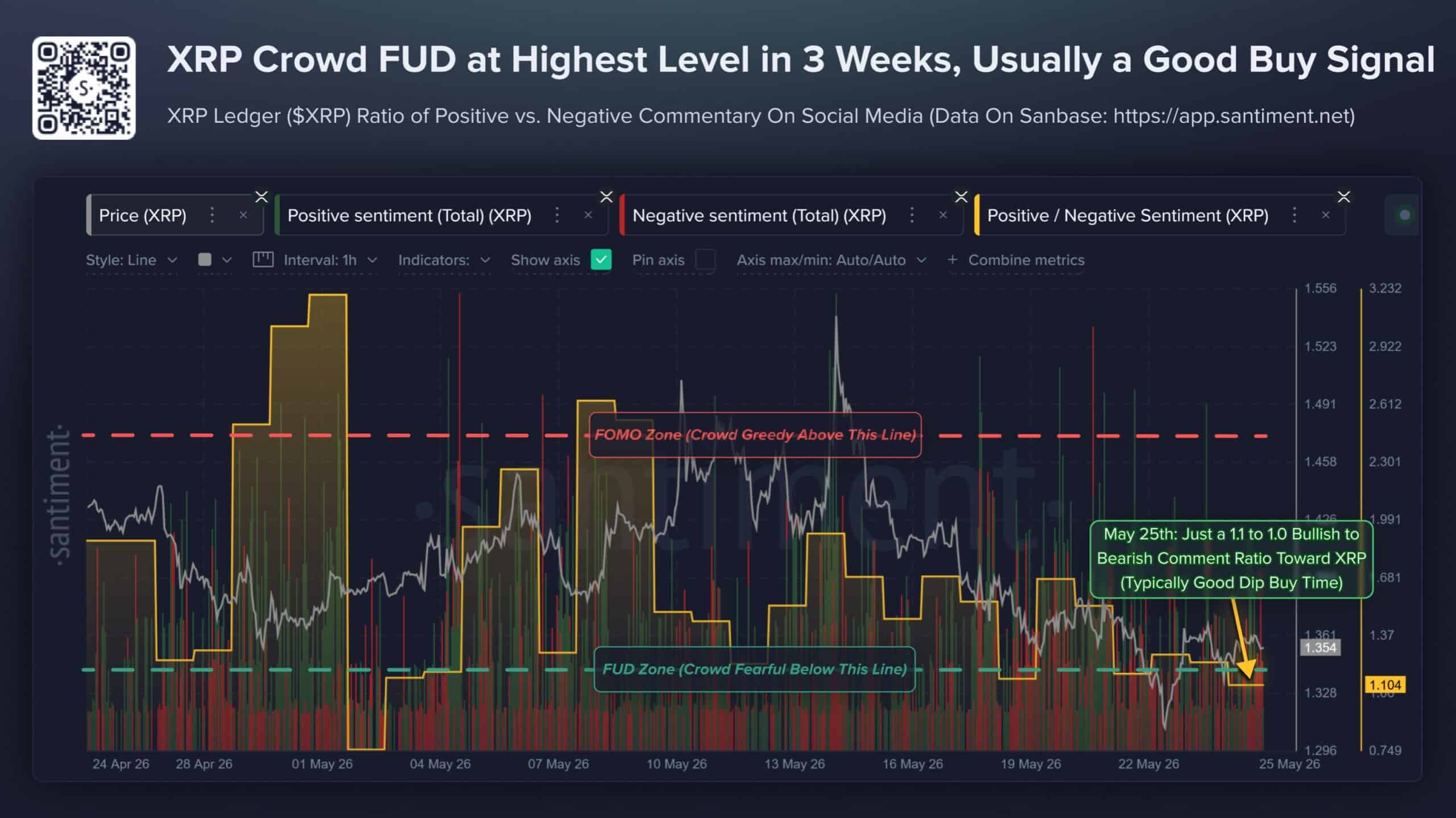
XRP crowd sentiment ratio fell to 1.1 bullish comments for every bearish one on May 25, according to Santiment, marking the token’s deepest push into what the analytics firm classifies as the FUD zone in three weeks.
At press time, XRP traded near $1.35, down approximately up 1% over the prior 24 hours against a backdrop of broad crypto market softness. The analytical question here is not whether crypto sentiment has deteriorated; it plainly has, but whether the historical signal embedded in that deterioration carries enough predictive weight to constitute a credible accumulation thesis.
That distinction matters. Retail fear readings on Santiment have preceded local XRP recoveries in prior cycles, with rebounds ranging from 20% to 50% in the weeks following comparable sentiment troughs. Whether the current setup follows that pattern or instead marks the beginning of a more sustained slide depends on what the corroborating on-chain data is actually showing.
What Does XRP’s 3-Week Sentiment Low Actually Signal?
Santiment’s crowd sentiment metric aggregates social media positioning – primarily commentary volume and directional tone across X and Reddit – and treats extreme retail pessimism as a contrarian buy signal.
The logic is structural: when retail participants capitulate and exit, selling pressure mechanically decreases while patient accumulators typically step in at discounted levels. As Santiment put it, “extreme fear typically means weaker hands have already exited the market” and “selling pressure decreases while long-term buyers begin accumulating.”
The firm has described the current XRP crowd mood as one of the most bearish readings in roughly two years, with the 1.1:1 bullish-to-bearish ratio representing a sharp compression from more optimistic periods earlier in 2026. Santiment’s broader framework holds that “when social media becomes excessively bearish, the market sometimes prepares for a move in the opposite direction” – a pattern it characterizes as “extreme crowd skepticism historically acting as a contrarian indicator preceding local market rebounds.”
That framing is documented rather than editorial: prior XRP fear cycles at comparable sentiment levels have, in several cases, resolved with meaningful short-term price recoveries, as outlined in recent XRP price analysis tracking sentiment and technical levels.
The important caveat is that sentiment data is a probabilistic input, not a deterministic one. Macro conditions and Bitcoin’s directional bias continue to exert outsized influence on XRP price trends. A signal worth watching is not the same as a confirmed trade.
XRP Price Scenarios: How Far Could a Sentiment Recovery Go?
Retail FUD has hit a local extreme, weak hands have largely exited, and whale accumulation, evidenced by a record 2,700-plus large-holder wallet count, is absorbing remaining sell pressure. XRP holds $1.30, sentiment stabilizes into the CME futures launch, and the token recovers toward the $1.40 to $1.48 resistance cluster. A confirmed close above $1.48 opens scope for a broader move consistent with the 20% to 50% rebounds seen in prior comparable fear cycles.
If sentiment bottoms near current levels without recovering sharply ahead of the May 29 CME debut, XRP oscillates in a $1.30 to $1.40 range. The futures launch provides a modest liquidity catalyst but not enough to break the structural consolidation. Market psychology stabilizes without delivering the asymmetric move the contrarian positioning implies.
If the FUD cycle deepens rather than reverses, Bitcoin sentiment deteriorates and pulls altcoins lower across the board. XRP loses $1.30 on a daily close, the wallet growth divergence stops functioning as a signal, and $1.20 comes into view. In that scenario, the current Santiment buy signal proves premature, a reminder that market psychology data identifies conditions, not outcomes.
The CME XRP futures debut on May 29 is the most immediate test of whether institutional access amplifies what the on-chain data is implying. Until XRP prints a sustained daily close above $1.40, confirming that sentiment recovery is translating into price structure, the contrarian setup remains a thesis rather than a confirmed trade.
Disclaimer: Coinspeaker is committed to providing unbiased and transparent reporting. This article aims to deliver accurate and timely information but should not be taken as financial or investment advice. Since market conditions can change rapidly, we encourage you to verify information on your own and consult with a professional before making any decisions based on this content.
Daniel Frances is a technical writer and Web3 educator specializing in macroeconomics and DeFi mechanics. A crypto native since 2017, Daniel leverages his background in on-chain analytics to author evidence-based reports and deep-dive guides. He holds certifications from The Blockchain Council, and is dedicated to providing "information gain" that cuts through market hype to find real-world blockchain utility.
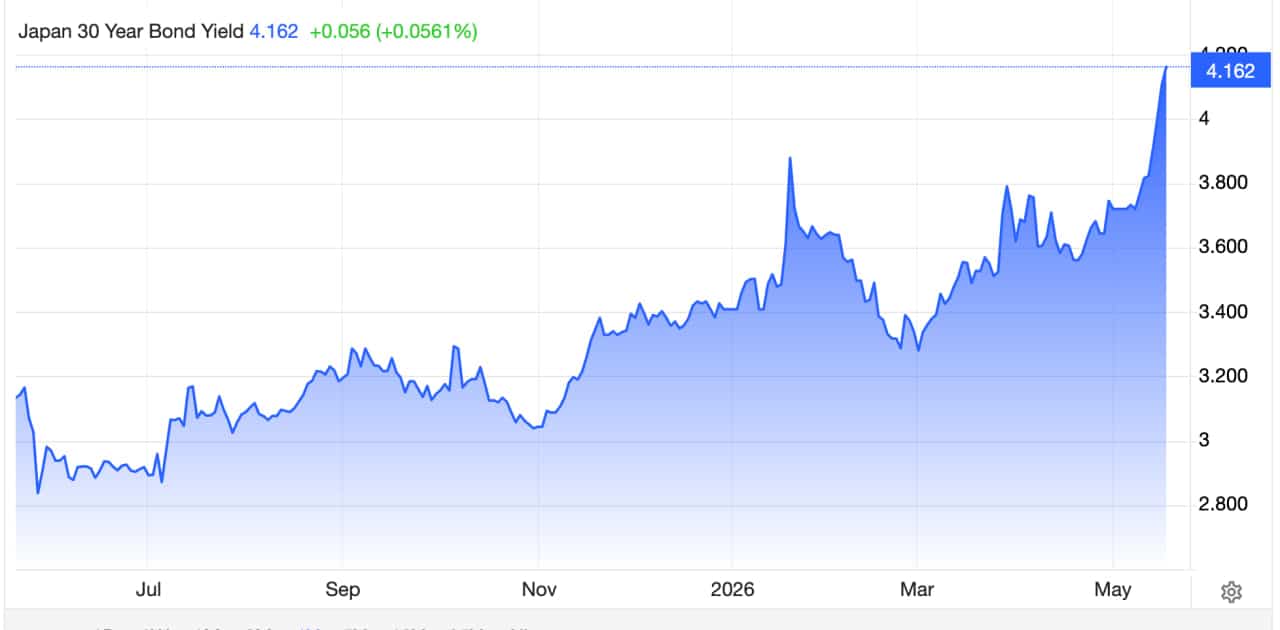
Japan’s 30-year government bond yield surpassed 4% for the first time since the instrument’s creation in 1999, reaching approximately 4.2% in May 2026, as the Bank of Japan’s sustained rate normalization program continues to unwind the decades-long yen carry trade that had quietly financed risk assets like XRP across global markets.
Japanese institutional investors sold close to $29.6 billion in US debt during the first quarter of 2026, the largest quarterly liquidation since 2022, contributing to a US 30-year Treasury yield that breached 5% in the same week, compressing liquidity conditions across mortgages, corporate credit, and sovereign debt simultaneously.
Analyst Catalina Castro, writing to a wide audience, framed the dynamic with pointed arithmetic: Japan sells American bonds, American yields rise further, mortgages rise, credit becomes more expensive, and pressure accumulates across the entire US financial system.
This is not simply a domestic Japanese bond correction. It is a structural stress event in the global liquidity transmission chain – one that exposes a fundamental inefficiency that Ripple and XRP were, architecturally, designed to address.
We suspect the JGB crisis will prove to be the most consequential real-world stress test that Ripple’s settlement infrastructure has yet encountered, not because XRP can absorb a $9 trillion bond market in distress, but because the specific mechanism by which yield spikes drain institutional liquidity is precisely the mechanism that on-demand bridge settlement is built to relieve.
XRP and Ripple Payments: How the On-Demand Liquidity Mechanism Actually Functions
The mechanism functions as follows: a Japanese city bank or regional insurer holding yen-denominated liabilities and needing to settle a cross-border dollar obligation would, under the conventional correspondent banking model, draw on pre-funded nostro accounts, pools of foreign currency held idle at correspondent institutions abroad, earning nothing while bond yields climb and opportunity costs rise.
Ripple’s Payments platform, formerly branded as On-Demand Liquidity and reintroduced in late 2024 as part of a broader institutional infrastructure push, eliminates that pre-funding requirement by routing the transaction through XRP as a bridge asset: the sending institution converts yen to XRP, the XRP leg settles on the XRP Ledger in seconds, and the receiving institution converts XRP to the destination currency before the transaction closes.
⚠️ATENCIÓN⚠️
EL TERCER MERCADO DE BONOS MÁS GRANDE DEL MUNDO SE ESTÁ ROMPIENDO + RELACIÓN CON $XRP
🤯Japón acaba de cruzar niveles que NO SE VEÍAN desde los años 90 y las CONSECUENCIAS pueden sacudir a TODOS LOS MERCADOS GLOBALES
Castro described the theoretical outcome in direct terms: a bank sends its local currency, it is converted to XRP, stablecoins, or CBDCs in seconds, then converted to the currency of the receiving bank, no intermediaries, no pre-funded accounts, and the released liquidity returns to the productive system to buy bonds, extend loans, or invest.
Ripple’s own pilot data supports the directional claim: its deployments have demonstrated cost savings of between 40% and 70% relative to SWIFT, with settlement completing in minutes against the multi-day clearing windows that correspondent banking requires.
The Japan corridor is not theoretical infrastructure; SBI Holdings, through its joint venture SBI Ripple Asia, has been embedding XRP-based settlement into domestic remittance and institutional payment flows for several years, giving Ripple a live institutional distribution network inside the market most directly affected by the JGB dislocation.
Disclaimer: Coinspeaker is committed to providing unbiased and transparent reporting. This article aims to deliver accurate and timely information but should not be taken as financial or investment advice. Since market conditions can change rapidly, we encourage you to verify information on your own and consult with a professional before making any decisions based on this content.
Daniel Frances is a technical writer and Web3 educator specializing in macroeconomics and DeFi mechanics. A crypto native since 2017, Daniel leverages his background in on-chain analytics to author evidence-based reports and deep-dive guides. He holds certifications from The Blockchain Council, and is dedicated to providing "information gain" that cuts through market hype to find real-world blockchain utility.
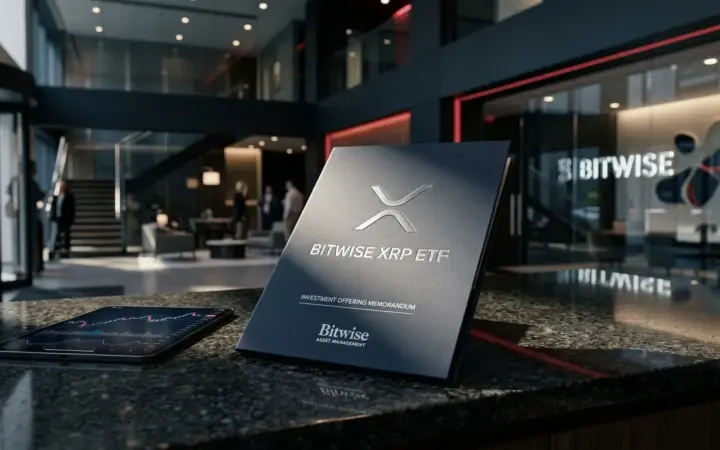
XRP News: Royal Bank of Canada, one of North America’s five largest banks and a designated Global Systemically Important Bank, disclosed a position in the Bitwise XRP ETF through a Form 13F filing submitted to the U.S. Securities and Exchange Commission for the quarter ended March 31, 2026, acquiring 2,000 shares valued at approximately $30,000.
The disclosure, citing CUSIP 09174F107, represents RBC’s first reported indirect exposure to XRP through a regulated investment vehicle. This is not simply a small-cap allocation from a large balance sheet. It is a compliance-cleared signal from a G-SIB that altcoin-specific ETF products have crossed an institutional risk threshold.
🚨JUST IN: Royal Bank of Canada now has INDIRECT $XRP exposure through the Bitwise XRP ETF🇨🇦👀
RBC’s latest 13F filing shows the institutional door to XRP keeps opening wider. From ETFs to tokenization to cross-border settlement, the infrastructure around XRP is growing FAST🚀🚀 pic.twitter.com/g485MZbrAm
— Chloe the XRP shiller 💙 (@Chloe_XRPL) May 16, 2026
We suspect the significance of RBC’s position lies not in its dollar size, $30,000 is a rounding error against a $570 billion AUM base, but in what clearing it required internally. G-SIBs operate under Basel III capital frameworks and stringent compliance review; any crypto-adjacent product must pass legal, risk, and regulatory scrutiny before appearing on a 13F.
The fact that it did, at a major Canadian bank with deep correspondent-banking relationships, suggests that the jurisdictional uncertainty that once surrounded XRP and Ripple Labs has receded sufficiently for institutional compliance departments to approve exposure. That is a materially different environment than existed even eighteen months ago.
XRP News: RBC’s 13F Filing: How the Disclosure Mechanism Actually Functions
The mechanism functions as follows: Section 13(f) of the Securities Exchange Act requires institutional investment managers with more than $100 million in qualifying assets under discretionary management to file Form 13F with the SEC within 45 days of each calendar quarter’s end.
The filing discloses long positions in U.S.-listed equity securities, including ETF shares, as of the quarter-close date; it does not capture short positions, derivatives, or non-U.S. holdings. RBC’s filing for Q1 2026, therefore, reflects its held position in the Bitwise XRP ETF as of March 31, 2026, not necessarily its current exposure.
The Bitwise XRP ETF (NYSE Arca: XRP) was created in November 2025 to provide investors with regulated access to XRP, the native asset of the XRP Ledger, without requiring direct custody. The fund holds physical XRP through The Bank of New York Mellon, which serves as custodian, an institution that has been building dedicated digital-asset infrastructure since at least 2021 and now services multiple U.S. spot crypto ETFs across Bitcoin, Ethereum, and select altcoins.
The fund charges a management fee of 0.34% and had accumulated approximately $345–$360 million in assets under management as of mid-May 2026. It is necessary to flag the epistemic status of one detail here: RBC has made no public statement confirming the rationale for the position, and the 13F reflects a point-in-time snapshot that may not represent the bank’s current view.
Disclaimer: Coinspeaker is committed to providing unbiased and transparent reporting. This article aims to deliver accurate and timely information but should not be taken as financial or investment advice. Since market conditions can change rapidly, we encourage you to verify information on your own and consult with a professional before making any decisions based on this content.
Daniel Frances is a technical writer and Web3 educator specializing in macroeconomics and DeFi mechanics. A crypto native since 2017, Daniel leverages his background in on-chain analytics to author evidence-based reports and deep-dive guides. He holds certifications from The Blockchain Council, and is dedicated to providing "information gain" that cuts through market hype to find real-world blockchain utility.
XRP NEWS: XRP price is trading at $1.44, pressing against the upper boundary of a descending parallel channel that has capped the asset since its late-April highs, while on-chain metrics compiled by CryptoQuant show a neutral-to-slightly-bullish reading with spot markets displaying buy-side dominance and cooling sell pressure.
The data and the price action are not yet aligned, derivatives sentiment has turned constructive, and accumulation signals are building, but the bears retain structural control above current levels.
Whether XRP can convert those on-chain signals into a clean technical breakout, or whether macro headwinds force another rejection at $1.48, is the question defining the asset’s near-term trajectory.
🐳 According to our on-chain data, XRP Ledger now has reached an all-time high of 332,230 wallets holding at least 10K $XRP. This extends a consistent growth trend that has been building since June, 2024. The continued rise in XRP Ledger wallets holding at least 10,000 XRP is an… pic.twitter.com/bd68Os2mJR
— Santiment Intelligence (@SantimentData) May 12, 2026
XRP tested the $1.50 psychological level over the weekend and was turned back, leaving a fresh rejection point that now anchors the bearish case. That failed attempt extended a pattern familiar to anyone who has followed this asset through its consolidation phase: on-chain conditions improve, price approaches resistance, and sellers re-emerge before a daily close can confirm the move.
The broader crypto market is also trading cautiously on Tuesday, with Bitcoin and Ether similarly subdued amid geopolitical risk. U.S. President Donald Trump rejected Iran’s counterproposal on Middle East negotiations, calling it “totally unacceptable,” while Iranian Foreign Ministry spokesperson Esmail Baghaei described the terms as “reasonable” and “generous”, a standoff that has kept risk appetite measured across digital assets.
XRP NEWS: Can XRP Price Break Above $1.48 and Target the $1.71 Moving Average?
XRP price is trading above the 50-day EMA at $1.44, a level that has held as a floor through recent pullbacks, but remains capped by a 2-layer resistance cluster at $1.48 to $1.49 where the descending channel’s upper boundary meets the 100-day EMA. A daily close above both would represent a channel breakout and a reclaim of overhead resistance that has been in place since the late-April retracement.
The technicals are constructive but not decisive. RSI on the 4-hour chart sits at 61, reflecting improving momentum without signaling overbought conditions. MACD remains above the zero line with histogram readings consistent with a bullish momentum phase still intact. Neither indicator is flashing urgency. The resolution sits entirely on the price structure itself.
On-chain data adds a moderately bullish tilt. CoinGlass shows the OI-Weighted Funding Rate flipped positive on Friday, reading 0.0048% as of Tuesday. Long positions are paying shorts, reflecting a real bias toward upside positioning in derivatives.
CryptoQuant corroborates this with buy-side dominance in XRP spot markets and cooling sell-side pressure consistent with accumulation dynamics reasserting themselves at this exact resistance zone.
The disconnect between improving on-chain conditions and price stalling at resistance is the signal worth watching. Accumulation beneath structural resistance paired with declining exchange inflows has historically preceded breakout moves. The setup is in place. The confirmation is not.
A daily close above $1.49 on meaningful volume clears both the channel boundary and the 100-day EMA, exposing the 200-day EMA near $1.71 as the next target, with $1.90 beyond it. Failure to hold $1.41 on a daily close reopens the path toward $1.30.
Middle East escalation remains an active variable that could override the technical setup in either direction. Ripple’s Q2 network update, expected later this month, is the other fundamental input to watch.
The $1.48 to $1.49 cluster resolves everything. Until XRP closes a daily candle above it, the on-chain case for upside remains a thesis rather than a trade.
Disclaimer: Coinspeaker is committed to providing unbiased and transparent reporting. This article aims to deliver accurate and timely information but should not be taken as financial or investment advice. Since market conditions can change rapidly, we encourage you to verify information on your own and consult with a professional before making any decisions based on this content.
Neil is a professional cryptocurrency content writer with years of experience. He has written for various cryptocurrency websites to report on breaking news, and been hired by all sorts of cryptocurrency projects, to create content that would increase their exposure and attract more potential investors.
XRP NEWS: JPMorgan, Mastercard, Ripple, and Ondo Finance completed a live cross-border redemption of tokenized U.S. Treasuries on the XRP Ledger on May 6, 2026, executing the asset leg in approximately 4.2 seconds before routing fiat settlement through JPMorgan’s Kinexys platform to a DBS Bank account in Singapore, outside conventional banking hours, a deliberate demonstration of around-the-clock institutional settlement.
The tokenized instrument at the center of the pilot was Ondo Finance’s OUSG, which holds $250 million in assets under management backed by short-term U.S. Treasuries carrying an average maturity of 100 days and a 4.8% yield, with more than 1,200 institutional holders on record as of May 2026.
Today, Mastercard, @OndoFinance, Kinexys by @JPMorgan, and @Ripple successfully completed a landmark transaction connecting a public blockchain with interbank settlement rails.
Together, we’re laying the groundwork for 24/7 global markets that never close. pic.twitter.com/UddCbUl7zR
This is not simply a settlement speed demonstration. It is the first confirmed instance of a public blockchain serving as the transport layer for a tokenized RWA redemption that terminates directly on JPMorgan’s institutional cash rails, a structural distinction that separates this pilot from prior tokenization experiments conducted on permissioned or proprietary networks.
We suspect the precise timing of the transaction, executed well outside U.S. banking hours, was not incidental: it was the proof-of-concept point the consortium needed to make, that public-ledger-to-bank-rail settlement no longer requires the market to be open.
XRP News: Kinexys and XRP Ledger: How the Hybrid Settlement Mechanism Actually Functions
The mechanism functions as follows: Ondo Finance initiated the redemption of OUSG tokens natively on the XRP Ledger, where the asset leg settled in RLUSD, Ripple’s USD-pegged stablecoin, in 4.2 seconds, with XRP covering only the minimal network fee.
Concurrently, Mastercard’s Multi-Token Network (MTN) transmitted settlement instructions to JPMorgan’s Kinexys platform, which then wired USD to Ripple’s DBS Bank account in Singapore to close the fiat leg of the transaction.
This is a meaningful step toward 24/7 global financial markets.
By combining the XRP Ledger with global banking infrastructure, this pilot shows how institutions can execute cross-border transactions in a single integrated flow. https://t.co/H2mjgDSzvY
Kinexys by JPMorgan, launched in October 2024, had processed $1.2 billion in tokenized deposits since inception before this pilot; according to available reporting, this marked its first public blockchain integration beyond the private Onyx network underpinning JPM Coin. The architecture is therefore genuinely hybrid: the XRP Ledger handled asset movement under a permissioned validator set configured for institutional compliance with MiCA and SEC tokenized asset guidelines, while the dollar settlement traveled through established correspondent banking infrastructure.
That is a materially different model than either a fully on-chain settlement or a fully off-chain transfer; it separates the speed and programmability of public ledger settlement from the identity and compliance layer that institutional counterparties require.
The pilot was built directly on a sequence of preceding XRPL institutional tests. In November 2025, Mastercard, Ripple, WebBank, and Gemini ran an RLUSD credit card settlement pilot on the XRP Ledger. In March 2026, Ripple and Archax settled £100 million in tokenized gilts on XRPL in a 20-second cross-border test. Ondo Finance had separately launched OUSG on the XRP Ledger in June 2025, explicitly designed to settle redemptions in RLUSD.
The May 6 pilot was not an isolated experiment; it was the convergence of parallel institutional development tracks that had been running concurrently for more than twelve months.
Disclaimer: Coinspeaker is committed to providing unbiased and transparent reporting. This article aims to deliver accurate and timely information but should not be taken as financial or investment advice. Since market conditions can change rapidly, we encourage you to verify information on your own and consult with a professional before making any decisions based on this content.
Daniel Frances is a technical writer and Web3 educator specializing in macroeconomics and DeFi mechanics. A crypto native since 2017, Daniel leverages his background in on-chain analytics to author evidence-based reports and deep-dive guides. He holds certifications from The Blockchain Council, and is dedicated to providing "information gain" that cuts through market hype to find real-world blockchain utility.
Former Ripple CTO David Schwartz reveals he once held 26 million XRP and recalls co-founder Arthur Britto selling Bitcoin for expenses. Here’s what it means for XRP price.
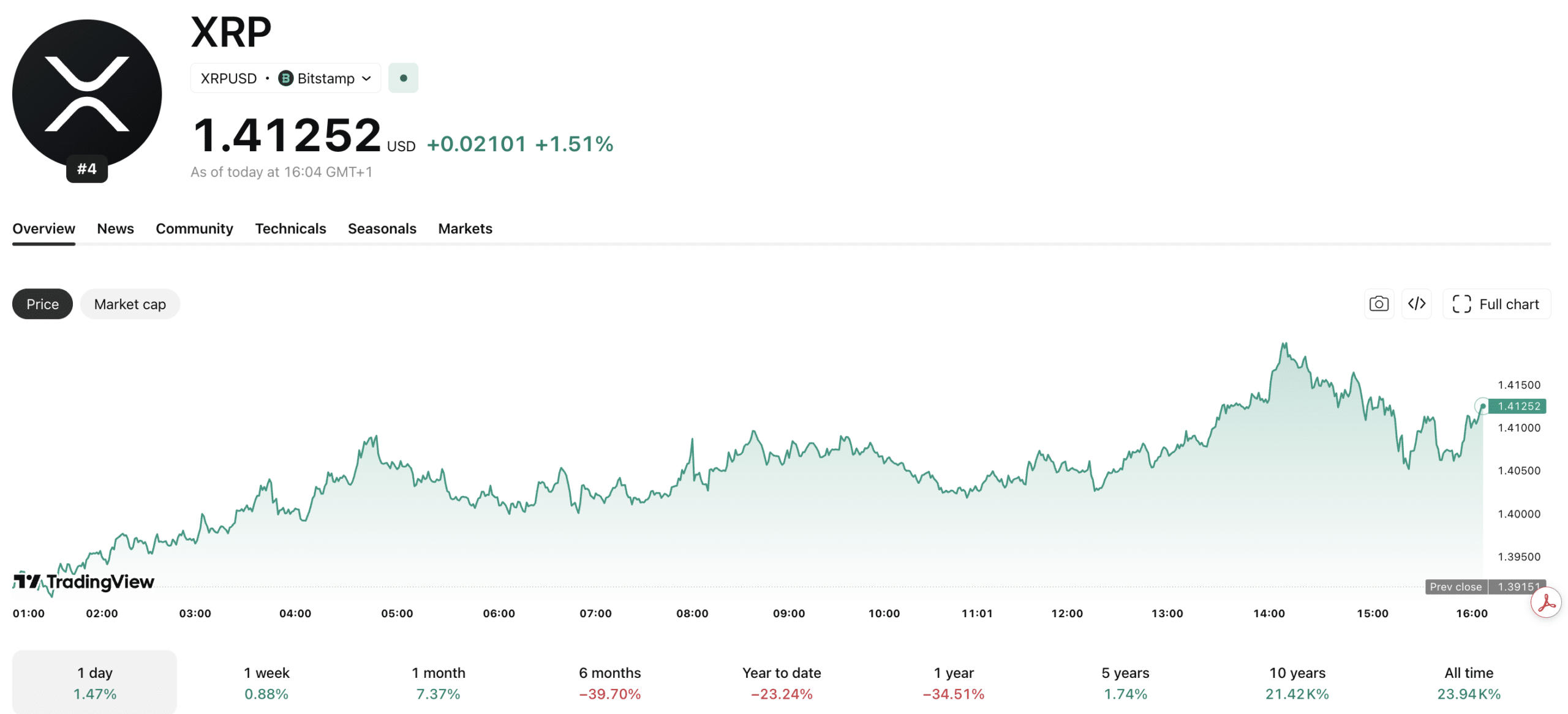
David Schwartz, formerly Ripple’s Chief Technology Officer and widely known online as JoelKatz, disclosed this week that he once held 26 million XRP, a sum worth roughly $36.6M at current market prices. XRP was trading near $1.40 at the time of writing, up approximately +0.4% over the prior 24 hours, with technicals on shorter timeframes sending mixed signals.
Responding to a question on X about the scale of his personal XRP position, Schwartz offered an unexpected benchmark. “My idea of not a lot is still more than a million,” he wrote. “I once had 26 million XRP.”
Schwartz Reveals Over 1M $XRP Holdings, Says #Ripple and XRP Remain Only Crypto Exposure.
Ripple CTO Emeritus David Schwartz revealed he once held 26 million XRP.
Although he described his current holdings as “not a lot,” he clarified they still exceed one million XRP.
The comment arrived in the context of a broader conversation about risk tolerance among Ripple’s founding figures. Schwartz also touched on co-founder Arthur Britto, saying his vague recollection from years ago was that Britto had been selling Bitcoin to cover living expenses while retaining most or all of his XRP. “I vaguely remember him saying that he’s been selling Bitcoin to cover expenses and hadn’t sold any, or very little, XRP,” Schwartz wrote.
Ripple’s leadership and acquisition posture have drawn sustained attention throughout 2025 as the company expands its footprint. The disclosure lands against a backdrop of fragmented but watchful momentum in the XRP market, and the broader question of what insider behavior at founding-era holdings actually signals about long-term conviction.
Can XRP Price Reclaim $1.50 This Week After Insider Holdings Disclosure?
XRP’s price action has been choppy. The token was benchmarked near $1.40 in recent sessions, with a 24-hour range of $1.39–$1.42, representing a roughly +3% upside from current levels. Support appears to be consolidating around the $1.38 floor, while resistance clusters near $1.43–$1.45.
Technical signals are not uniform. The Fear & Greed Index has finally exited fear territory and is now at neutral, hitting 50/100 for the first time in 2026.
Three scenarios appear plausible in the near term. The bull case sees XRP clear $1.45 on volume, with a path toward the $1.55 weekly target if institutional interest materializes around the Ripple regulatory narrative. The base case holds XRP in the $1.35–$1.44 band through the week, with consolidation preceding any catalyst-driven breakout.
The bear case, worth monitoring given recent volume patterns, involves a slip below $1.38 support, which could open a retest of lower levels flagged by some models near $1.30. Position sizing around that floor seems like the operative question for active traders right now.
LiquidChain Targets Early-Mover Upside as Ripple Consolidates at Key Support
XRP’s consolidation near support reflects a pattern familiar to longer-cycle holders: assets with strong fundamentals and insider conviction often compress before moving. But at a $1.40 price point and with a market capitalization already in the tens of billions, the asymmetry that early XRP holders captured is structurally different from what new entrants face today. Supply dynamics continue to evolve, but the easy multiples belong to a different era.
That structural gap is precisely where early-stage infrastructure plays attract attention. LiquidChain ($LIQUID) is a Layer 3 infrastructure project positioning itself as a cross-chain liquidity layer, fusing Bitcoin, Ethereum, and Solana liquidity into a single execution environment.
The stated architecture lets developers deploy once and access all three ecosystems, addressing a persistent friction point in multi-chain development. The presale is currently priced at $0.01456, with over $718,000 raised to date. Key features include a Unified Liquidity Layer, Single-Step Execution, and Verifiable Settlement.
Disclaimer: Coinspeaker is committed to providing unbiased and transparent reporting. This article aims to deliver accurate and timely information but should not be taken as financial or investment advice. Since market conditions can change rapidly, we encourage you to verify information on your own and consult with a professional before making any decisions based on this content.
Daniel Frances is a technical writer and Web3 educator specializing in macroeconomics and DeFi mechanics. A crypto native since 2017, Daniel leverages his background in on-chain analytics to author evidence-based reports and deep-dive guides. He holds certifications from The Blockchain Council, and is dedicated to providing "information gain" that cuts through market hype to find real-world blockchain utility.
XRP broke above $1.40 on a 13% volume surge during early Asia hours, with price consolidating near $1.4040–$1.4060. Here’s what the technicals say about the next move toward $1.50.
Ripple XRP pushed back above $1.40 during early Asia hours, trading near $1.41–$1.42, up roughly 0.50% in 24 hours from intraday lows around $1.37, as a sharp volume surge raised the immediate question of whether bulls can sustain the reclaim.
The move matters precisely because $1.40 had capped multiple upside attempts in recent sessions, making its breach something traders will watch closely on any pullback. What happens at this level over the next 24–48 hours could define XRP’s near-term trajectory.
The breakout unfolded as Bitcoin climbed during the same window, lifting broader risk sentiment across crypto markets and providing a tailwind for altcoin positioning. Volume spiked approximately 13%, driving XRP from a low near $1.38 to a session high around $1.42, with price accelerating cleanly through the $1.3990 resistance zone in the final hour of the move.
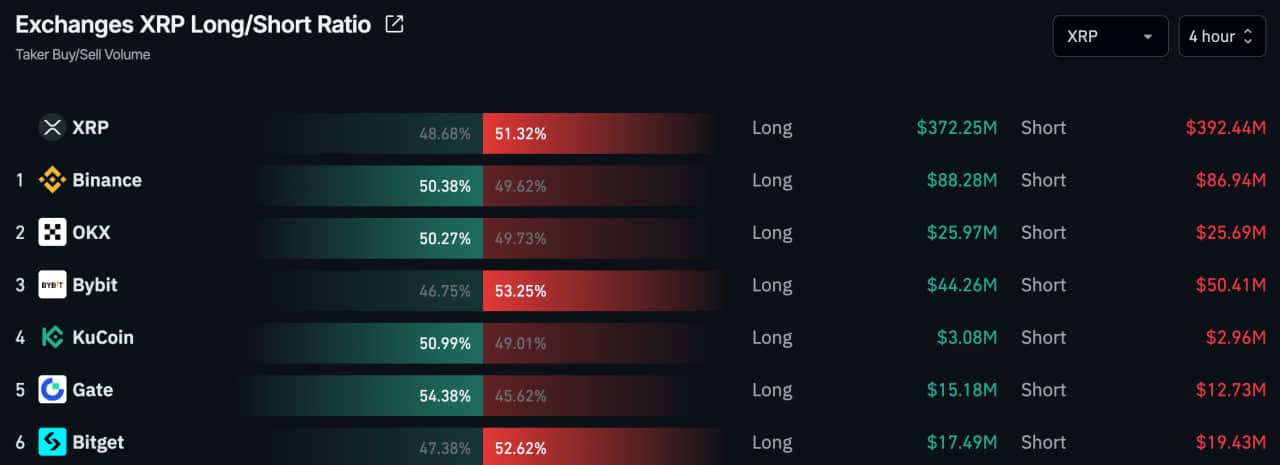
Binance futures data showed takers buying 372M XRP against 372.1M sold, suggesting real directional positioning rather than a low-liquidity drift higher.
Source: Coinglass
Price is currently consolidating near $1.4040–$1.4060, holding just above the breakout zone, but the structure of the move, not just the price level, is what sets up the analysis below.
XRP’s 24-hour price action presents a technically coherent picture. The token climbed from $1.3840 to a high of $1.4065, breaking above the $1.3990 resistance level on expanding volume, a key distinction between genuine breakouts and noise.
Daily volume has exceeded $2 billion, and the surge in the move confirms broad participation. The traders have noted a pattern of higher lows feeding into the breakout, signaling underlying bid strength rather than a single aggressive push.
RSI rebounded from oversold territory, and an hourly golden cross has been widely cited as additional confirmation of momentum, though RSI is now approaching levels that introduce overbought risk.
From here, the focus shifts to how price behaves around the $1.40 level. If it holds as support on a retest and Ripple pushes through the $1.41–$1.42 resistance band, the path opens toward the $1.50–$1.55 zone, a target frequently referenced by traders.
Alternatively, the market may pause to consolidate within the familiar $1.40–$1.46 range as buyers absorb recent gains, with $1.46 remaining the key ceiling for any broader breakout. A loss of $1.40, however, would weaken the structure and likely pull the price back into the $1.35–$1.39 range, reinforcing how often this level has acted as a contested pivot.
Momentum remains constructive overall, but $1.40 is the defining condition. A confirmed move toward $1.50 would mark a meaningful technical resolution of the compression that has persisted over recent sessions.
Ripple XRP breaking out is a positive shift, but at this size, the upside is naturally more measured. Even strong moves tend to require sustained inflows, not just momentum.
That is why some traders look earlier in the cycle, where price discovery has not happened yet, and the upside is not already constrained by market cap.
LiquidChain is positioning in that space, focusing on cross-chain liquidity by connecting Bitcoin, Ethereum, and Solana into one execution layer. The idea is to reduce fragmentation so assets and users can interact across ecosystems more efficiently.
The presale is still early, at around $0.01456 with just over $700K raised, suggesting it is in the accumulation phase rather than fully priced.
But it is also unproven. Execution, adoption, and liquidity after launch are still unknown, which is the trade-off with early-stage infrastructure.
So the contrast is simple: XRP offers a more stable but capped upside, while something like LiquidChain offers earlier positioning with higher potential, but also higher risk.
Disclaimer: Coinspeaker is committed to providing unbiased and transparent reporting. This article aims to deliver accurate and timely information but should not be taken as financial or investment advice. Since market conditions can change rapidly, we encourage you to verify information on your own and consult with a professional before making any decisions based on this content.
Neil is a professional cryptocurrency content writer with years of experience. He has written for various cryptocurrency websites to report on breaking news, and been hired by all sorts of cryptocurrency projects, to create content that would increase their exposure and attract more potential investors.
Ripple XRP CEO Brad Garlinghouse has signaled that further acquisitions are planned for the second half of 2026, a disclosure that arrives after the company already closed two deals in the first quarter of a year he had publicly characterized as one focused on integration rather than expansion.
The contradiction between stated strategy and actual deal flow suggests Ripple’s M&A appetite is less discretionary than management has let on.
The structural implication is significant. Ripple has methodically assembled a vertically integrated financial infrastructure stack – custody, prime brokerage, treasury management, stablecoin settlement, and payments licensing – and each new acquisition narrows the remaining gaps rather than diversifying into unrelated territory.
What Garlinghouse is signaling is not opportunistic deal-making. It is a deliberately built infrastructure toward a specific institutional end-state.
Ripple XRP Acquisition Stack: How the Strategy Actually Works
To understand where Ripple is going, it helps to map what it has already built. The company’s acquisitions since 2023 share a common characteristic: none were crypto-native businesses. Every target was a traditional finance infrastructure firm that Ripple has since rebuilt around XRP and RLUSD rails.
The $1.25 billion acquisition of Hidden Road – now operating as Ripple Prime – gave the company ownership of a global multi-asset prime brokerage clearing over $3 trillion annually across 300-plus institutional clients. That is not a crypto product.
That is the institutional plumbing that underpins leveraged trading, financing, and clearing across both traditional and digital markets, now controlled by a single crypto-native parent. No other company in the digital asset space operates at that layer.
Just got some words… Ripple Treasury (GTreasury) just launched on April 1, 2026 but is ready to bring $34 trillion dollars later this month.
Big players like Swift and J.P. Morgan are about to flip their switches onto Ripple's Rail and Hidden Road. $XRP#XRP
The $1 billion GTreasury acquisition, rebranded as Ripple Treasury, embedded XRP and RLUSD support directly into corporate treasury workflows previously used by Fortune 500 companies managing $12.5 trillion in annual payment volume. The Rail stablecoin platform acquisition – approximately $200 million – added a B2B stablecoin processing layer handling an estimated 10% of global institutional stablecoin flows. Solvexia added financial automation and reconciliation tooling in January 2026; BC Payments added a regulated payments license in March.
The mechanism Ripple is executing is vertical integration – acquiring the institutional touchpoints that control how money moves, then inserting XRP and RLUSD as the settlement layer across each one. The strategy works not by making XRP more attractive on its own terms, but by making it structurally unavoidable within the infrastructure Ripple now owns.
Competitive Position: What Changes If the Strategy Holds
Ripple’s current infrastructure reach – 75 regulatory licenses across major jurisdictions, a prime brokerage, a treasury management platform, and a stablecoin settlement network – positions it differently from every other crypto company operating at scale.
The competitive moat is not token appreciation or exchange volume. It is the switching cost.
An institutional client using Ripple Prime for clearing, Ripple Treasury for cash management, and RLUSD for settlement is deeply embedded. Migrating any one layer would require replacing the others.
Clear validation of @Ripple Prime’s strength, reliability and tech with today’s investment grade issuer rating from Kroll. Momentum builds when markets recognize these things. https://t.co/WjGi14OuaZ
That is the same logic that made Bloomberg Terminal sticky for decades despite persistent complaints about cost – once the data and the workflow are integrated, the friction of leaving outweighs the marginal benefit of switching.
The broader crypto M&A consolidation wave reinforces this read. Polymarket’s acquisition of DeFi infrastructure startup Brahma earlier this year illustrated the same logic at a smaller scale – buying infrastructure to reduce dependency on third-party rails and deepen user retention. Ripple is executing a similar playbook, but targeting the institutional layer rather than the consumer-facing interface.
The question for XRP holders specifically is whether token utility follows infrastructure ownership. Currently, most settlement on Ripple’s institutional network runs through RLUSD and fiat channels; On-Demand Liquidity, the mechanism that generates direct XRP demand, has not yet scaled to produce material buy pressure. The infrastructure build is real, the supply-side dynamics for XRP remain a point of active debate, but the link between Ripple’s corporate expansion and XRP token demand is still more structural potential than demonstrated flow.
Disclaimer: Coinspeaker is committed to providing unbiased and transparent reporting. This article aims to deliver accurate and timely information but should not be taken as financial or investment advice. Since market conditions can change rapidly, we encourage you to verify information on your own and consult with a professional before making any decisions based on this content.
Daniel Frances is a technical writer and Web3 educator specializing in macroeconomics and DeFi mechanics. A crypto native since 2017, Daniel leverages his background in on-chain analytics to author evidence-based reports and deep-dive guides. He holds certifications from The Blockchain Council, and is dedicated to providing "information gain" that cuts through market hype to find real-world blockchain utility.
On March 17, 2026, the Securities and Exchange Commission (SEC) and the Commodity Futures Trading Commission (CFTC) jointly released a regulatory framework that officially classifies XRP as a “digital commodity.” This designation, arguably the most significant regulatory pivot in the asset’s history, places XRP on the same legal footing as Bitcoin and Ethereum, effectively ending the securities debate that has shadowed Ripple Labs since 2020. With the “security” label removed, oversight of XRP spot markets now falls primarily under the CFTC’s jurisdiction, clearing the path for standardized institutional products and potential ETF approvals later this month.
SEC Chairman Paul Atkins noted that the framework ends the uncertainty that has plagued the sector for a decade. By formally recognizing that the token’s value is derived from network utility and supply-demand mechanics rather than managerial profit expectations, the agency has effectively validated Ripple’s long-standing defense.
The SEC’s Classification Framework: Where XRP Stands
The new 68-page joint guidance moves beyond the piecemeal clarity provided by federal courts over the last three years. While U.S. District Judge Analisa Torres ruled in July 2023 that secondary sales of XRP were not securities, the operational friction of “investment contract” ambiguity remained for institutions. The new framework definitively lists XRP alongside 15 other assets as commodities, signaling that the network has sufficiently decentralized.
This alignment marks a stark departure from the SEC’s previous “regulation by enforcement” strategy. By ceding jurisdiction over the token’s asset status, regulators have removed the specter of future disgorgement penalties similar to those sought in the original 2020 complaint. For Ripple, this is not merely a moral victory but a structural release valve.
Ripple Chief Legal Officer Stuart Alderoty welcomed the clarity, crediting the SEC’s Crypto Task Force for finally aligning policy with market reality. The classification dismantles the legal basis for the restricted exchange environments that have handicapped XRP’s liquidity in US markets compared to its global footprint. We suspect that after five years of litigation, the shift to commodity status feels less like a triumph and more like an overdue correction.
Exchange Listings and Institutional Access: What’s at Stake
The immediate downstream effect of commodity status is the derisking of custodial services and exchange listings. Pre-2026, compliance departments at major financial institutions treated XRP as radioactive due to the lingering threat of aiding unregistered securities sales. With primary oversight shifting to the CFTC, the compliance burden shifts from securities registration to commodities reporting—a standard far easier for legacy finance to navigate.
The market is now pricing in a rapid acceleration of institutional product launches. Spot XRP ETFs, which have already seen $1.44 billion in cumulative inflows, are facing a final approval deadline on March 27 for the latest batch of applications. With the commodity designation secured, the SEC has little statutory ground to deny these filings, following the precedent set by Bitcoin and Ethereum ETFs.
Furthermore, this clarity reopens the conversation around a potential Ripple IPO. Without the overhang of securities litigation, Ripple’s path to public markets looks significantly clearer, a move that would likely act as a secondary catalyst for the token’s valuation. Large asset managers are no longer forced to rely on complex trust structures to gain exposure.
XRP Price Dynamics: How Classification Risk Is Priced In
Historically, XRP price action has been a proxy for regulatory sentiment, often decoupling from broader market trends during key court dates. Analysts are now projecting a move toward the $2.50-$4.00 range as the “regulatory discount” evaporates. However, traders should curb immediate enthusiasm; the broader macro environment remains hostile, with oil prices breaching $110 and geopolitical tensions dampening risk asset appetite.
While the “XRP Army” anticipates a vertical repricing, institutional accumulation is likely to be more measured. The market structure suggests a rotation of capital rather than an immediate fresh liquidity injection, particularly as high interest rates persist. Current support levels are being tested against macro headwinds, meaning the “commodity premium” may take quarters, not days, to fully materialize on the chart.
Derivatives markets are already signaling a shift in sentiment. We are seeing a restructuring of open interest as traders position for the March 27 ETF deadline. The removal of the securities label lowers the tail risk for market makers, likely tightening spreads and deepening liquidity across US books.
Disclaimer: Coinspeaker is committed to providing unbiased and transparent reporting. This article aims to deliver accurate and timely information but should not be taken as financial or investment advice. Since market conditions can change rapidly, we encourage you to verify information on your own and consult with a professional before making any decisions based on this content.
Daniel Frances is a technical writer and Web3 educator specializing in macroeconomics and DeFi mechanics. A crypto native since 2017, Daniel leverages his background in on-chain analytics to author evidence-based reports and deep-dive guides. He holds certifications from The Blockchain Council, and is dedicated to providing "information gain" that cuts through market hype to find real-world blockchain utility.
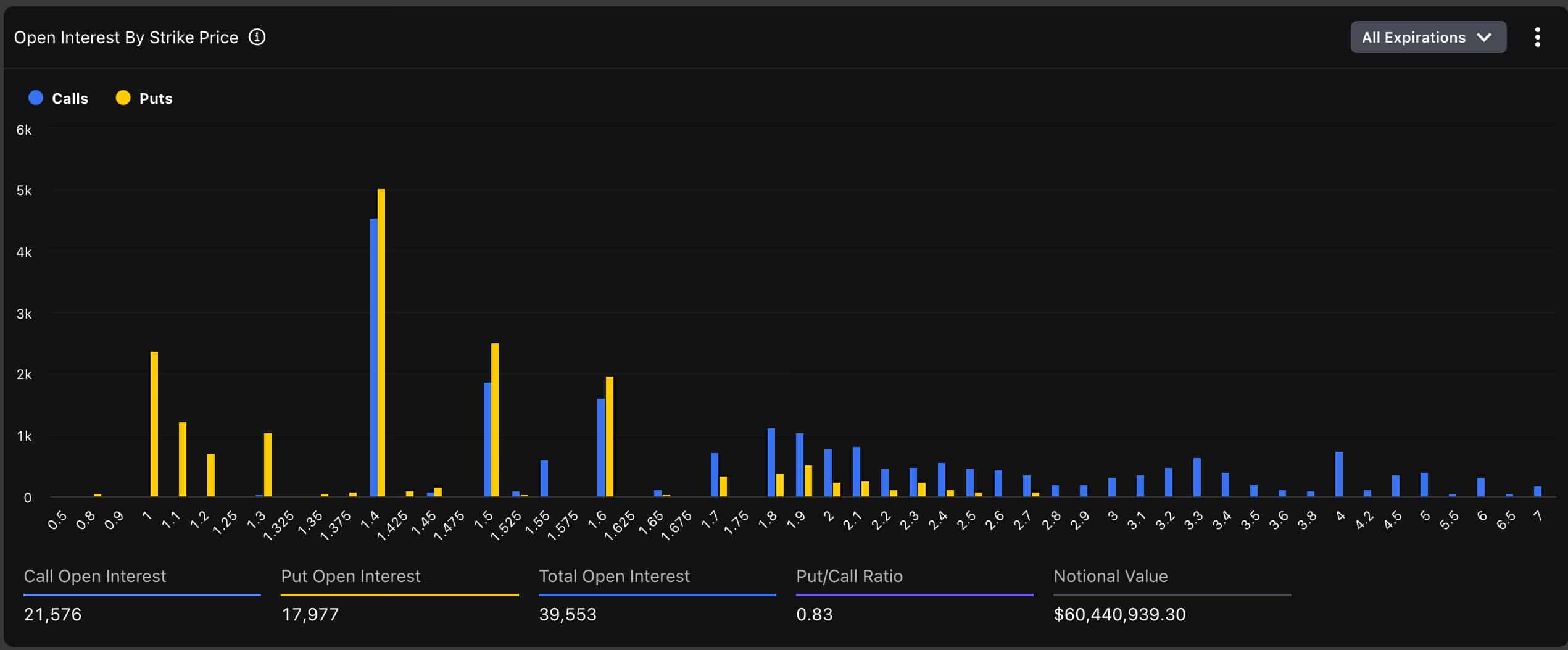
XRP price is trading tightly around the $1.45 mark, but derivatives data suggest the asset is being magnetized by a significant cluster of options open interest at the $1.40 strike. With approximately $14.6 million in contracts concentrated at this specific level, the market is facing a classic liquidity battleground that could dictate short-term volatility as expiry approaches. The mechanics of dealer hedging around this “pin” risk often suppress price discovery until the contracts settle, creating a coiled-spring effect on the subsequent move.
This concentration represents nearly a quarter of all open XRP options on major exchanges, flagging the $1.40 level as a critical pivot point for traders monitoring the March 27 expiry.
Data from derivatives exchange Deribit reveals an unusual clustering of activity at the $1.40 strike price. As of press time, traders hold approximately $6.95 million in call options and $7.69 million in put options at this level. This balanced positioning brings the total notional value of open contracts at the strike to roughly $14.6 million. Such a high concentration at a single price point typically forces market makers—the entities that facilitate these trades—to actively manage their risk exposure.
When open interest is this dense, market makers who are “short gamma” (meaning they have sold options to traders) must hedge their positions by buying the underlying asset as prices drop and selling as prices rise,, roughly around the strike price. This dynamic hedging activity creates a gravitational pull, often referred to as “pinning,” which anchors the spot price to the strike level as expiry nears. This phenomenon, common in mature fiat currency markets like EUR/USD, is becoming increasingly relevant in crypto derivatives as institutional participation grows.
The current structure creates a unique friction point. With nearly 25% of the exchange’s XRP open interest locked at $1.40, any significant deviation from this level before the March 27 expiry would require substantial spot volume to overcome dealers’ counter-cyclical hedging flows.
XRP Price Levels: Support and Resistance Around the Options Battleground
The options data provides a clear structural framework for XRP’s technical setup on the charts. A clean break above the psychological barrier at $1.50 is necessary to distance the price from the gravitational pull of the $1.40 strike. Conversely, the $1.40 level itself is now reinforced as formidable support, backed not just by technical buyers but by the mechanical hedging flows described above.
Technical indicators suggest the asset is in a consolidation phase. Recent price action has seen XRP form a triple bottom structure, a pattern that typically precedes a reversal or sustained accumulation. However, for this bullish structure to play out, XRP needs to hold the $1.40 floor. A failure here brings the $1.35 level into focus—a price point that aligns with recent futures pricing on regulated venues like Coinbase.
If the price remains pinned between $1.40 and $1.50, volatility indices (such as DVOL) would likely compress, setting the stage for an expansion move once the options expire and the dealer inventory is cleared.
Two Scenarios: What Happens if XRP Breaks the Options Strike
The binary nature of options expiry presents two distinct paths for price action over the coming week.
The Bullish Scenario: If XRP sustains trade above $1.50, the put options at the $1.40 strike will likely expire worthless. This would force market makers who are short puts to buy back their hedges, potentially adding fuel to a rally. A confirmed daily close above $1.50 with rising volume would validate this thesis, opening the door to a test of the $1.60-$1.65 resistance zone. In this case, the $14.6 million “wall” acts as a launchpad rather than a ceiling.
The Bearish Scenario: Conversely, if spot selling pressure drives the price decisively below $1.40, the dynamic flips. As the price drops through the strike, market makers who sold put options would be forced to sell the underlying asset closer to expiry to hedge their increasing exposure. This mechanical selling can exacerbate the downward move, triggering a “gamma slide.” In this scenario, a loss of the $1.40 support could see XRP rapidly retest lower liquidity zones around $1.30 or even $1.25.
What XRP Traders Need to Watch for Expiry
As the March 27 expiry approaches, traders should monitor open interest on Deribit and CME Group futures spread data. The spot price’s behavior relative to the $1.40 strike will serve as a leading indicator of momentum. Additionally, the growing maturity of the XRP market—evidenced by the launch of regulated futures and the integration of institutional treasury solutions by Ripple, suggests that derivatives data is becoming a more reliable signal for spot price direction than in previous cycles.
While the $1.40 level acts as a magnet today, the resolution of this positioning will likely dictate the trend heading into April. A clean expiry without a breakdown would reinforce investor confidence in the $1.40 floor, potentially inviting fresh capital allocation from funds waiting for the event risk to pass.
Disclaimer: Coinspeaker is committed to providing unbiased and transparent reporting. This article aims to deliver accurate and timely information but should not be taken as financial or investment advice. Since market conditions can change rapidly, we encourage you to verify information on your own and consult with a professional before making any decisions based on this content.
Daniel Frances is a technical writer and Web3 educator specializing in macroeconomics and DeFi mechanics. A crypto native since 2017, Daniel leverages his background in on-chain analytics to author evidence-based reports and deep-dive guides. He holds certifications from The Blockchain Council, and is dedicated to providing "information gain" that cuts through market hype to find real-world blockchain utility.
Major financial entities including BlackRock and Mastercard are reportedly assessing the XRP Ledger (XRPL) for potential integration into their digital asset strategies. Senior executive from XRPL Commons revealed that these industry giants are actively evaluating the network’s capabilities for supporting real-world financial applications, specifically focusing on cross-border payments and asset tokenization.
BlackRock and Mastercard Evaluation of Blockchain Utilities
The potential involvement of traditional finance giants in the XRPL ecosystem underscores a wider trend of institutional convergence with blockchain technology. Odelia Torteman, Director of Corporate Adoption at XRPL Commons, confirmed in a recent statement that firms such as BlackRock, Mastercard, and Franklin Templeton have expressed definitive interest in the ledger’s utility for enterprise operations.
This development aligns with broader institutional efforts to achieve blockchain maturity. For instance, BlackRock has steadily expanded its digital asset footprint, moving beyond simple spot products to explore deeper infrastructure plays.
Similarly, Ripple Labs has worked to de-risk the ecosystem for regulated players. Ripple’s acquisition of an EMI license in Luxembourg reinforces the compliance-first environment that risk-averse institutions require for settlement operations.
XRP Ledger Technology Designed for Cross-Border Settlement
The interest from Wall Street appears to stem from the ledger’s specific design architecture, which prioritizes speed, low transaction costs, and settlement finality over the general-purpose flexibility found on other networks. Torteman emphasized that the XRPL was “purpose-built for financial services,” focusing on transparent flows and institutional-grade settlement rather than being a retrofitted generalist network.
Recent technical enhancements have further tailored the network for enterprise use. The introduction of features like Token Escrow and Permissioned Domains reportedly allows institutions to engage with decentralized protocols while maintaining strict regulatory controls. These upgrades enable compliant asset issuance and controlled trading environments, which are essential prerequisites for tokenizing real-world assets (RWAs).
Furthermore, Ripple has continued to build out institutional-grade tools. Initiatives such as the Ripple Prime integration for institutional DeFi demonstrate how the ecosystem is creating bridges between traditional liquidity needs and on-chain mechanisms.
Potential Market Impact of Institutional Flows
If these evaluations mature into live integrations, the role of XRP$1.1024h volatility:0.2%Market cap:$68.45 BVol. 24h:$662.97 M
as a bridge currency could expand significantly. By utilizing XRP for cross-border settlement, institutions can potentially minimize the capital inefficiencies associated with pre-funding nostro and vostro accounts globally.
Market analysts are watching these developments closely, as genuine institutional utility often precedes sustained value appreciation. While XRP recently hit a 15-month low, the long-term accumulation thesis relies heavily on the success of these high-level enterprise pilots. Additionally, with forecasts predicting a mainstream tokenization boom within the next three years, the ledger’s specific focus on cross-border flows places it in a strategic position to capitalize on updates to legacy banking systems.
Disclaimer: Coinspeaker is committed to providing unbiased and transparent reporting. This article aims to deliver accurate and timely information but should not be taken as financial or investment advice. Since market conditions can change rapidly, we encourage you to verify information on your own and consult with a professional before making any decisions based on this content.
Daniel Frances is a technical writer and Web3 educator specializing in macroeconomics and DeFi mechanics. A crypto native since 2017, Daniel leverages his background in on-chain analytics to author evidence-based reports and deep-dive guides. He holds certifications from The Blockchain Council, and is dedicated to providing "information gain" that cuts through market hype to find real-world blockchain utility.
According to the Madras High Court, cryptocurrencies are regarded as property, citing fundamental property rights. It also clarified that the customer’s XRP and what was stolen from WazirX are “completely different” digital assets.
Madras High Court Takes Side With XRP Holder
On October 25, an order was delivered by the Madras High Court, stating that WazirX was barred from redistributing 3,532 XRP holdings, which belong to a customer, to absorb the platform losses.
The stash in question is worth roughly $9,400. By this declaration, Justice N. Anand Venkatesh for the court has granted the user “interim protection.”
For context, the Indian crypto exchange is trying to get its users to absorb a portion of the loss that it suffered following a $230 million exploit in July 2024.
This includes even those who do not hold ERC-20 tokens, like the XRP holders. It calls this move a “socialization of losses” in line with its restructuring plan.
Judge Venkatesh hardly spoke against the plan, but he also did not agree that those without ERC-20 tokens should bear any loss.
In his opinion, the plan should not apply to this set of people because the siphoned digital assets were ERC-20 tokens, which are “completely different cryptocurrencies.”
Cryptocurrency Is Affected by Fundamental Property Rights
On the premise that digital assets can be possessed, the Madras High Court noted that they are categorized as property.
Based on fundamental property rights, which the court centered its ruling on, users’ XRP assets should remain theirs. In no instance should it be used to compensate for WazirX’s operational failures.
In addition to taking sides with the XRP holder, the court concluded that he is “entitled to an interim protection” under the country’s Arbitration and Conciliation Act.
Meanwhile, WazirX resumed operations on October 24 after the High Court of Singapore approved its restructuring plan.
To make its relaunch significant, the exchange introduced zero trading fees, which will last for at least 30 days. It is hoping to restore full functionality by October 27.
WazirX founder Nischal Shetty noted that the zero trading fee initiative is aimed at rebuilding confidence. He hopes that users can return to trading freely as the platform reopens.
Disclaimer: Coinspeaker is committed to providing unbiased and transparent reporting. This article aims to deliver accurate and timely information but should not be taken as financial or investment advice. Since market conditions can change rapidly, we encourage you to verify information on your own and consult with a professional before making any decisions based on this content.
Benjamin Godfrey is a blockchain enthusiast and journalist who relishes writing about the real life applications of blockchain technology and innovations to drive general acceptance and worldwide integration of the emerging technology. His desire to educate people about cryptocurrencies inspires his contributions to renowned blockchain media and sites.