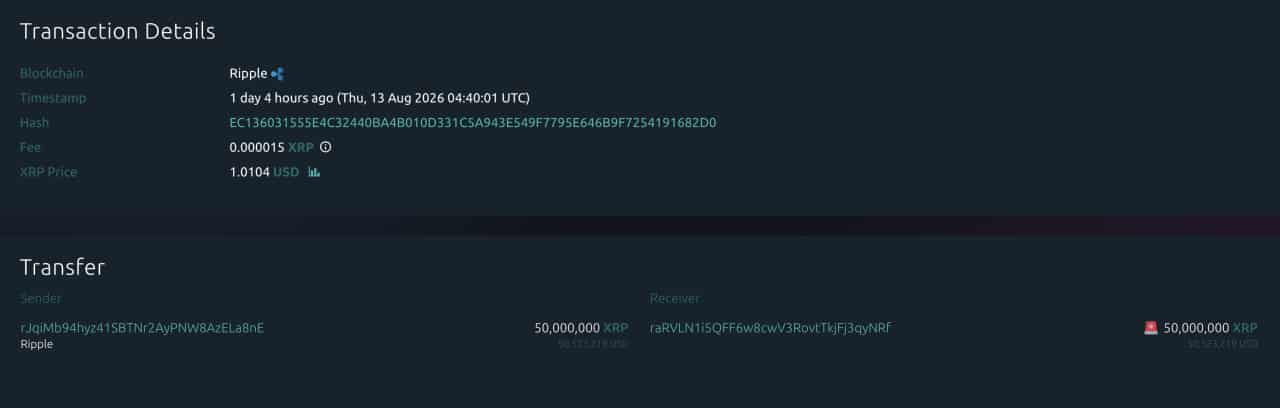
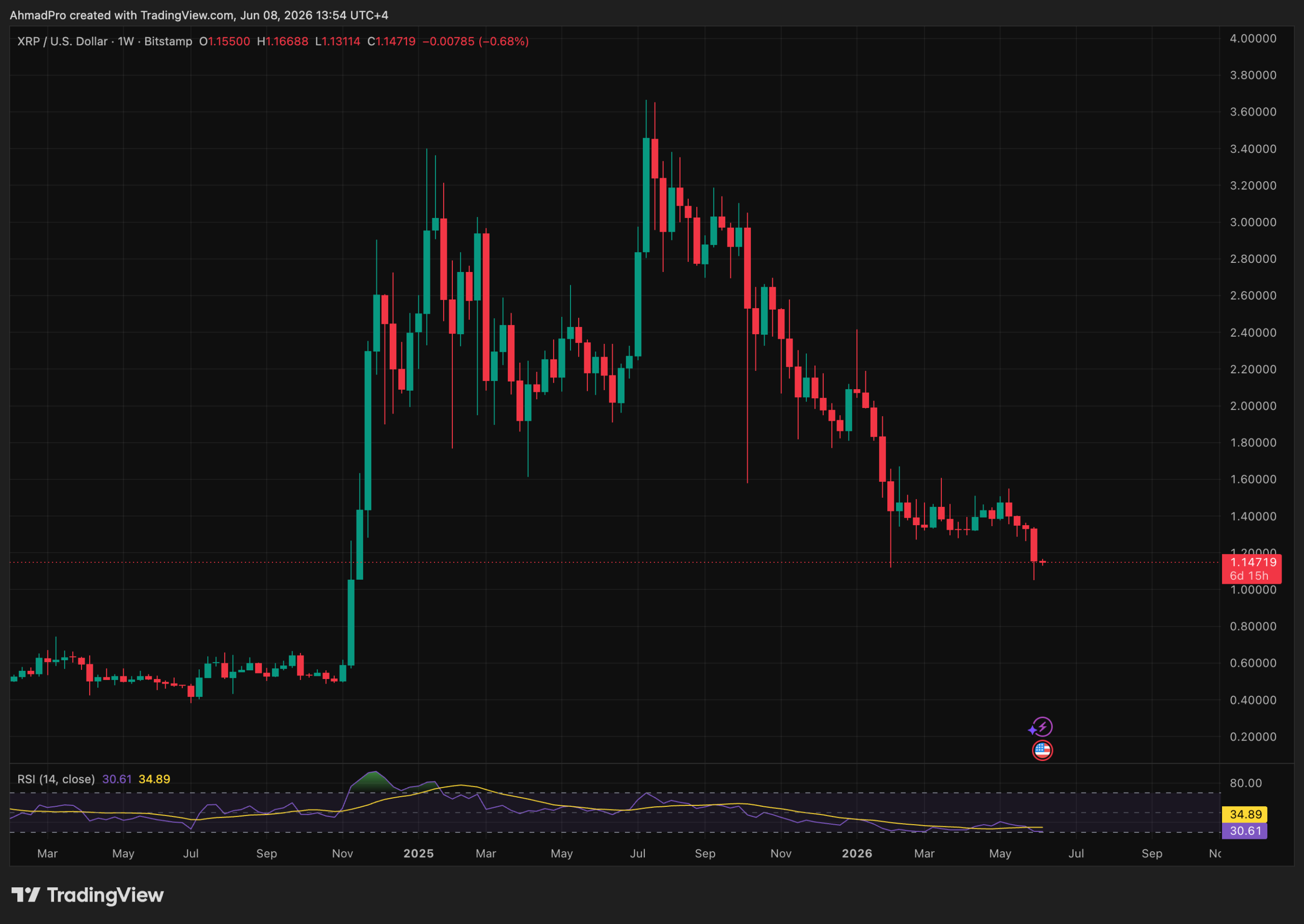
A Ripple-linked wallet moved 50 million XRP, worth more than $50 million at the time, to an internal subwallet on August 13. The movement came as XRP closed near $1.00, its lowest daily close since November 2024, while aggregate derivatives open interest climbed toward $986.48 million.
Transaction data showed that the Ripple (50) wallet first transferred the XRP to raRVLN1, an internal subwallet. The subsequent movements drew attention because XRP was trading near a key support area while derivatives data showed traders leaning heavily toward long positions.
The raRVLN1 subwallet later distributed XRP, primarily in batches of 1 million tokens per transaction, to the rBNCyN address, which XRPScan data ties to Binance. Ripple-linked wallets sent a combined 23 million XRP to the rBNCyN wallet during the week, after which the tokens were moved on to Binance.
The activity likely reflects an operational liquidity wallet used for on-demand liquidity or market-making purposes. The transfer trail shows movement between related wallets and toward a Binance-linked address, but the on-chain data does not by itself establish the purpose of every transfer.
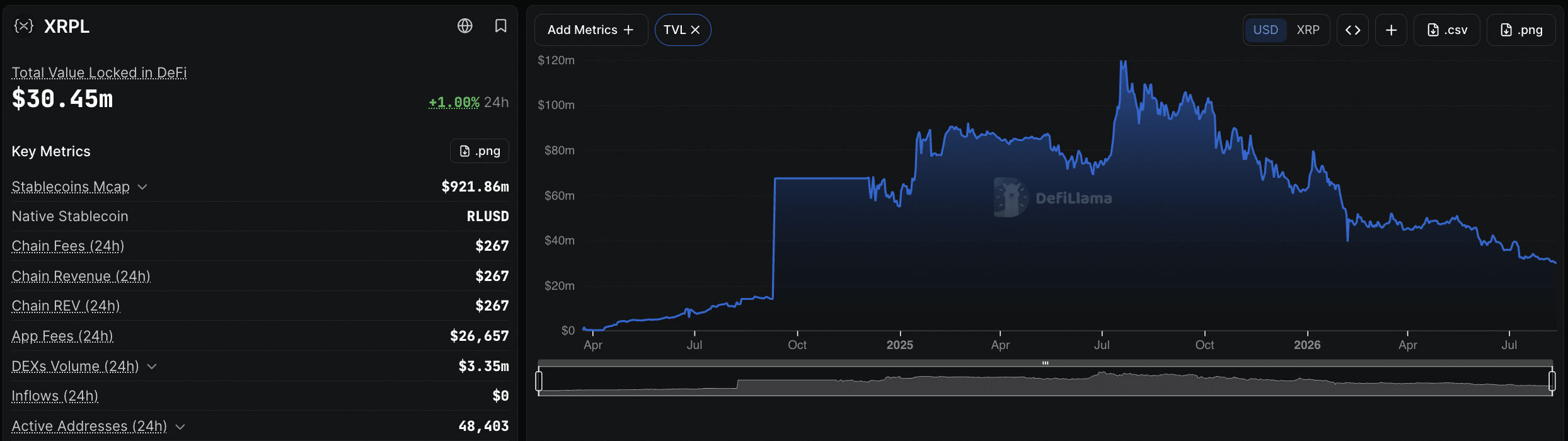
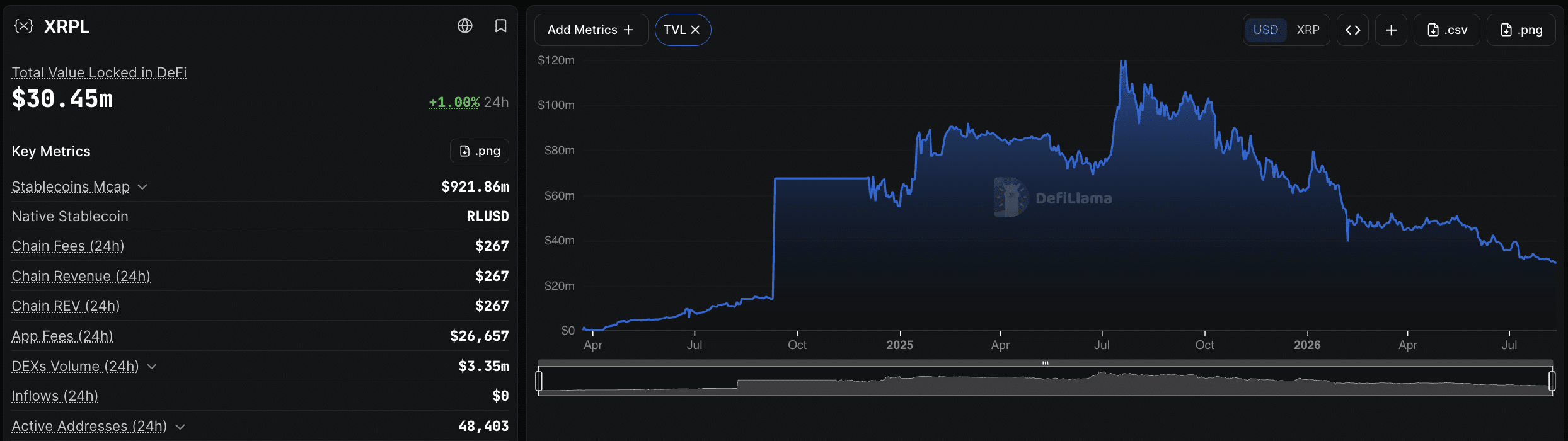
Active addresses on the XRP Ledger averaged about 35,700 per day in August, up from roughly 26,400 in July, while new-address creation remained nearly unchanged near 2,260 per day. The pattern suggests that existing users were becoming more active rather than indicating a broad wave of new users joining the network.
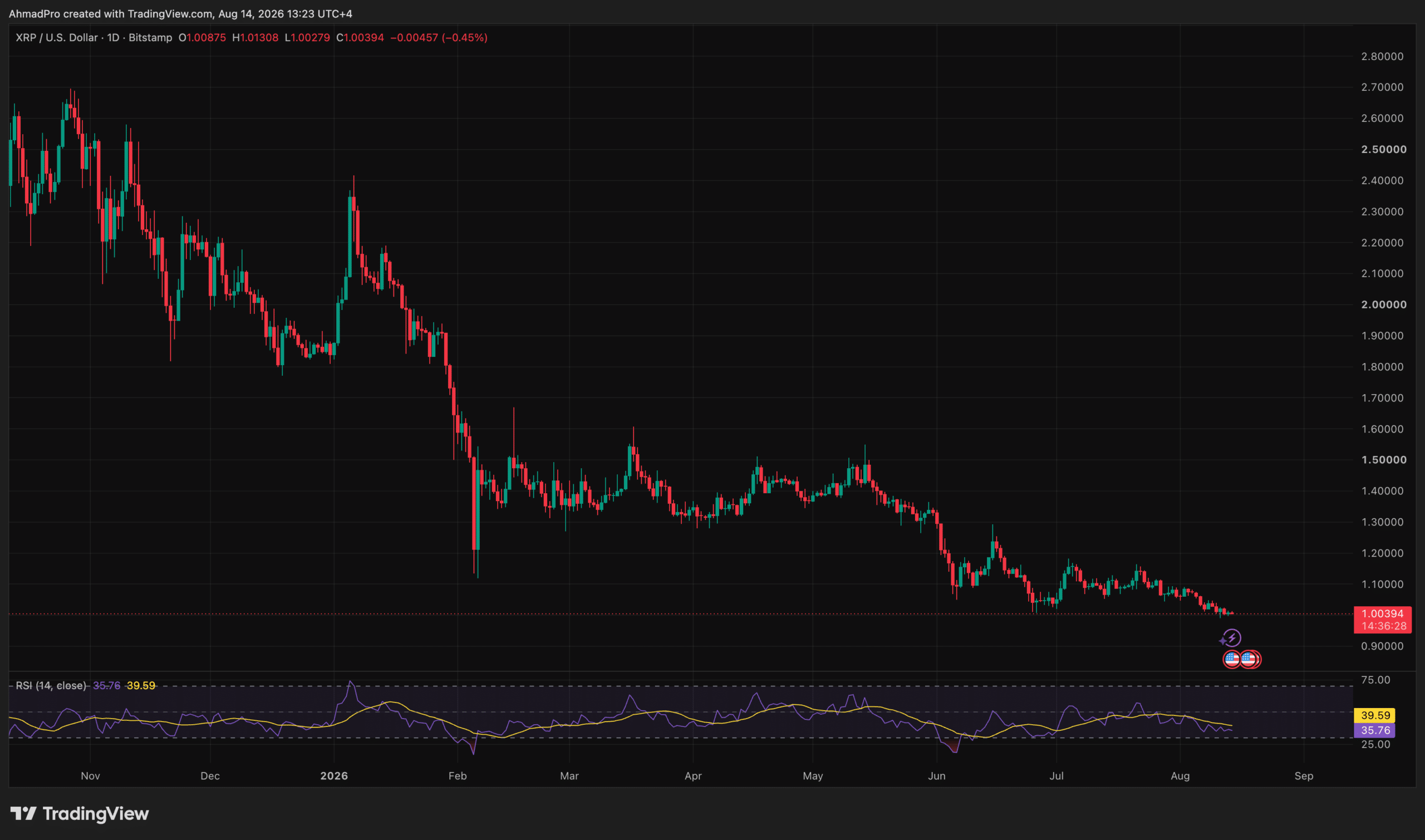
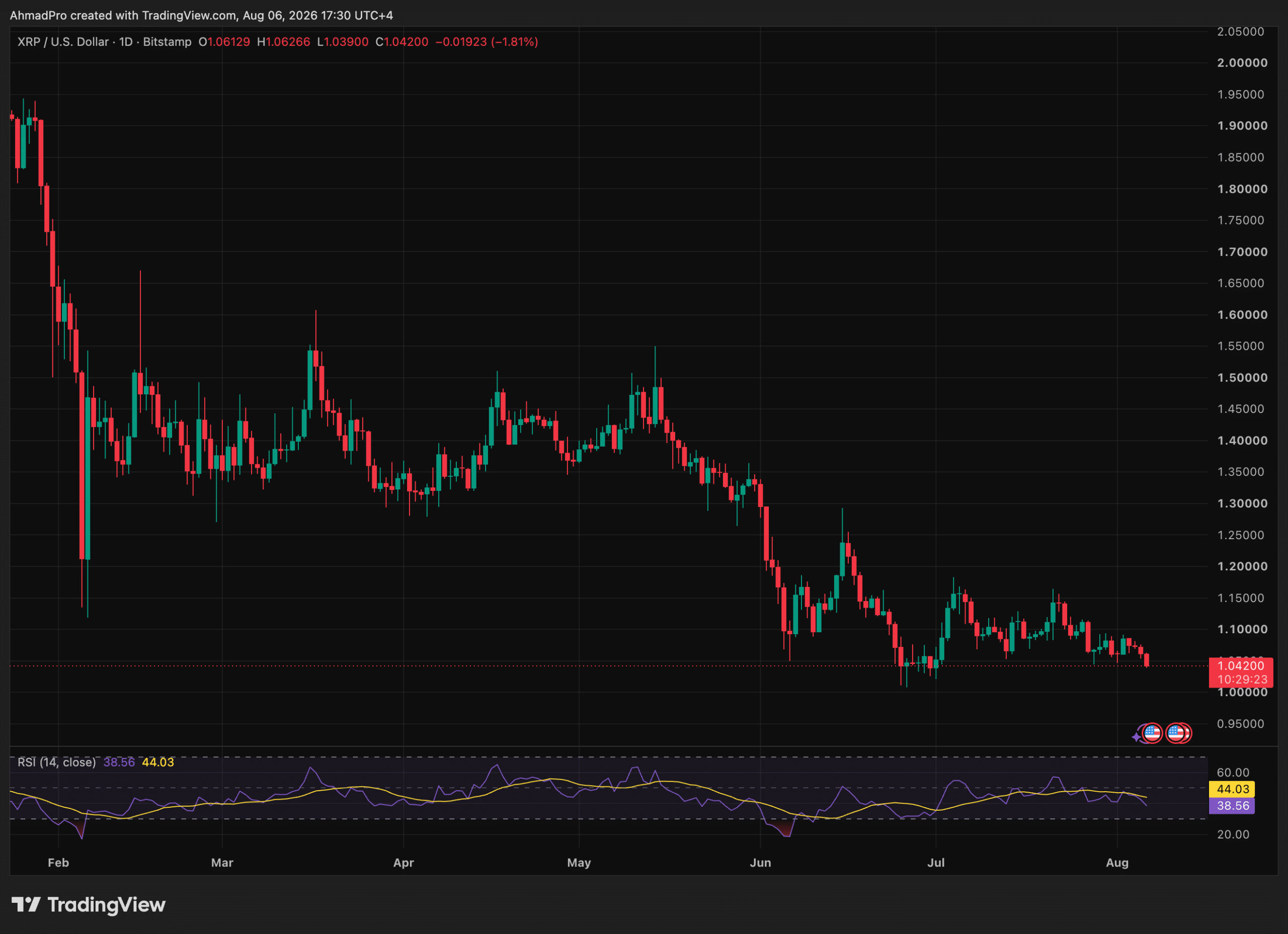
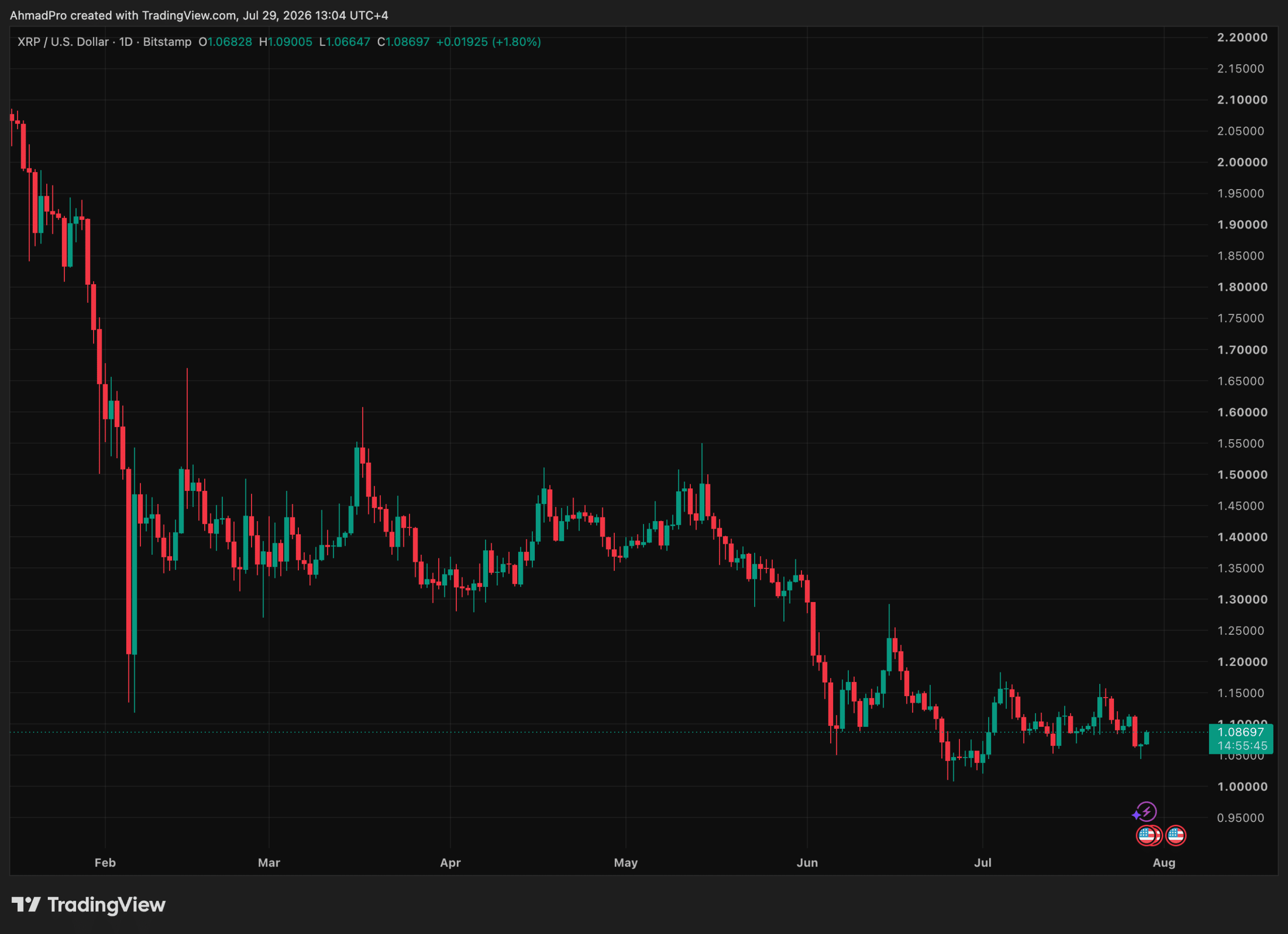
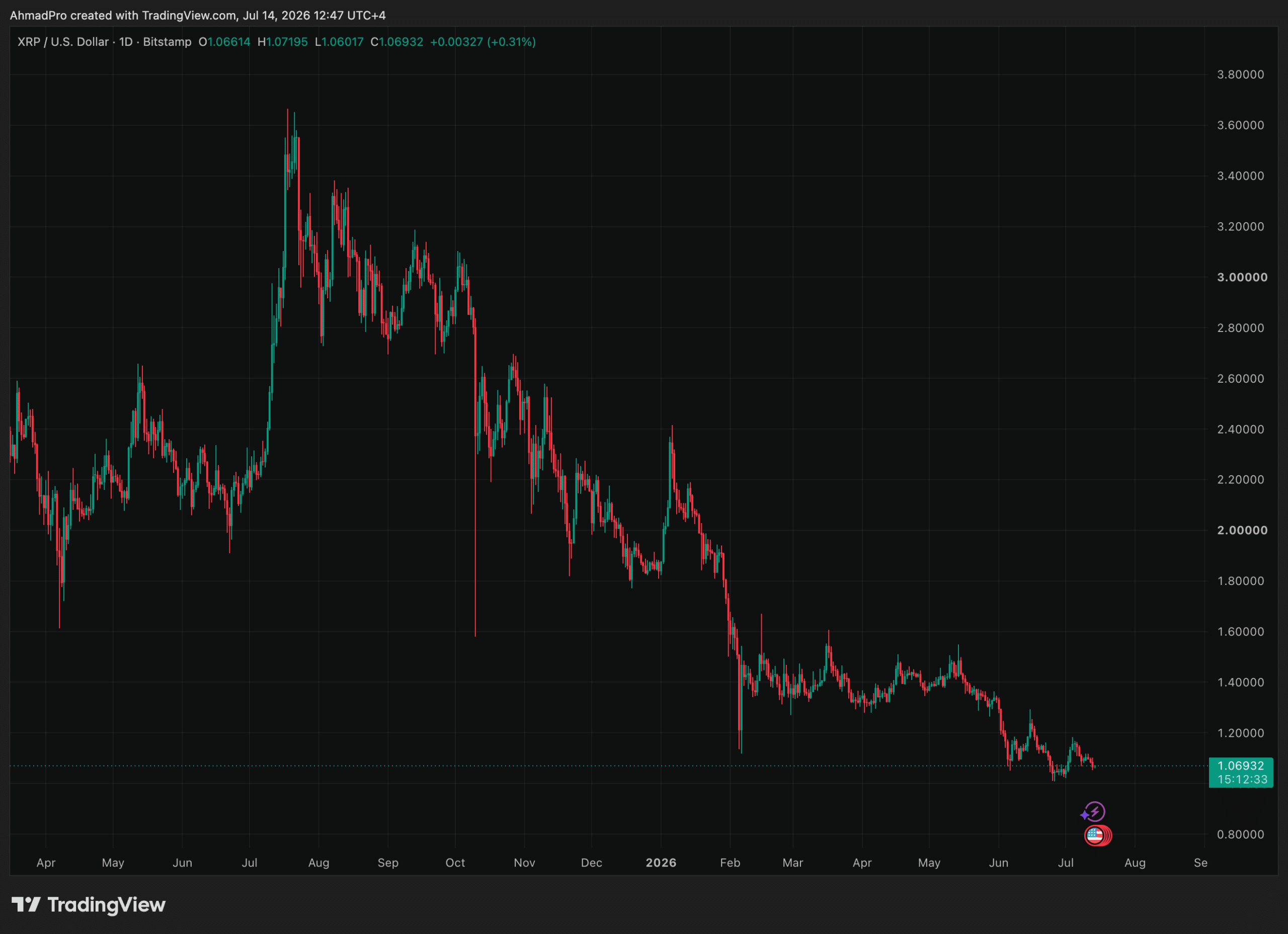
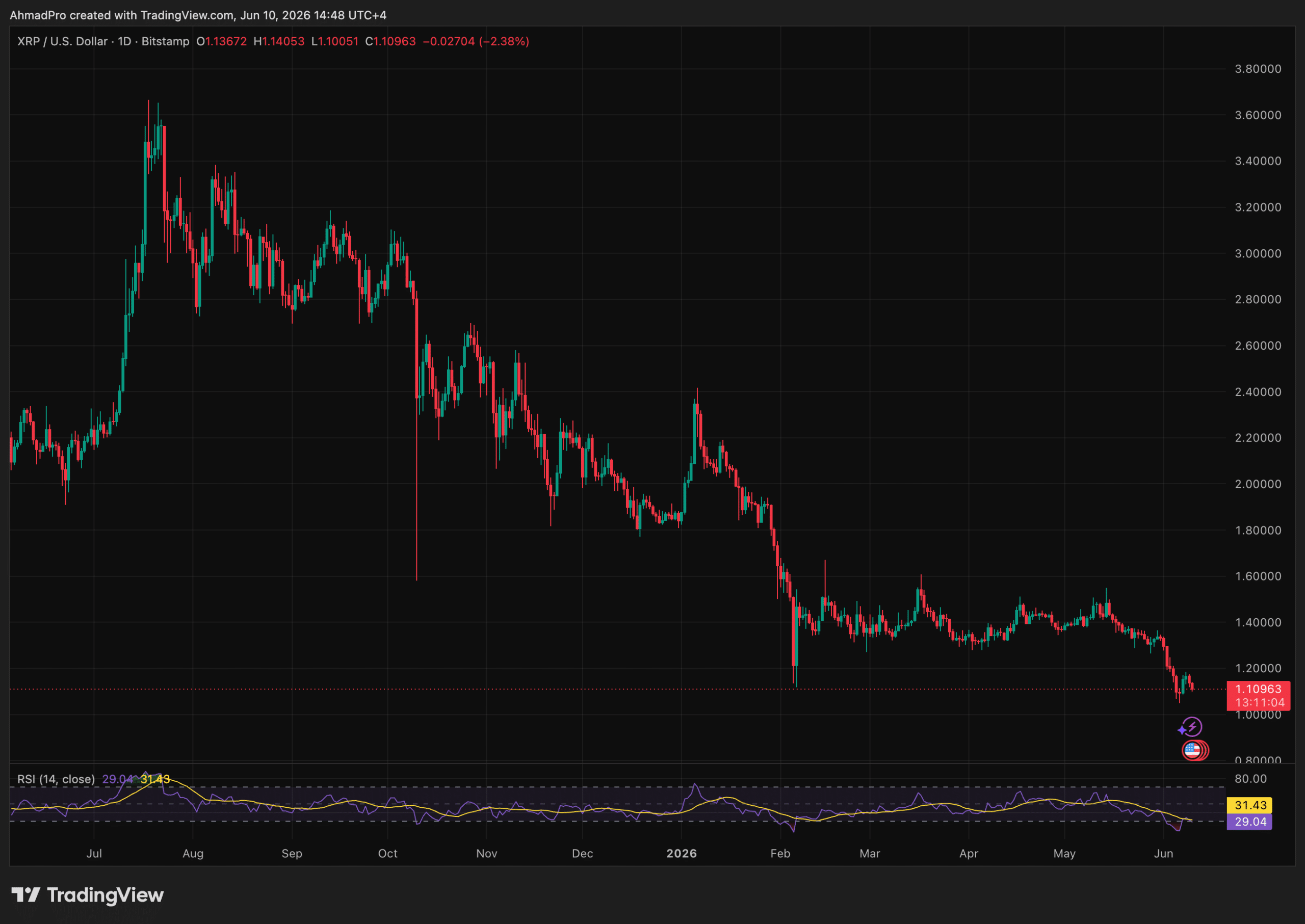
XRP was trading within a descending structure, with $1.022 identified as first resistance. A move above that level could open a path toward the $1.05-$1.07 zone, while a decisive move below $1.00 could expose the token to further downside.
The long/short ratio stood at 3.095 and the funding rate was positive at 0.0087, both indicating a strong long bias among derivatives traders. The source data also noted that crowded long positions could add liquidation risk if support fails.
Price Levels and Derivatives Positioning Remain in Focus
The $1.00-$1.015 area remained a key range for XRP. Holding that zone could keep the token in consolidation, while a break below it could lead to a deeper decline.
On the upside, a move above $1.022 would be the first important recovery signal and could bring the $1.05-$1.07 resistance area into focus.
Source: XRPUSD / Tradingview
With open interest near $986.48 million and long positioning elevated, the market’s reaction around support may be especially important.
The wallet activity, network data and derivatives positioning together show XRP facing a technical test near $1.00 as on-chain transfers continue to route funds through Ripple-linked addresses and toward Binance.
Disclaimer: Coinspeaker is committed to providing unbiased and transparent reporting. This article aims to deliver accurate and timely information but should not be taken as financial or investment advice. Since market conditions can change rapidly, we encourage you to verify information on your own and consult with a professional before making any decisions based on this content.
Daniel Frances is a technical writer and Web3 educator specializing in macroeconomics and DeFi mechanics. A crypto native since 2017, Daniel leverages his background in on-chain analytics to author evidence-based reports and deep-dive guides. He holds certifications from The Blockchain Council, and is dedicated to providing "information gain" that cuts through market hype to find real-world blockchain utility.
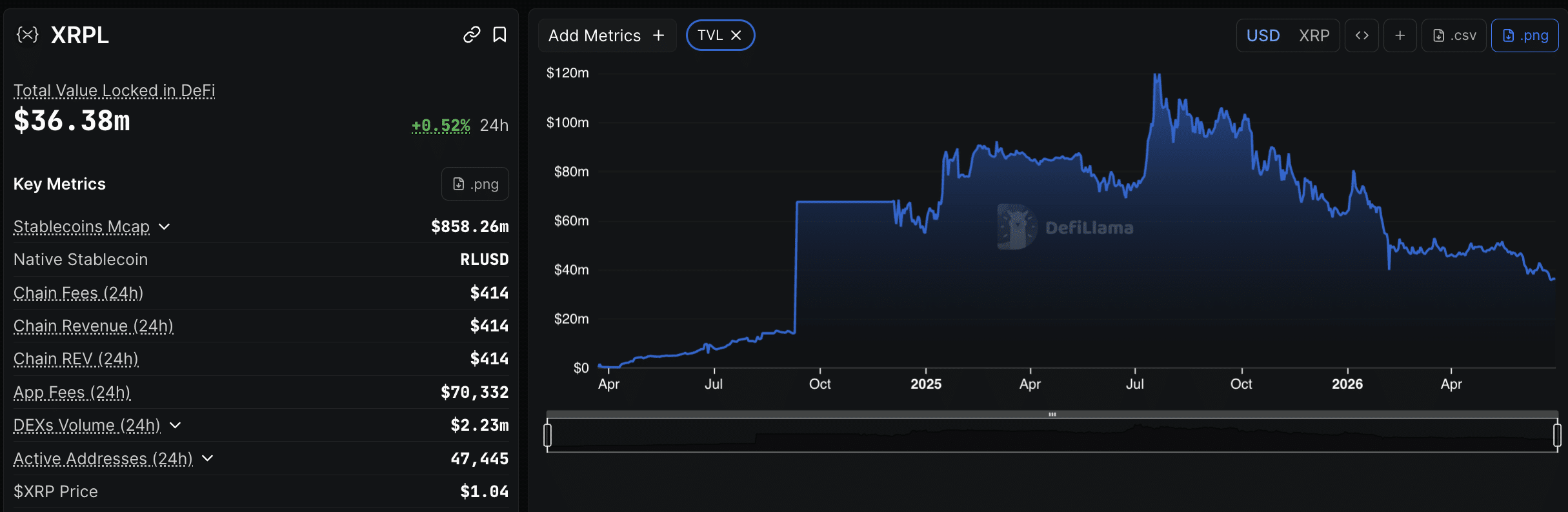
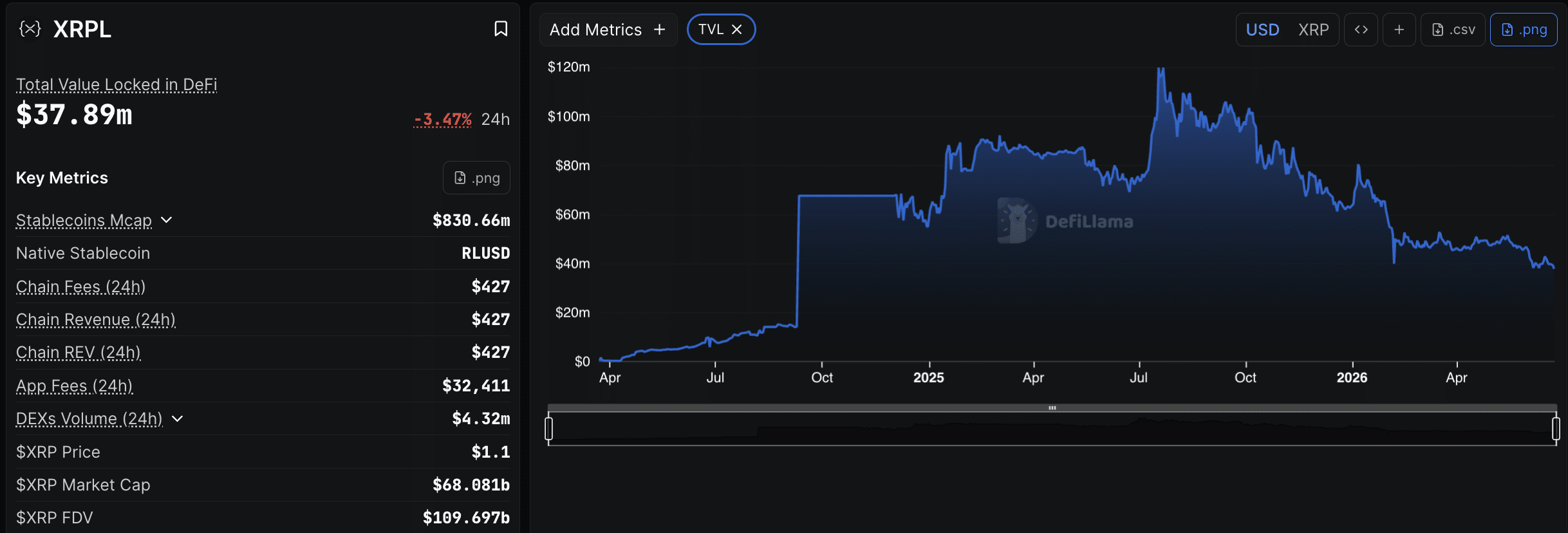
Daily successful payments on the XRP Ledger crossed 2.6 million for the first time in roughly four months, according to reporting from The Crypto Basic, aggregated by cryptorank.io on August 10, 2026. XRP is trading at $1.01 as this news dropped, with bullish on-chain metrics unable to provide the much-needed boost to price action.
The increase follows a prolonged period in which XRP traded at lower price levels while activity on the XRP Ledger declined. The latest reading points to a pickup in payments activity after that downtrend.
$XRP is showing a different kind of activity on the ledger today.
In the latest 24-hour window, XRPL processed about 1.45 million transactions. Around 495,000 were payments. More than 835,000 were OfferCreate transactions.
The 2.6 million figure was described as the highest level for daily successful XRP payments in four months. The Crypto Basic report, as aggregated by cryptorank.io, linked the increase to renewed activity on the XRP Ledger despite XRP’s extended price decline.
The reading adds to a picture of elevated activity on the network, although the available data covers a single daily count. Earlier XRP Ledger figures show that payments are one component of wider transaction activity, alongside decentralized exchange operations and account-related transactions.
June Data Showed Payments Leading Network Activity
Separate data from XRPScan, reported by Yahoo Finance on June 16, 2026, showed the XRP Ledger processed 769,646 total transactions that day. Successful payments reached about 427,000, accounting for more than half of the total activity reported in the snapshot.
The network averaged 23.49 transactions per second at the time of that snapshot, with ledgers closing every 3.82 seconds. Decentralized exchange offer creation was the second-largest source of activity, while account operations also contributed to the total transaction count.
The June 16 figures followed a June 15 session with 900,189 total transactions and 403,422 payments, according to the report. Both sessions recorded more than 750,000 total transactions, leaving the 1 million daily transaction threshold within reach if payments and decentralized exchange activity continue to build.
Ripple’s Revenue Target Beyond XRP
$XRP just closed at its lowest since November 2024, and the on-chain read is more interesting than the price.
📉 Price closed at ~$1.00 on Aug 12, the lowest daily close since Nov 2024 and roughly 69% below the January 2025 peak near $3.30.
Ripple is also pursuing institutional infrastructure beyond the token itself. Yahoo Finance reported that Ripple CEO Brad Garlinghouse said the company expects to end 2026 with a $1Bn annualized revenue run rate, excluding XRP held on Ripple’s balance sheet.
The target follows Ripple’s $1.25Bn acquisition of prime broker Hidden Road in 2025. The report said the acquisition added credit, clearing and prime-brokerage services to Ripple’s existing payments business.
For the XRP Ledger, the latest 2.6 million-payment reading marks a notable increase from the levels described in the four-month comparison.
The June data also show that total ledger activity includes payments, decentralized exchange transactions and other operations, providing context for the network’s broader throughput figures.
Disclaimer: Coinspeaker is committed to providing unbiased and transparent reporting. This article aims to deliver accurate and timely information but should not be taken as financial or investment advice. Since market conditions can change rapidly, we encourage you to verify information on your own and consult with a professional before making any decisions based on this content.
Daniel Frances is a technical writer and Web3 educator specializing in macroeconomics and DeFi mechanics. A crypto native since 2017, Daniel leverages his background in on-chain analytics to author evidence-based reports and deep-dive guides. He holds certifications from The Blockchain Council, and is dedicated to providing "information gain" that cuts through market hype to find real-world blockchain utility.
In XRP news today, Aviva Investors, the global asset management arm of Aviva plc, has issued a tokenized share class of its US Dollar Liquidity Fund on the XRP Ledger (XRPL) in collaboration with Ripple, with the structure approved by the Central Bank of Ireland, according to reporting from Ledger Insights and Structured Retail Products.
This is not simply a proof-of-concept announcement. It is the operational follow-through on a partnership Aviva Investors and Ripple disclosed on February 11, 2026, marking the asset manager’s first venture into fund tokenization and one of Ripple’s first collaborations with a European investment manager.
This news dropped as XRP USD climbed +1.3% over the past 24 hours. However, this modest increase still has the token sitting precariously above its 18-month support level of $1. It is currently trading for $1.02 with a daily trading volume of $1.26Bn.
Kamilah breaks down how Aviva Investors and the UK national treasury just moved Ripple onto the ripple:native ledger in the same year
"Aviva Investors manages around 253 billion pounds and is the asset management arm of one of the largest insurers in the United Kingdom."
Per Ledger Insights, the new share class sits within Aviva Investors’ existing US Dollar Liquidity Fund, a European UCITS money market fund whose other share classes already hold approximately $1.23Bn in assets under management.
The tokenized class carries a minimum investment threshold and functions as a digital twin: on-chain tokens mirror a conventional book-entry register, with the two reconciled daily rather than existing as an independently transferable instrument.
Structured Retail Products reports that the tokens are not freely transferable and are available only to eligible investors holding digital wallets.
Komainu has been named as the regulated institutional digital-asset custodian for the tokenized layer, while Bank of New York Mellon continues to serve as custodian for the underlying fund assets, with tokenization infrastructure supplied by Licuido.
The underlying portfolio remains a conventional short-term, high-grade US dollar debt allocation; XRP itself is not held as an underlying asset, and XRPL functions here as issuance and recordkeeping infrastructure rather than an investment exposure.
After rejecting below the $1.06 resistance ceiling, $XRP has now printed a new 2026 low. August is historically one of XRP's weakest months, especially during midterms (behind June). So far, this time has been no different. If we get the sweep below $1.00, we back up the truck 🛻 https://t.co/HsrpoFP8rOpic.twitter.com/xms57ylAYw
The collaboration was first announced by Aviva Investors and Ripple on February 11, 2026, with both firms framing it as a long-term effort to bring tokenized funds to XRPL through 2026 and beyond.
Jill Barber, Chief Distribution Officer at Aviva Investors, said the firm was “really delighted to announce our collaboration with Ripple,” adding that tokenization could bring “improvements in terms of both time and cost efficiency” and that she believed “tokenized funds can be hugely beneficial to our clients.”
Nigel Khakoo, Vice President of Trading and Markets at Ripple, said tokenization is “now moving from experimentation to large-scale production,” and that XRPL’s “built-in compliance tools, near-instant settlement, and native liquidity” provide infrastructure suited to institutional assets.
At the time of the February announcement, Ripple cited XRPL as having processed more than 4 billion transactions since 2012 across over 7 million active wallets, maintained by 120 independent validators.
In other XRP news, the Aviva launch extends a pattern of asset managers using XRPL as a settlement and issuance layer for regulated products rather than as a venue for XRP exposure itself.
We suspect the non-transferable, reconciled-daily design of Aviva’s token reflects a deliberately conservative first step, with collateral mobility and 24/7 transferability likely reserved for later iterations once the regulatory and operational track record is established.
Disclaimer: Coinspeaker is committed to providing unbiased and transparent reporting. This article aims to deliver accurate and timely information but should not be taken as financial or investment advice. Since market conditions can change rapidly, we encourage you to verify information on your own and consult with a professional before making any decisions based on this content.
Daniel Frances is a technical writer and Web3 educator specializing in macroeconomics and DeFi mechanics. A crypto native since 2017, Daniel leverages his background in on-chain analytics to author evidence-based reports and deep-dive guides. He holds certifications from The Blockchain Council, and is dedicated to providing "information gain" that cuts through market hype to find real-world blockchain utility.
In the latest Ripple news, XRPprice entered August 2026 at $1.06, down approximately 43% from its January high of $2.41, with the $1.00 support level now functioning as the only demand zone bulls have successfully defended across the entire calendar year. The token’s weekly momentum readings have fallen to levels last seen in the 2022 bear market when XRP traded near $0.29.
This is not simply a correction after a strong run. It is a structural question about whether the 2026 XRP bull thesis, built on ETF inflows, regulatory clarity, and institutional adoption, can survive contact with the data now available.
XRP Technical Setup: Death Cross, Descending Channel, and the $1.20 Cap
The XRP price is trading below both its 50-day simple moving average near $1.21 and its 200-day SMA near $1.37, a configuration that technical analysts describe as a death cross, implying continued selling pressure absent a significant catalyst.
The 14-day Relative Strength Index sits near 38–41, per the Bitcoin Foundation’s June 2026 market analysis, indicating a market that is weakening but has not yet reached deeply oversold territory where mean-reversion buying typically accelerates.
Since late June, XRP has been confined between $1.00 and $1.18, with every attempted rally capped at the $1.18–$1.20 resistance band. That ceiling is explored in technical analysis of XRP’s descending channel structure, which shows repeated failures to break above the channel’s upper boundary, each failure reinforcing the compression.
The next meaningful resistance above $1.20 sits at $1.45, a level the Bitcoin Foundation analysis describes as one that could materially improve the longer-term technical picture if reclaimed.
Ripple News: XRP ETF Flows and the CLARITY Act Delay, Catalysts That Didn’t Arrive
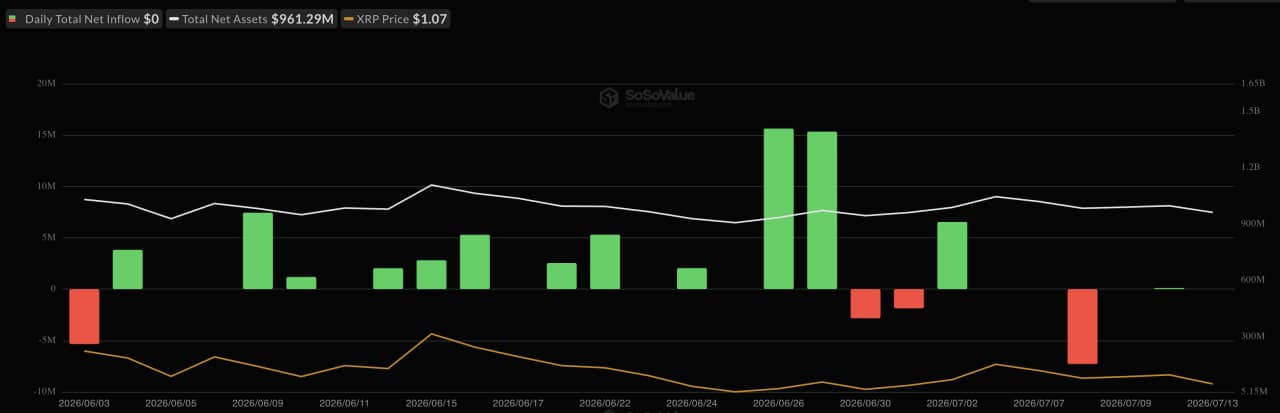
The institutional demand story that underpinned most XRP price analysis heading into 2026 has not materialized at scale. Spot XRP ETFs recorded zero flows on 11 of July’s 22 trading days, taking in just $27.29 million for the entire month, according to SoSoValue data , against the $666 million the same vehicles gathered in their first month of trading in November 2025.
That collapse in XRP ETF inflows has stripped out the institutional buying momentum that analysts assumed would anchor XRP price above $1.20.
On the legislative side, the Senate set aside the CLARITY Act on July 27 to address other business before its recess, per 247 Wall St. The bill, which would permanently classify XRP as a commodity under federal law, cannot receive the vote institutional participants have been waiting on until lawmakers return in the fall.
The CLARITY Act delay removes the one regulatory catalyst that could have prompted a re-rating of XRP through August.
Sentiment and On-Chain Context: Exhausted Sellers, Absent Buyers
Approximately 60% of XRP’s circulating supply is held at a loss, with an average cost basis near $1.48, according to 247 Wall St. That cohort distribution is historically consistent with late-stage capitulation, holders sitting on realized losses of that depth have largely decided not to sell.
XRP held on exchanges has also dropped to roughly 1.6 billion tokens, its lowest level in seven years and approximately half the 3.76 billion parked there in October 2025, per CryptoQuant data.
The analytical question is no longer whether sellers are exhausted. It is whether buyers return before the $1 floor gives way on thin volume.
Disclaimer: Coinspeaker is committed to providing unbiased and transparent reporting. This article aims to deliver accurate and timely information but should not be taken as financial or investment advice. Since market conditions can change rapidly, we encourage you to verify information on your own and consult with a professional before making any decisions based on this content.
Daniel Frances is a technical writer and Web3 educator specializing in macroeconomics and DeFi mechanics. A crypto native since 2017, Daniel leverages his background in on-chain analytics to author evidence-based reports and deep-dive guides. He holds certifications from The Blockchain Council, and is dedicated to providing "information gain" that cuts through market hype to find real-world blockchain utility.
The Senate postponed the CLARITY Act before its August recess, threatening Standard Chartered’s $8 XRP target and deferring key institutional ETF inflows.
The U.S. Senate formally set aside the Digital Asset Market CLARITY Act on July 28, 2026, redirecting its floor schedule toward a Russia sanctions bill and federal nominations, effectively foreclosing a vote before the chamber’s August 7 recess begins – and with it, any near-term statutory path to cementing XRP commodity classification in federal law.
This is not simply a scheduling casualty. It is a structural inflection point for an asset class whose institutional buildout, custody products, bank balance-sheet treatment, and spot XRP ETF inflows – depends on legislative permanence that agency-level rulings cannot reliably provide.
CLARITY Act News: How the Senate Calendar Closed Before a Cloture Vote Was Filed
The CLARITY Act reached the Senate floor calendar on June 1, 2026, as Calendar No. 423, after the Senate Banking, Housing, and Urban Affairs Committee advanced it on May 14 by a 15–9 vote – all 13 Republicans joined by Democrats Ruben Gallego of Arizona and Angela Alsobrooks of Maryland, both of whom conditioned broader support on stronger ethics provisions.
Senate Majority Leader John Thune had not filed a cloture motion as of mid-July, and the bill needed 60 votes to clear that threshold, with confirmed support estimated at roughly 51 at the time of shelving.
UPDATE: The CLARITY Act has been pushed back further, the Senate is now prioritizing nominations and a Russia sanctions bill, leaving crypto legislation unlikely to see floor time before next week at the earliest. pic.twitter.com/cQakjnv2l5
Polymarket odds for Senate passage peaked at 43% on July 21, briefly lifted when the White House signaled openness to the bill’s ethics provision, before settling near 42% as the recess deadline approached. The ethics clause dispute – centered on whether state attorneys general could pursue Department of Justice enforcement actions – proved the final sticking point, with Republicans and the White House withdrawing that provision before any agreement was reached.
Galaxy Digital’s policy research team has placed the odds of CLARITY becoming law in 2026 at roughly even or lower, citing the cloture math and the multi-step reconciliation still required between the Banking Committee draft, the Senate Agriculture Committee’s Digital Commodity Intermediaries Act – which the Agriculture panel advanced on January 29, 2026, by a 12–11 party-line vote – and the House-passed version (H.R. 3633), which cleared with a 294–134 bipartisan majority in July 2025.
XRP Price and the Standard Chartered Conditional: What Statutory Permanence Was Actually Worth
XRP was trading near $1.08 on Binance as of July 29, down roughly 8% over the prior week, with a 24-hour range of $1.0450 to $1.0679. The token peaked near $3.40 in mid-2025 and has traced lower highs and lower lows since, with a confirmed death cross – the 50-day exponential moving average crossing below the 200-day – still in place.
The ADX reading of 11.2 reflects one of the weakest trend readings of the summer; sub-20 readings indicate a trendless, choppy environment prone to false breakouts.
Standard Chartered’s $8 XRP price target is conditional on $10 billion in cumulative spot ETF inflows, with its analysts attributing $4 billion to $8 billion of that figure specifically to CLARITY passage unlocking institutional product development.
Without a floor vote before the recess, that inflow scenario is deferred. XRP’s recent slide toward the $1.06–$1.08 range reflects both the legislative setback and broader risk-off positioning ahead of today’s FOMC decision.
Ripple secured agency-level commodity treatment for XRP following the SEC’s settled litigation in 2025 and a joint SEC-CFTC determination in March 2026 that XRP is not a security – but that status rests on regulatory releases, not statute. A future administration retains the discretion to revisit it. CLARITY would embed the classification in the U.S. Code, requiring new legislation to reverse, which is the durability that institutional custodians and ETF issuers require before committing product infrastructure.
Macro Overlay: The Fed Rate Decision and What a Hawkish Hold Implies
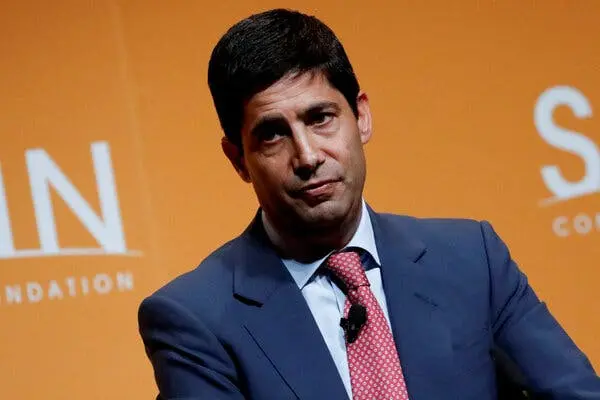
Fed Chair Kevin Warsh presides over his second FOMC meeting today, July 29, with the policy rate widely expected to hold at 3.50%–3.75%. CME FedWatch hike probability reached approximately 38% last weekend – the highest reading of this cycle – before pulling back slightly. Bitcoin ETF outflows and broader crypto selling pressure have tracked the repricing of rate expectations, with Bitcoin near $63,400 as of Tuesday.
Former Federal Reserve Governor Kevin Warsh.
A dovish hold with language hinting at a September cut could lift XRP toward the $1.10–$1.12 Fibonacci golden zone. A hawkish statement or dissenting vote in favor of a hike extends the sell-off toward the next support cluster at $1.0125 and $0.9711. Neither scenario substitutes for the legislative catalyst that the market has now lost until at least late 2026.
We suspect the more consequential variable for crypto regulation timelines is not the August recess itself but the midterm election calendar that follows it: a compressed fall legislative window leaves CLARITY structurally vulnerable to slipping into the next Congress, where the entire Senate coalition would need to be rebuilt from scratch.
Disclaimer: Coinspeaker is committed to providing unbiased and transparent reporting. This article aims to deliver accurate and timely information but should not be taken as financial or investment advice. Since market conditions can change rapidly, we encourage you to verify information on your own and consult with a professional before making any decisions based on this content.
Neil is a professional cryptocurrency content writer with years of experience. He has written for various cryptocurrency websites to report on breaking news, and been hired by all sorts of cryptocurrency projects, to create content that would increase their exposure and attract more potential investors.
XRP News: Spot XRP ETFs recorded zero inflows on Monday, July 13, according to data cited by Invezz, capping a reversal from an eight-week consecutive inflow streak that had accumulated $1.48 billion in cumulative net flows since the products launched in November 2025.
With the prior session’s inflow amounting to a token $107,000 on Friday, July 11, and a $7.29 million single-day outflow on July 8, marking the sharpest point of the turn.
This is not simply a slow news day for XRP ETF mechanics. It is a simultaneous breakdown in every demand signal the market uses to track conviction: institutional flow, retail derivatives activity, and sentiment all pointing in the same direction on the same session.
XRP News: XRP ETF Inflows, The Mechanism Behind the Stall
The mechanism functions as follows: the eight-week inflow streak had created a perception of durable, self-reinforcing institutional demand for regulated XRP exposure. That narrative depended on each week’s positive print validating the last. When XRP was rejected at the $1.15 resistance level in early July, per data tracked by CoinStats, the conviction underpinning that sequential buying evaporated – producing the first red week for XRP ETFs in more than two months.
The seven U.S. spot XRP ETFs collectively hold approximately $988 million in assets under management, with roughly 970.9 million XRP in custody as of July 9, per data tracked by FinanceFeeds – down from a peak above $1 billion earlier in 2026.
That figure, set against $1.48 billion in cumulative net inflows, illustrates how far XRP price depreciation has eroded the market value of accumulated positions even as net flows remained nominally positive through most of the streak.
The analytical question is no longer whether XRP inflows can sustain a multi-week streak. It is whether the current demand structure – retail-weighted, sensitive to short-term price rejection, and unanchored by the deep institutional allocation that was anticipated at launch – is sufficient to absorb further selling pressure.
XRP Price: Technical Structure Offers Little Relief
The XRP price extended its XRP correction into a fourth consecutive session on Tuesday, trading within a descending channel below all three major exponential moving averages: the 50-day EMA at $1.16, the 100-day EMA at $1.26, and the 200-day EMA at $1.47.
The Relative Strength Index sits around 39, indicating sellers retain momentum control. Immediate support is at $1.04; a sustained break below that level opens a technical path toward $0.78, the lower boundary of the current bearish channel.
Ripple CEO Brad Garlinghouse disclosed, speaking at the University of Kansas School of Business, that the company had seriously considered dissolving and distributing XRP holdings to shareholders rather than contesting the U.S. Securities and Exchange Commission lawsuit filed in 2020. Ripple and the SEC officially settled in May 2025, with Judge Analisa Torres having previously ruled that XRP itself is not a security – a decision that cleared the legal runway for the spot ETF approvals that followed.
The gap between the current $1.48 billion cumulative inflow figure and JPMorgan’s first-year forecast is notable context for evaluating where institutional demand actually stands. Prior institutional outflow episodes have shown that XRP ETF flows are more sensitive to near-term price rejection than the original launch narrative acknowledged.
Disclaimer: Coinspeaker is committed to providing unbiased and transparent reporting. This article aims to deliver accurate and timely information but should not be taken as financial or investment advice. Since market conditions can change rapidly, we encourage you to verify information on your own and consult with a professional before making any decisions based on this content.
Neil is a professional cryptocurrency content writer with years of experience. He has written for various cryptocurrency websites to report on breaking news, and been hired by all sorts of cryptocurrency projects, to create content that would increase their exposure and attract more potential investors.
Evernorth, the San Francisco-based XRP digital asset treasury company planning a Nasdaq listing under ticker XRPN through a SPAC merger with Armada Acquisition Corp II, launched a dedicated Japanese-language X account on July 12, 2026.
This is its first disclosed operational step in Japan, while the SEC registration statement enabling that listing remains ineffective and Armada shareholders have yet to vote on the transaction.
This is not simply a communications initiative. It is a market-positioning move timed to SBI Holdings’ existing institutional infrastructure in Japan, where Evernorth’s anchor investor already operates banking, securities, and crypto businesses that have made Japan one of the most structurally XRP-ready markets globally.
The account opened with the statement: “Japan believed in XRP early on. Together, we will build from here.” Evernorth described the channel as a source of market analysis delivered in accessible terms, and specified it “will not discuss prices”, a deliberate boundary that keeps the account away from any activity that might draw regulatory scrutiny as investment guidance under Japanese Financial Services Agency rules.
No new office, local license, product launch, or Japan-specific fundraising vehicle has been announced alongside the account. Evernorth’s primary address remains 600 Battery St.
San Francisco, and the company has not disclosed staffing, local partnerships, or service offerings tied to the Japanese presence. The launch is a communication and engagement initiative, not a regulated operating unit.
SBI Holdings: The Structural Link to Japan’s XRP Ecosystem
SBI Holdings committed $200 million to Evernorth’s planned raise, the largest single anchor commitment in the transaction, and its footprint in Japan provides the network Evernorth is positioning against.
SBI and Ripple co-founded SBI Ripple Asia in 2016, and SBI VC Trade now provides retail and institutional XRP access under Japan’s payment services framework.
In June 2026, Ripple and SBI launched RLUSD, Ripple’s dollar-denominated stablecoin, in Japan following FSA approval, with SBI VC Trade handling local distribution.
SBI has also moved to acquire Bitbank, adding another domestic exchange to its digital asset stack. Evernorth’s public materials have not specified how its Japanese presence will interface with RLUSD, SBI VC Trade, or Bitbank; the connection currently runs through investor alignment rather than disclosed product integration on the XRP Ledger.
The SPAC merger between Evernorth and Armada Acquisition Corp II has received unanimous board approval from both parties. An amended SEC registration statement was filed in June 2026, according to company filings, but the filing explicitly states the registration is not yet effective. Armada shareholders must still vote to approve the merger, and other closing conditions remain outstanding.
Per earlier SEC filings, Evernorth holds approximately 473 million XRP. The broader raise, which includes Ripple, Pantera Capital, Kraken, and Arrington Capital among named backers alongside SBI, targets more than $1 billion in committed capital, intended primarily for open-market XRP purchases. The expected treasury size, use of proceeds, and Nasdaq debut date all remain forward-looking until registration becomes effective.
The analytical question is no longer whether Evernorth has institutional backing in Japan; SBI’s $200 million commitment settled that. It is whether the Japanese-language channel evolves into regulated local services, XRP lending, RLUSD-based DeFi participation, or institution-facing treasury products, once the public listing path clears, or remains a communication layer that trails rather than leads Evernorth’s corporate milestones.
Disclaimer: Coinspeaker is committed to providing unbiased and transparent reporting. This article aims to deliver accurate and timely information but should not be taken as financial or investment advice. Since market conditions can change rapidly, we encourage you to verify information on your own and consult with a professional before making any decisions based on this content.
Neil is a professional cryptocurrency content writer with years of experience. He has written for various cryptocurrency websites to report on breaking news, and been hired by all sorts of cryptocurrency projects, to create content that would increase their exposure and attract more potential investors.
XRP climbed to $1.0894 on July 3 with volume 26.92% above average and wallet growth at a 14-week high — but $1.1087 resistance remains the key breakout test.
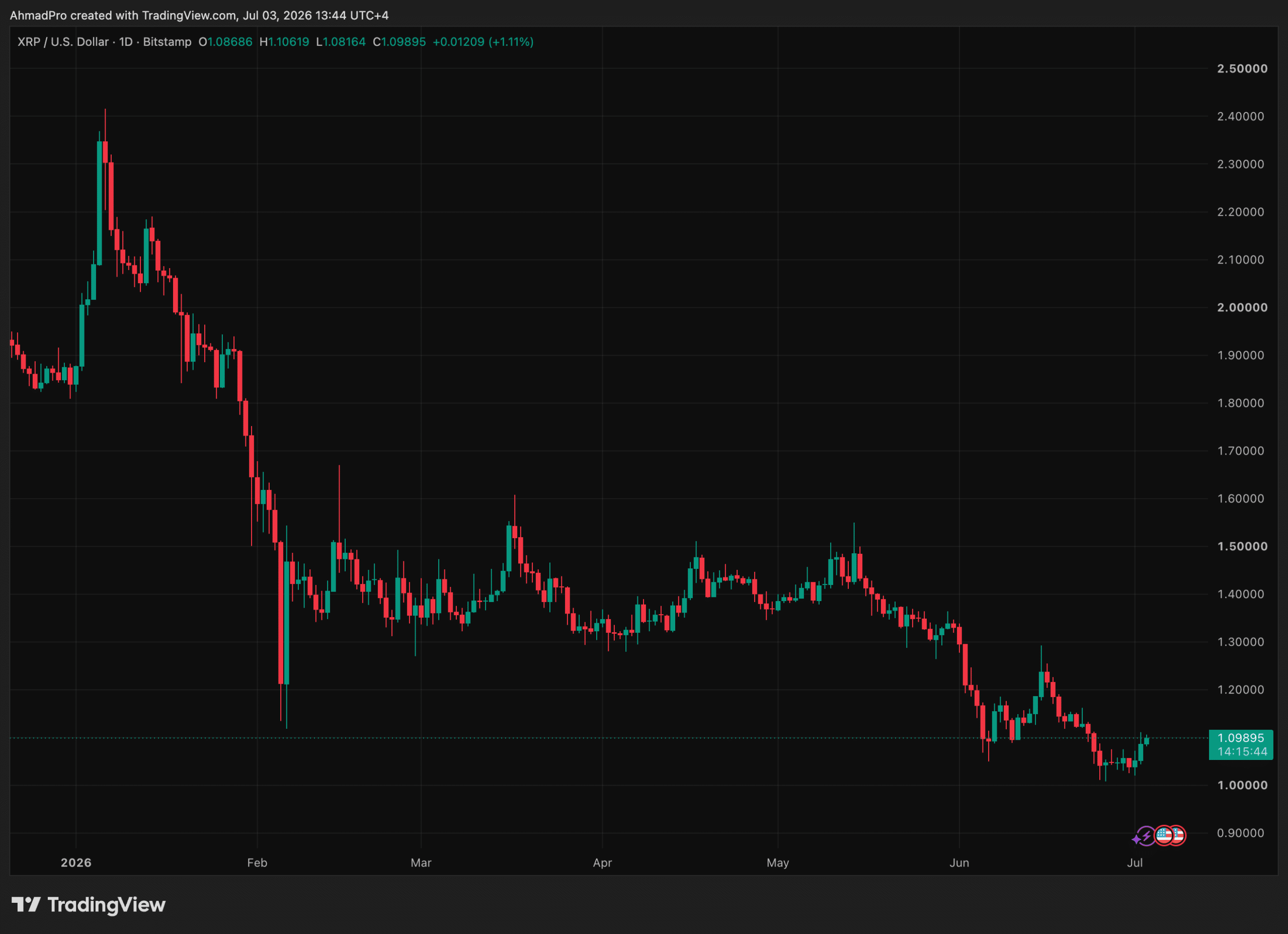
XRP advanced from $1.0611 to $1.0894 during the July 3 session, a net gain of 0.62%, as buyers defended a series of higher lows at $1.0552, $1.0589, and $1.0799 and pushed the token toward the $1.10–$1.1087 resistance band that has capped every rally attempt in recent weeks.
This is not simply a day’s worth of upside. It is the early formation of a higher-base structure above $1 – a constructive shift from the defensive trading that characterized the prior several weeks, though one that remains unconfirmed until XRP produces a clean close above $1.10.
XRP Price Action: Higher Lows, Elevated Volume, and a Ceiling at $1.10
The session’s defining characteristic was volume expanding during the advance rather than the pullback, a sequencing that suggests buyers, not sellers, were driving the marginal flow. Total volume ran 26.92% above the seven-day average, with the peak occurring at 13:00 UTC when volume reached 117.5 million XRP, approximately 142% above the 24-hour mean.
XRP ran into seller resistance at $1.10 and subsequently consolidated between $1.08 and $1.09 on lighter volume, the pattern of a market that has used up near-term buying pressure without breaking through.
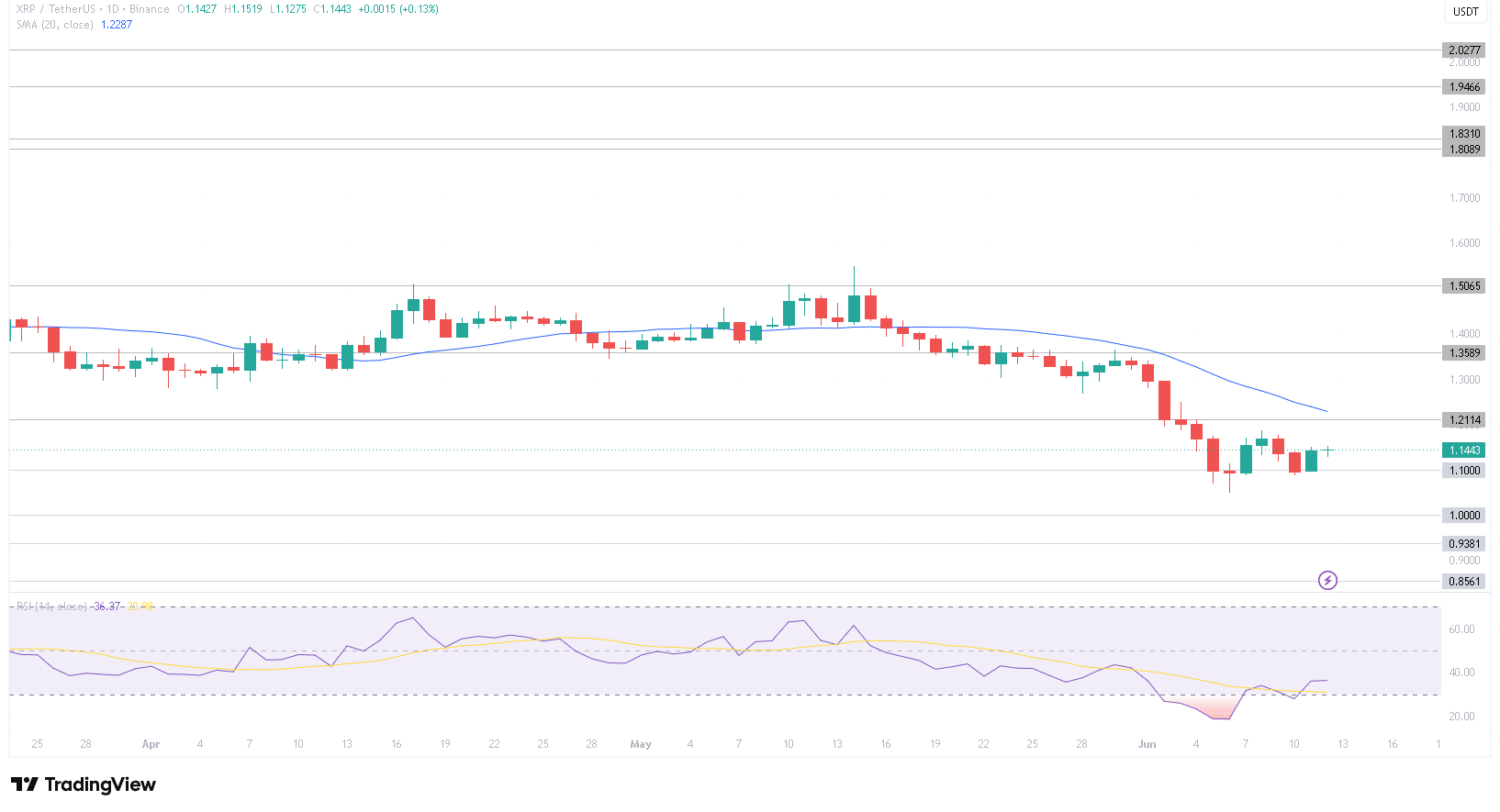
Source: XRPUSD / Tradingview
The immediate support level bulls must defend is $1.08; a failure there puts $1.0611 back in scope as the next structural test.
Above spot, a clean move through $1.10 would open the path toward $1.12–$1.13. The analytical question is no longer whether XRP can bounce from $1; it is whether the current accumulation is sufficient to drive a sustained XRP breakout above the resistance cluster that has defined the ceiling since the sell-off.
Wallet Growth and Sentiment: On-Chain Metrics Support the Setup
XRP wallet creation reached 4,941 daily addresses on July 3, the strongest single-day growth in 14 weeks. That figure is notable in context: address creation at this rate during a consolidation phase tends to reflect genuine onboarding rather than speculative recycling of existing wallets.
Bullish social sentiment simultaneously hit a three-month high, with positive comments outnumbering bearish ones by a ratio of 3.7 to 1. That sentiment spread, combined with the XRP volume expansion, provides a more complete picture of market participation than price alone.
✍️ TL;DR: XRP’s massive new wallet creations & FOMO emerge in midst of price threatening to drop below $1 📊 Metrics used: Network Growth, Pos/Neg Social Ratio 🔗 Link to chart: https://t.co/0WJTZI6VSS
Ripple completed its scheduled 1 billion XRP escrow unlock during the session without a meaningful price shock, a result consistent with the market having priced the unlock in advance.
Analysts noted that XRP’s idiosyncratic variance against the CD5 index stayed well below the threshold that would signal a major asset-specific catalyst – the session’s gains tracked the broader crypto rally rather than reflecting a Ripple-specific development.
Disclaimer: Coinspeaker is committed to providing unbiased and transparent reporting. This article aims to deliver accurate and timely information but should not be taken as financial or investment advice. Since market conditions can change rapidly, we encourage you to verify information on your own and consult with a professional before making any decisions based on this content.
Neil is a professional cryptocurrency content writer with years of experience. He has written for various cryptocurrency websites to report on breaking news, and been hired by all sorts of cryptocurrency projects, to create content that would increase their exposure and attract more potential investors.
Ripple announced on June 29 that developers can begin testing the XRPL Lending Protocol in a dedicated environment, advancing a dual upgrade comprising two technical specifications, XLS-65 and XLS-66, that would introduce native, fixed-term credit infrastructure directly on the XRP Ledger.
This is pending approval by the network’s validator set under the XRPL amendment process, which requires sustained support of over 80% from trusted validators for two consecutive weeks.
This is not simply another DeFi yield layer grafted onto a blockchain. It is a structural effort to establish the XRP Ledger as a regulated credit rail for institutional participants.
It would require off-chain underwriting authority, first-loss capital protection, and fixed-rate loan terms that map onto bank and asset-manager risk frameworks rather than the automated liquidation logic that governs permissionless protocols.
@Ripple just published the full breakdown of the XRPL Lending Protocol credit infrastructure, natively onchain.
Single Asset Vaults. Standardized loan origination. Repayment and default logic enforced at the protocol layer.
XRPL Lending Protocol: How the Dual Upgrade Is Structured
The mechanism functions as follows: XLS-65 establishes the Single Asset Vault, a standardized pooling format that allows liquidity providers to deposit one asset type, such as XRP or RLUSD, and earn yield.
XLS-66, the Lending Protocol layer, governs loan terms, repayment schedules, interest calculations, and default conditions, all of which are enforced at the protocol level rather than through external smart contracts.
Loans under the design are fixed-term and uncollateralized, a deliberate departure from collateral-dependent models such as Aave. Creditworthiness assessment remains off-chain, preserving institutional control over lending decisions while on-chain logic handles lifecycle events once a loan is originated.
Losses from defaults are absorbed first by pool managers and underwriters – a first-loss capital structure that mirrors tranched credit in traditional finance.
Ripple said the design choice reflects deliberate architecture rather than a limitation. “This separation mirrors real financial infrastructure,” the company stated. “By preserving that distinction, XRPL can support a wider range of credit structures over time, rather than hard-coding one lending model into a single application.”
RippleX developer Edward Hennis has described the target as “real credit, not a DeFi gambling pool,” characterizing the system as regulation-friendly institutional DeFi with loan durations typically running 30 to 180 days at fixed rates.
All you have to do is spot and chill.
As we progress into H2 2026 we are likely to witness more historical oversold signals print for $XRP, such as the 2W RSI reaching its lowest levels of 34
Higher lows or lower lows under lower highs: all led to major breakouts eventually 🚀 pic.twitter.com/6N7WSYUwcp
On-Chain Credit Context: RWAs, RLUSD, and the Ondo Precedent
Ripple frames the lending protocol as the functional complement to tokenized RWA activity already occurring on XRPL. In May 2026, Ondo Finance executed the first cross-border, cross-bank redemption of tokenized US Treasuries on the ledger, a milestone Ripple described as proof that moving an asset on-chain is only half the infrastructure problem.
The XRPL Lending Protocol, if activated, would allow those same tokenized assets to serve as working capital rather than static inventory, providing payment providers short-duration liquidity and enabling treasury teams to generate revenue by lending digital assets under predefined terms.
RLUSD, Ripple’s stablecoin, is positioned as a primary vault asset within that credit structure. According to CoinGecko, RLUSD has reached a $1.5Bn market cap since its late-2024 debut, giving the lending vaults a liquid, dollar-denominated base asset with meaningful existing supply. The protocol’s activation would deepen RLUSD’s on-chain utility beyond payments and into on-chain credit markets.
Validator Vote and Ripple Price at Time of Announcement
The amendment entered validator voting following the XRPL v3.1.0 release in January 2026, according to multiple reports. As of the June 29 announcement, the vote has not concluded.
RippleX has applied formal verification to the XLS-65/66 code and is offering up to $200,000 in security bounties to researchers who can identify flaws in the lending protocol’s design or implementation before any mainnet activation.
XRP traded around $1.05 at the time of the announcement, down -8% over the prior week. The token had fallen to its lowest level since President Donald Trump’s reelection the previous Thursday, briefly nearing $0.99 in sympathy with Bitcoin’s movement.
The analytical question is no longer whether XRPL can move assets on-chain; it is whether the validator set will ratify the credit infrastructure needed to put those assets to work.
Disclaimer: Coinspeaker is committed to providing unbiased and transparent reporting. This article aims to deliver accurate and timely information but should not be taken as financial or investment advice. Since market conditions can change rapidly, we encourage you to verify information on your own and consult with a professional before making any decisions based on this content.
Daniel Frances is a technical writer and Web3 educator specializing in macroeconomics and DeFi mechanics. A crypto native since 2017, Daniel leverages his background in on-chain analytics to author evidence-based reports and deep-dive guides. He holds certifications from The Blockchain Council, and is dedicated to providing "information gain" that cuts through market hype to find real-world blockchain utility.
Ripple and Bitso announced on June 13, 2026, the expansion of their partnership to bring MXNB, a regulated, peso-backed stablecoin issued by Juno, a Bitso subsidiary, natively to the XRP Ledger, integrating it alongside RLUSD on XRPL’s Permissioned DEX to create a direct on-ledger USD/MXN settlement rail targeting the US–Mexico cross-border payments corridor.
This is not simply a network expansion for an existing asset. It is an attempt to recast XRPL as regulated, enterprise-grade liquidity infrastructure for one of the world’s most active remittance corridors.
Secondary sources, including Bitget’s coverage, cite annual flows exceeding $60Bn between the US and Mexico, a figure the primary Ripple press release does not enumerate but which frames the commercial logic of the pairing.
🚨 KNOW: #Ripple Just Expanded Its Bitso Partnership And Put Mexico's Peso Stablecoin Directly On The $XRP Ledger's Permissioned DEX.
Ripple and Bitso, Latin America's leading digital finance company, are bringing $MXNB, a regulated Mexican peso stablecoin, onto the XRP Ledger.… pic.twitter.com/gtVSwoB60Q
MXNB on XRPL: How the Settlement Mechanism Functions
MXNB, already live on Arbitrum, Ethereum, and Avalanche, is now deployed within XRPL’s Permissioned DEX, a compliance-focused environment where only KYC/AML-verified institutional counterparties can access liquidity pools and settlement rails, distinct from XRPL’s public DEX.
Paired with RLUSD, Ripple’s enterprise USD stablecoin, the two assets form a single-ledger FX and settlement layer for cross-border payments without relying on correspondent banking rails.
MXNB reserves are held 1:1 in Mexican pesos in safeguarded accounts at licensed financial institutions in Mexico, according to Bitso’s published reserve disclosures.
Juno operates as an authorized electronic payment institution under Mexico’s Fintech Law, providing the regulatory foundation that Ripple is leaning on to market the product to institutional clients rather than retail users.
The 2W GC has reliably captured cyclical behavior during bear markets, with price consistently tagging the lower regression band to mark cycle lows EVERY three years (2017, 2020, 2023). The 2026 POC confirmed at $1.04.
Ripple and Bitso Partnership History: The LATAM On-Ramp Context
Ripple first brought Bitso on as a preferred liquidity provider in 2019, using XRP-based On-Demand Liquidity flows to process hundreds of millions of dollars in remittances into Mexico.
That relationship established Bitso as one of Ripple’s primary on-and off-ramps across LATAM and laid the operational groundwork for what is now a stablecoin settlement layer rather than a pure XRP liquidity play.
Silvio Pegado, Managing Director of LATAM at Ripple, described the integration as “the next evolution of how value moves between dollars and pesos,” stating in the official press release that the RLUSD and MXNB pairing on the XRPL Permissioned DEX creates “regulated, onchain liquidity infrastructure purpose-built for enterprise cross-border payments.”
Ben Reid, Head of Stablecoins at Bitso Business, said MXNB “was built from the ground up for enterprise settlement” and that the integration gives institutional users “access to peso-denominated liquidity on-chain, with the compliance certainty and settlement efficiency that enterprise use cases require.”
Industry Implication: A Template for Regional Stablecoin Infrastructure
The analytical question is no longer whether XRPL can support stablecoin activity; RLUSD’s growth has already demonstrated that. It is whether the XRPL Permissioned DEX can attract enough institutional counterparties, banks, payment processors, and fintechs to establish the network density required for on-chain MXN FX liquidity to compete with legacy settlement rails in terms of cost and speed.
Ripple’s own framing positions the MXNB/RLUSD pairing as a template for locally native stablecoin settlement infrastructure across additional LATAM corridors, with the US–Mexico corridor as the proof of concept.
We suspect the near-term signal to watch is not price action on XRP itself but the pace of institutional onboarding onto the Permissioned DEX – that pipeline will determine whether this corridor play scales into a regional infrastructure franchise or remains a well-structured bilateral arrangement.
Disclaimer: Coinspeaker is committed to providing unbiased and transparent reporting. This article aims to deliver accurate and timely information but should not be taken as financial or investment advice. Since market conditions can change rapidly, we encourage you to verify information on your own and consult with a professional before making any decisions based on this content.
Daniel Frances is a technical writer and Web3 educator specializing in macroeconomics and DeFi mechanics. A crypto native since 2017, Daniel leverages his background in on-chain analytics to author evidence-based reports and deep-dive guides. He holds certifications from The Blockchain Council, and is dedicated to providing "information gain" that cuts through market hype to find real-world blockchain utility.
Ripple CEO Brad Garlinghouse has publicly committed to a $1 billion revenue run rate by the end of 2026, with the figure explicitly excluding XRP held on the company’s balance sheet, a condition that is doing as much strategic work as the number itself.
The target is anchored to four operating business lines: cross-border payments infrastructure, the RLUSD stablecoin, treasury software, and AI-enabled payments on the XRP Ledger.
The analytical question is not whether $1 billion is an ambitious number; it is whether the XRP-exclusion framing successfully repositions Ripple as an underwritable fintech infrastructure provider in the eyes of institutional buyers who currently have no clean operating revenue lens through which to evaluate it.
LATEST: 📈 Ripple CEO Brad Garlinghouse says the company expects to end 2026 with a $1B revenue run rate, not including the XRP on its balance sheet. pic.twitter.com/hNF20FBGUw
Ripple XRP $1B Target: How the Revenue Run Rate Definition Actually Functions
The mechanism functions as follows: a revenue run rate annualizes a current period’s operating revenue, typically one quarter, to project a full-year figure, and it differs from GAAP revenue in that it represents a forward trajectory rather than a historically booked figure.
Garlinghouse’s framing specifies that neither XRP token sales nor the XRP inventory Ripple holds on its balance sheet contributes to the $1 billion figure, which strips out the component of Ripple’s economics most difficult for regulated institutional counterparties to model or get comfortable with from a compliance standpoint.
The four named business lines each carry a distinct institutional logic. Cross-border payments, Ripple’s original product, targets banks and payment firms seeking faster correspondent settlement. RLUSD, the company’s dollar-pegged stablecoin, is positioned for enterprise settlement, collateral use, and now AI agent payments on the XRP Ledger; XRPL stablecoin supply has reached $762 million with RLUSD dominant, though it is necessary to flag that on-chain supply figures reflect minted tokens rather than confirmed transactional volume. Treasury software targets corporates and banks building crypto treasury infrastructure, a segment Ripple President Monica Long has projected will grow from under $200 billion to over $1 trillion in total market size by end-2026.
As AI agents begin transacting on behalf of businesses, payments need more than speed. They need trust, controls, and clear rules for how value moves.
The fourth line, AI-enabled payments via the XRPL AI Starter Kit released June 13, 2026, is the earliest-stage of the four, using the x402 protocol to let software agents transact in XRP and RLUSD with minimal human involvement; its contribution to a 2026 run rate remains speculative at this stage.
It is necessary to flag the epistemic status of the $1 billion figure itself: Garlinghouse’s statement, as shared by CoinMarketCap and corroborated across multiple outlets, represents a stated target rather than a disclosed current run rate. Ripple does not report audited financials publicly, so there is no independently verifiable baseline against which to measure the gap between current revenue and the target.
Disclaimer: Coinspeaker is committed to providing unbiased and transparent reporting. This article aims to deliver accurate and timely information but should not be taken as financial or investment advice. Since market conditions can change rapidly, we encourage you to verify information on your own and consult with a professional before making any decisions based on this content.
Daniel Frances is a technical writer and Web3 educator specializing in macroeconomics and DeFi mechanics. A crypto native since 2017, Daniel leverages his background in on-chain analytics to author evidence-based reports and deep-dive guides. He holds certifications from The Blockchain Council, and is dedicated to providing "information gain" that cuts through market hype to find real-world blockchain utility.
XRP trades near $3.05 as SBI Holdings pushes Japan’s first Bitcoin-XRP ETF through FSA review. Key levels, analyst targets, and what approval could mean for price.
Latest XRP Price Prediction: Ripple (XRP) has clawed backposition, trading near $1.14 after bouncing sharply from an intraday low of $1.10, and the catalyst driving that recovery is institutional, not retail. SBI Holdings has outlined plans for Japan’s first dual Bitcoin–XRP ETF targeting the Tokyo Stock Exchange, with filings lodged in 2025 now reportedly entering what analysts describe as a “late-stage” regulatory phase at the Financial Services Agency (FSA). No approval date has been confirmed.
According to Finance Magnates and Yahoo Finance, SBI’s product lineup includes both a Bitcoin–XRP blended ETF and a separate gold-and-crypto vehicle—both pending FSA review. Community sentiment on Binance Square describes the filing as “one of the clearest institutional catalysts XRP has ever had,” while TradingView analysts point to renewed volume as confirmation that traders are pricing in an approval, not just speculating on one. Rakuten’s recent integration of XRP for payments, which triggered an earlier breakout above $1.40 back in May suggests Japanese corporate adoption is already ahead of the ETF queue.
The question now is whether the ETF approval itself has been partially priced in, or whether the actual FSA green light would constitute a second, larger leg upward.
XRP is currently testing immediate resistance at $1.17, with technicians flagging $1.20 as the decisive breakout trigger on the 4-hour chart. The $1.05 level has held as near-term support after a decisive bounce, establishing a short-term range that tilts modestly bullish as long as that floor remains intact. Volume has picked up alongside the ETF headlines, a pattern consistent with institutional positioning rather than speculative retail rotation.
The technical setup is a bullish retest: an initial rejection at $1.18, followed by a rapid return to test that same level, a formation that technicians generally associate with accumulation and elevated breakout probability. Binance Square commentary cited by Finance Magnates suggests a push toward $1.18 is plausible within roughly 24 hours if volume sustains.
LiquidChain Targets Early-Mover Upside as XRP Tests Key Levels
LiquidChain (LIQUID) is an emerging Layer 3 infrastructure project positioning itself as the cross-chain liquidity layer for the next cycle. Its core proposition: fusing the liquidity of Bitcoin, Ethereum, and Solana into a single execution environment, so developers can deploy once and access all three ecosystems simultaneously.
The architecture centers on a Unified Liquidity Layer, Single-Step Execution, Verifiable Settlement, and a Deploy-Once design that removes the multi-chain fragmentation problem most DeFi protocols currently work around (a problem that costs the industry billions in stranded liquidity annually).
The presale has raised $836,066.62 at a current price of $0.01469. As with all early-stage presales, the project carries meaningful execution risk—L3 infrastructure is competitive, and delivery timelines are unconfirmed. Prospective participants should review the documentation independently.
Disclaimer: Coinspeaker is committed to providing unbiased and transparent reporting. This article aims to deliver accurate and timely information but should not be taken as financial or investment advice. Since market conditions can change rapidly, we encourage you to verify information on your own and consult with a professional before making any decisions based on this content.
Daniel Frances is a technical writer and Web3 educator specializing in macroeconomics and DeFi mechanics. A crypto native since 2017, Daniel leverages his background in on-chain analytics to author evidence-based reports and deep-dive guides. He holds certifications from The Blockchain Council, and is dedicated to providing "information gain" that cuts through market hype to find real-world blockchain utility.
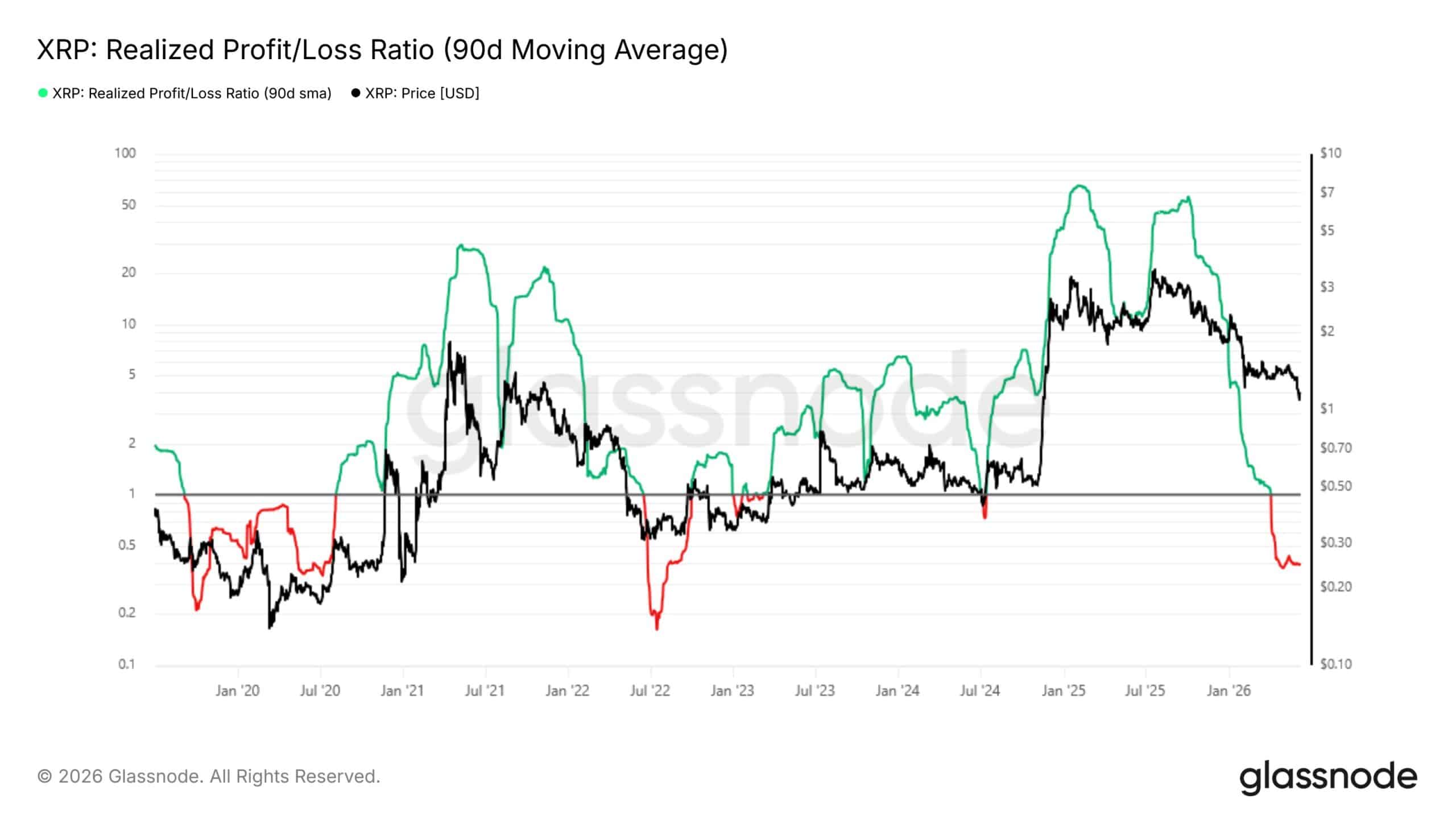
XRP News: On-chain analytics firm Glassnode has recorded XRP’s 90-day realized profit-to-loss ratio at 0.38, meaning that for every $1 of profit realized on-chain, investors are booking $2.63 in losses, and has classified the current market phase as one of “intense capitulation.”
The reading sits at less than half the 1.0 equilibrium threshold that separates net-profit from net-loss regimes, and represents a near-total reversal from the ratio’s peak of approximately 50 during XRP’s 2025 euphoria phase, when realized gains dwarfed losses by an almost incomprehensible margin.
XRP was trading near $1.10 at the time of the analysis, below its aggregate realized price of approximately $1.48, meaning the average holder is currently underwater on a cost-basis basis.
Glassnode stated directly that “this ratio so far from the equilibrium threshold of 1 shows a market where most investors moving their tokens do so at a loss, a typical characteristic of intense capitulation,” and added that “this dynamic has completely reversed” relative to the prior bull phase.
The speed of the reversal, from 50 to 0.38 across a single cycle, has drawn comparisons to the structural deterioration Glassnode documented for XRP in early 2022, the last time the asset entered a comparably loss-dominated on-chain regime.
XRP News: Compounding Signals, XRPL Fees, SOPR, and Supply Underwater
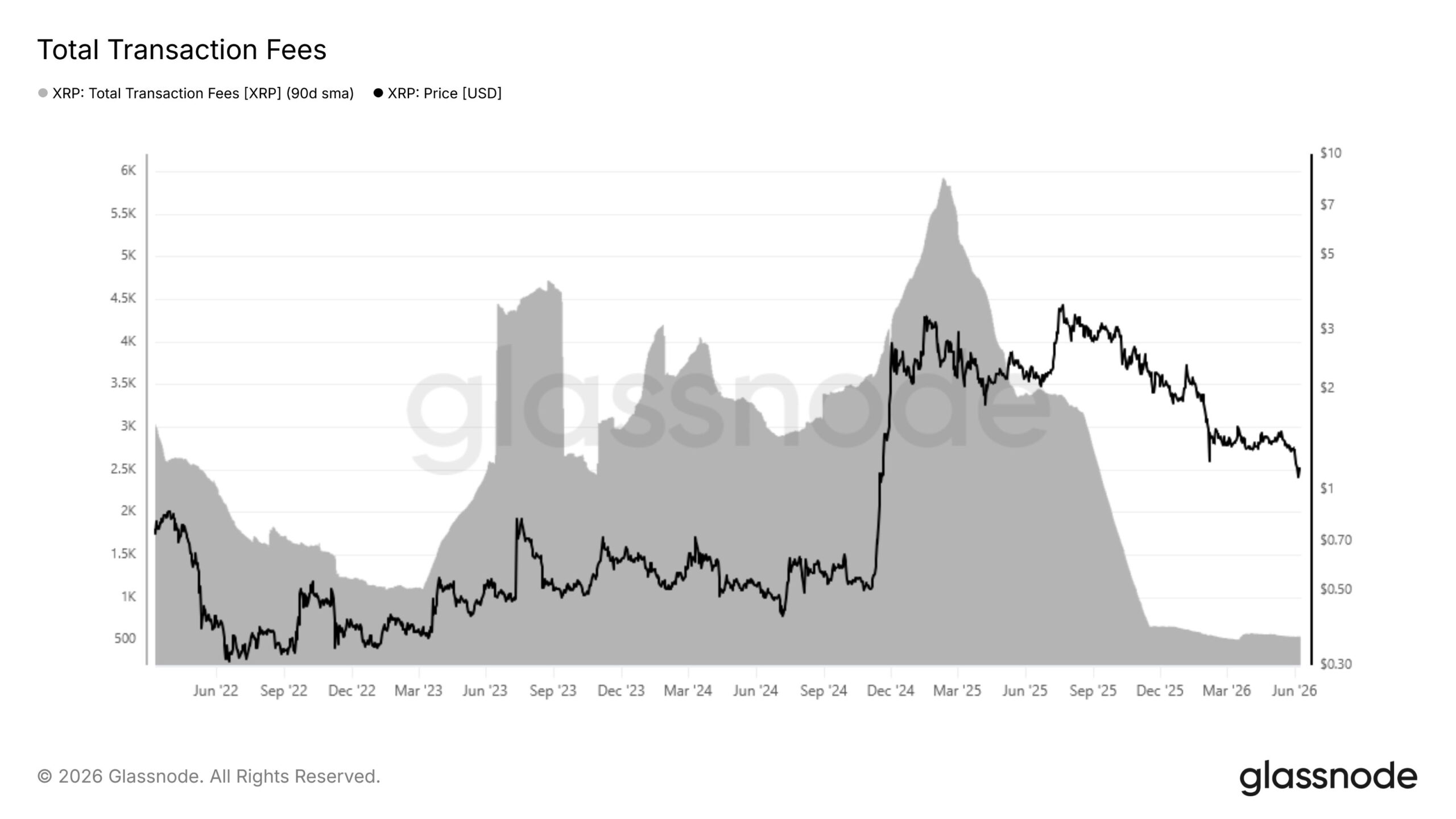
The realized profit loss ratio does not stand alone. XRPL fees, measured on a 90-day moving average, collapsed from approximately 5,900 XRP per day in February 2025 to just 500 XRP, a 91.5% reduction that Glassnode attributes to a sharp decline in transactional demand associated with the prior speculative phase.
The fee metric is a direct proxy for block-space demand: when developers, payment processors, and active users transact on the XRP Ledger, fees rise; when they withdraw, fees fall, and a 91.5% decline is not fee optimization, it is user exodus.
Separately, XRP’s Spent Output Profit Ratio, or SOPR, slid from approximately 1.16 in July 2025 to 0.96 by early 2026, crossing below the critical 1.0 breakeven line that separates net-gain from net-loss coin movement.
SOPR below 1.0 means that the average coin being moved on-chain was acquired at a higher price than its current sale price, a structural confirmation that loss realization, not profit-taking, is driving on-chain activity. Compounding this, Glassnode data indicate that approximately 41.5% of circulating XRP supply, roughly 26.5 billion tokens, is currently held at a loss, with 62.8% of XRP’s realized cap concentrated in investors who established their cost basis within the past six months, a distribution profile Glassnode characterizes as “top-heavy” and structurally fragile.
XRP Capitulation: What the On-Chain Metrics Are Actually Showing
The analytical question is no longer whether XRP is in capitulation; the on-chain metrics confirm that it is. The question is whether the current configuration constitutes a terminal flush that precedes a cycle reset, or a structural demand collapse severe enough to make Glassnode’s implicit warning about a distant next rally the operative scenario.
The mechanics of the realized profit-to-loss ratio function as follows: the metric compares the aggregate dollar value of profits realized by coins moving on-chain against the aggregate dollar value of losses realized in the same window, smoothed here across a 90-day average to remove short-term volatility. A reading of 1.0 indicates equilibrium.
A reading of 0.38 indicates that the market is not merely weak – it is structurally dominated by holders who have either been forced to sell or have abandoned any expectation of near-term recovery. In prior Bitcoin cycles, realized profit-to-loss ratios at comparable extremes – around the December 2018 and November 2022 lows, preceded eventual bottoms, though the lag between extreme readings and price recovery ranged from weeks to several months and was not guaranteed by the ratio alone.
The “top-heavy” holder distribution that Glassnode identifies amplifies the downside transmission mechanism in a specific way: when 62.8% of realized cap was established by buyers who entered within the past six months, those buyers hold cost bases near the 2025 peak prices.
As XRP price falls below their acquisition levels, they enter the underwater cohort and face a binary choice: hold and wait, or sell and crystallize losses. When organic network demand, measured by XRPL fees, simultaneously collapses, there is no fundamental use-case catalyst to interrupt that selling calculus.
The result is the self-reinforcing loop that characterizes late-cycle capitulation: more sellers, fewer buyers, declining fees, declining prices. It is necessary to flag the epistemic status of this data: what the realized profit loss ratio at 0.38 proves is that capitulation is occurring with intensity. What it does not prove is that capitulation is complete, or that current price levels represent a durable floor.
Disclaimer: Coinspeaker is committed to providing unbiased and transparent reporting. This article aims to deliver accurate and timely information but should not be taken as financial or investment advice. Since market conditions can change rapidly, we encourage you to verify information on your own and consult with a professional before making any decisions based on this content.
Daniel Frances is a technical writer and Web3 educator specializing in macroeconomics and DeFi mechanics. A crypto native since 2017, Daniel leverages his background in on-chain analytics to author evidence-based reports and deep-dive guides. He holds certifications from The Blockchain Council, and is dedicated to providing "information gain" that cuts through market hype to find real-world blockchain utility.
The XRP Ledger Foundation is targeting June 15 for mainnet activation of the v3.2.0 upgrade, an infrastructure-level release that renames the network’s core server software from rippled to xrpld and is expected to reduce memory consumption by 30–40%.
The date was confirmed by dUNL validator Vet, an XRPL Foundation contributor, in response to community inquiries, though it is necessary to flag that XRPL Operations’ own announcement language as of June 4 reads ‘coming soon,’ leaving June 15 as a stated target rather than an irrevocably locked activation date.
Every validator and node operator on the network is required to upgrade before the migration; those who do not risk losing the ability to participate in consensus and serve the current ledger data. The analytical question the article addresses is twofold: what does this upgrade actually change at the infrastructure layer, and does it carry any genuine implications for XRP price, or is it, as one analyst framing put it, infrastructure noise dressed in a new binary name?
XRP Ledger 3.2.0 is coming soon!
The core software powering the XRPL is changing its name from rippled to xrpld.
This transition will require some updates for infrastructure operators. We're preparing a detailed playbook to help guide you through the upgrade process. pic.twitter.com/296TNhUGkC
— XRP Ledger Operations (@XRPLOperations) June 4, 2026
XRP was trading in the $1.13–$1.15 range as this upgrade approached, having briefly spiked approximately 7% to $1.17 before retreating, a pullback analysts attributed in part to geopolitical pressure following Israel’s strikes on Iran.
The token remains roughly 70% below its July 2025 high near $3.65, and the immediate price reaction to the upgrade announcement was muted, consistent with the interpretation that the market is not yet pricing a server release as a demand catalyst.
XRPL v3.2.0: How the rippled-to-xrpld Rebrand and Memory Overhaul Actually Function
The mechanism functions as follows: the rippled daemon has served as the XRP Ledger’s canonical reference implementation since Ripple open-sourced it in 2013–2014, and its name has historically embedded an implicit association with Ripple’s enterprise product suite.
The v3.2.0 upgrade renames that binary to xrpld, with the command-line interface now displaying ‘xrpld version 3.2.0’ after upgrade, a change XRPL Operations described explicitly as intended to reflect the broader, increasingly Ripple-independent XRPL ecosystem and reduce confusion with Ripple’s commercial offerings such as RippleNet.
Beyond the naming change, the upgrade’s most operationally significant improvement is a projected 30–40% reduction in memory usage. It is necessary to flag the epistemic status of this figure: the 30–40% range originates from developer commentary and secondary coverage, not from published benchmarks or formally released technical notes from XRPL Operations, which had not issued official performance documentation as of June 8.
#XRPL 3.2.0: “rippled” → “xrpld”. Sounds boring. It’s not. For 10 years regulators + institutions got confused: $Ripple ≠ #XRPL code. This rename removes friction. Mid-June upgrade. Backend clarity = frontend adoption. Price sleeps while infra gets serious. pic.twitter.com/dX0tq9fbpG
For a node operator running blockchain infrastructure at scale, even an unverified 30% memory footprint reduction translates meaningfully into hardware cost and the viability of running a validator on fewer provisioned machines, which, if confirmed post-upgrade, could lower the barrier to new validator participation.
The v3.2.0 release contains no new user-facing features; its scope is server refactoring, performance optimization, improvements to numerical handling and rounding logic, and general code maintenance. Security enhancements, including AI-powered testing protocols and an expanded bug bounty program, are also part of the release. This upgrade builds directly on v3.1.3, which activated on the XRPL mainnet in late May and addressed issues with NFTs, Permissioned Domains, Vaults, the Lending Protocol, and Multi-Purpose Tokens (MPTs).
What XRP Validators Must Do Before June 15, and What Happens If They Don’t
The compliance posture is unambiguous: validators, node operators, and all infrastructure providers are required to update to the latest version before mainnet migration. XRPL Operations has stated that all infrastructure providers ‘will need to make updates to their infrastructure before the migration to the new XRPL mainnet,’ and Ripple developers alongside validator Vet have reinforced that non-upgraded nodes risk losing network participation entirely.
The practical consequence of inaction extends beyond the binary name change. Operators whose automation scripts, systemd units, monitoring pipelines, and package sources reference ‘rippled’ will face operational breakage; the binary will no longer exist under that name post-migration. Precedent from the v3.1.2 security patch cycle is instructive: Ripple warned at that time that failure to update ‘could lead to degraded server performance or instability’ and risk of server crashes. Validator funds and XRP balances are not directly at risk, but the node’s ability to participate in consensus and serve current ledger data is.
XRPL Operations has indicated that a migration playbook will be provided ahead of deployment to walk operators through the rippled-to-xrpld transition. It is necessary to flag that the detailed contents of that playbook had not been publicly released as of the time of writing; operators should monitor the official XRPL Foundation channels directly for that documentation. As of June 8, network state data showed 84% of nodes already updated to XRP Ledger v3.1.3, a baseline that suggests the ecosystem’s update compliance rate is reasonably high heading into the June 15 window.
Disclaimer: Coinspeaker is committed to providing unbiased and transparent reporting. This article aims to deliver accurate and timely information but should not be taken as financial or investment advice. Since market conditions can change rapidly, we encourage you to verify information on your own and consult with a professional before making any decisions based on this content.
Daniel Frances is a technical writer and Web3 educator specializing in macroeconomics and DeFi mechanics. A crypto native since 2017, Daniel leverages his background in on-chain analytics to author evidence-based reports and deep-dive guides. He holds certifications from The Blockchain Council, and is dedicated to providing "information gain" that cuts through market hype to find real-world blockchain utility.
XRP printed $1.08 on June 5, 2026, its lowest level in 19 months, as a stronger-than-expected U.S. jobs news showing 172,000 new positions reignited Federal Reserve rate fears and triggered a cascade that wiped out more than $1 billion in leveraged crypto long positions within 24 hours.
Bitcoin plunged to a weekend low of $59,100, and XRP was pulled down with it, extending a drawdown that now stands at approximately 69% from the July 2025 cycle high of $3.65. The token has since stabilized in the $1.12–$1.16 range, recovering roughly 7% from Friday’s trough.
The analytical question is not whether XRP has crashed – it clearly has. The question is whether the divergence between that price action and concurrent institutional accumulation data represents a structural signal that precedes a re-rating, or a lagging indicator of buyers who will eventually capitulate to the same selling pressure that has driven the XRP price to its current level. That distinction matters considerably for how the evidence below should be read.
XRP ETF Inflow Divergence: What the Institutional Flow Data Actually Shows
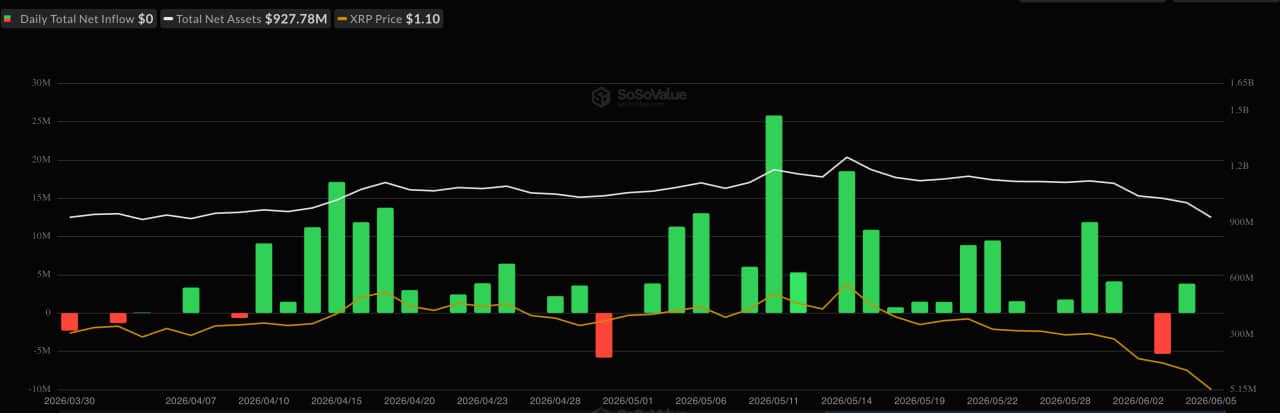
Spot XRP ETFs recorded $131.94 million in net inflows during May 2026, the strongest monthly figure since these products launched, even as the broader crypto crash accelerated through the final days of the month.
An additional $4.13 million entered XRP ETF products in early June, during the same week the XRP price was setting its 19-month low, bringing cumulative spot XRP ETF inflows to $1.43 billion.
The mechanism functions as follows: ETF inflows represent authorized participant activity, typically from institutional and large retail allocators, purchasing creation units directly from fund issuers, which in turn acquire spot XRP to back those units, reducing the circulating exchange supply.
The divergence from comparable products is not incidental. Over the same period, Bitcoin ETFs shed $4.4 billion across 13 consecutive trading days of outflows, and Ethereum ETFs lost $401 million over 17 days, meaning institutional flow into XRP investment products ran in the opposite direction from every other major crypto ETF category during a broad crypto liquidations event. Bitcoin ETF outflows broke a 13-day streak only on June 4 with a $3 million inflow, a figure the source material itself describes as insufficient to signal a reversal.
It is necessary to flag the epistemic status of this data, however. ETF inflow figures confirm that capital entered these products; they do not confirm that this capital represents conviction that will hold through a further drawdown, nor do they establish a price floor on any specific timeline. Authorized participants can and do reverse positions.
The news record May XRP ETF figure is notable precisely because it occurred against a deteriorating price environment, but the same deteriorating environment makes the durability of those inflows an open question rather than a settled one.
The forward-looking case for XRP ETF inflows rests substantially on the CLARITY Act, which would permanently classify XRP as a commodity under U.S. federal law. The bill cleared the Senate Banking Committee in May and was placed on the Senate Legislative Calendar on June 1.
Standard Chartered projects that CLARITY Act passage could trigger $4 to $8 billion in additional XRP ETF inflows by year-end, a figure representing roughly 30 to 60 times the record May monthly total. That projection is conditional on Senate floor scheduling and passage before the August recess, neither of which is guaranteed.
XRP News: What the XRP Price-Data Divergence Actually Resolves To
If macro conditions stabilize, incoming US inflation data softens rate-hold fears, and XRP ETF inflows sustain their May trajectory into June and July, the 9:1 short-to-long position skew becomes an accelerant of a short squeeze rather than a bearish indicator.
The CLARITY Act, advancing to a Senate floor vote before the August recess, adds fuel. Standard Chartered’s $4 to $8 billion inflow projection is starting to be priced in ahead of passage, driving XRP back toward $1.50 to $1.60 near term and toward $2.00 or higher if institutional inflows accelerate. The confirming signal is a sustained daily close above $1.30, followed by a reclaim of $1.40 on volume.
If Bitcoin stabilizes between $60,000 and $65,000 without decisively reclaiming higher levels and the CLARITY Act remains on the Senate calendar without a scheduled floor vote, XRP consolidates near $1.10 to $1.25. Whale accumulation continues quietly but finds no near-term catalyst.
The setup builds without resolving. The confirming signal is ETF inflows news holding positive week-over-week without acceleration, and XRP maintaining $1.08 as an unbroken floor.
If Bitcoin tests the Polymarket-implied $55,000 level, currently assigned 64% probability, a renewed round of crypto liquidations forces even high-conviction XRP holders to reduce exposure. XRP’s 0.87x correlation to Bitcoin’s recent move implies a price near $1.05 at $55,000.
A test of $50,000, assigned 51% probability, pushes XRP below $1.00. Below that, structural support sits at $0.95, with the $0.75 to $0.85 zone representing historical cycle lows. The confirming signal is a daily close below $1.08 on elevated volume accompanied by ETF inflow reversal.
The leading indicator across all 3 scenarios is not XRP price itself. It is the weekly ETF flow figure. Sustained reversal from inflows to outflows signals that the institutional accumulation thesis is unwinding. Continued inflows through further price weakness deepen the divergence and strengthen the eventual upside case.
Disclaimer: Coinspeaker is committed to providing unbiased and transparent reporting. This article aims to deliver accurate and timely information but should not be taken as financial or investment advice. Since market conditions can change rapidly, we encourage you to verify information on your own and consult with a professional before making any decisions based on this content.
Daniel Frances is a technical writer and Web3 educator specializing in macroeconomics and DeFi mechanics. A crypto native since 2017, Daniel leverages his background in on-chain analytics to author evidence-based reports and deep-dive guides. He holds certifications from The Blockchain Council, and is dedicated to providing "information gain" that cuts through market hype to find real-world blockchain utility.