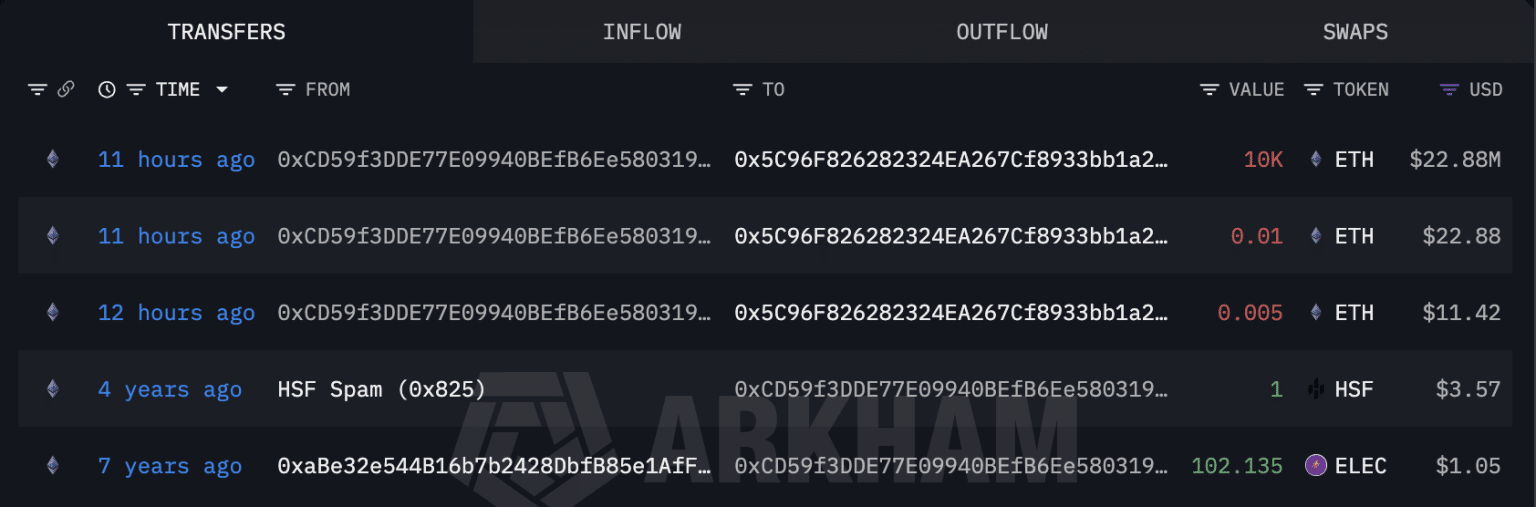
A wallet linked to Ethereum’s 2014 ICO moved approximately $23 million in ETH last week after roughly a decade of inactivity, with blockchain monitoring service flagging the transfer from the dormant address and tracing proceeds through a multisig wallet, which has since deposited a cumulative 12,001 ETH, equivalent to approximately $24.62 million, to OKX over the past 60 days.
The wallet originally accumulated around 38,800 ETH during the 2014 ICO at an average acquisition cost of roughly $0.31 per token via Poloniex, implying a cost basis near $12,000 total – a figure that places unrealized gains in the tens of millions and, by extension, places real distribution risk on the table.
An #Ethereum ICO participant "0xCD59" transferred all 10,000 $ETH($22.88M) to a new wallet after being dormant for 10.8 years.
Dormant whale reactivations are among the more closely watched on-chain signals in the Ethereum market precisely because they conflate three structurally distinct possibilities – outright distribution, custodial migration, and renewed accumulation – and the data available at the point of detection rarely resolves which is occurring.
The distinction matters: sell-side distribution from a wallet carrying a near-zero cost basis represents uninhibited exit pressure, while a custody reshuffle is market-neutral. That ambiguity is the tension driving analyst attention to this address right now.
Ethereum ICO Whale Reactivation: What a $23 Million Move After Ten Years Actually Represents
The mechanism functions as follows: when an ICO-era wallet that has not transacted in approximately ten years initiates an outbound transfer, on-chain surveillance tools flag the address against historical activity logs and cross-reference destination wallets against known exchange deposit addresses.
The ICO-era context is not incidental here. An acquirer who paid approximately $0.31 per ETH faces effectively no cost-basis pressure at any price above single digits, meaning the decision to sell or hold is driven entirely by portfolio strategy and macro outlook, not by a need to recover capital. That asymmetry is precisely why ICO-era whale reactivations carry structural weight beyond their nominal dollar size.
Disclaimer: Coinspeaker is committed to providing unbiased and transparent reporting. This article aims to deliver accurate and timely information but should not be taken as financial or investment advice. Since market conditions can change rapidly, we encourage you to verify information on your own and consult with a professional before making any decisions based on this content.
Daniel Frances is a technical writer and Web3 educator specializing in macroeconomics and DeFi mechanics. A crypto native since 2017, Daniel leverages his background in on-chain analytics to author evidence-based reports and deep-dive guides. He holds certifications from The Blockchain Council, and is dedicated to providing "information gain" that cuts through market hype to find real-world blockchain utility.
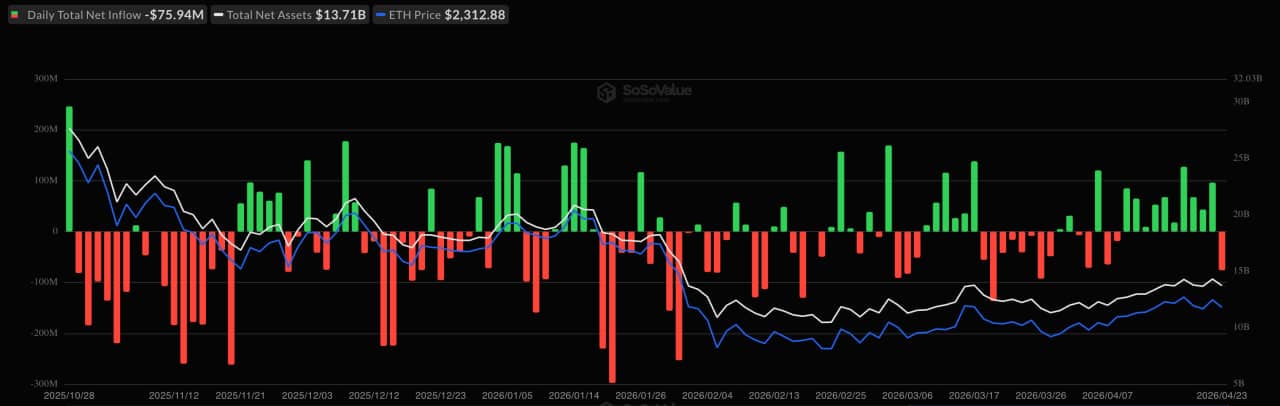
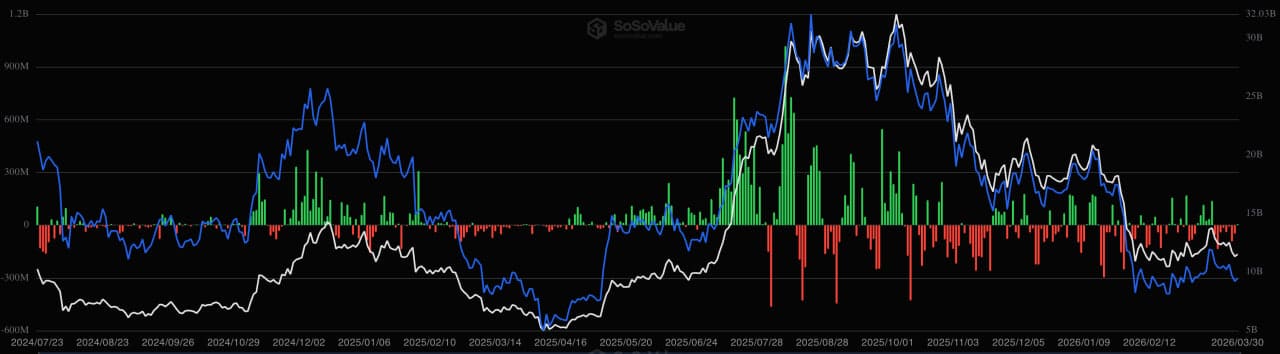
U.S. spot Ethereum ETFs products recorded a tenth consecutive day of net inflows on April 22, 2026, extending what is now the longest unbroken inflow streak since the funds launched in July 2024, with BlackRock’s iShares Ethereum Trust (ETHA) leading that session at $53.6 million and Fidelity’s Wise Origin Ethereum Fund (FETH) contributing an additional $40.6 million, according to data tracked by SoSoValue.
The sustained bid from institutional investors is functioning as a mechanical price floor, absorbing sell-side pressure that has periodically suppressed ETH price throughout the first quarter of 2025.
Spot Ethereum ETFs Inflow Data: What Ten Consecutive Days of Net Buying Actually Represents
The mechanism functions as follows: every dollar of net inflow into a spot Ethereum ETFs obligates the issuing fund to acquire physical ETH on open markets, reducing the liquid float available to sellers and tightening the supply-demand balance at prevailing price levels.
On April 21 alone, day nine of the streak, total net inflows reached $43.36 million, per SoSoValue. BlackRock’s ETHA contributed $37 million, and its ETHB vehicle added $15.46 million; Grayscale’s Ether Mini Trust captured $3.93 million, and Bitwise’s ETHW logged $1.99 million.
Against those inflows, Grayscale’s legacy Ethereum Trust (ETHE) saw $12.14 million in exits, and Fidelity’s FETH posted $1.99 million in outflows, a pattern that mirrors the rotation dynamic observed in Bitcoin ETFs, where investors shifted capital from higher-fee legacy products to lower-cost alternatives from BlackRock and Fidelity.
Day ten extended that pattern. ETHA’s $53.6 million and FETH’s $40.6 million were partially offset by a $9.2 million outflow from ETHE, consistent with the structural migration away from Grayscale’s original trust product.
Total net assets across the spot Ethereum ETF complex stood at approximately $13.66 billion as of April 21, with combined trading volume at $648.88 million – figures that reflect a product set still building liquidity depth but clearly past its post-launch outflow phase. For context, Bitcoin ETFs logged only $11.84 million in net inflows on April 21, led by BlackRock’s IBIT at $39.34 million, making ETH’s ten-day run the more notable flow event across the two asset classes during that period.
Can ETH Price Break Resistance or Does Persistent Sell Pressure Become the Binding Constraint?
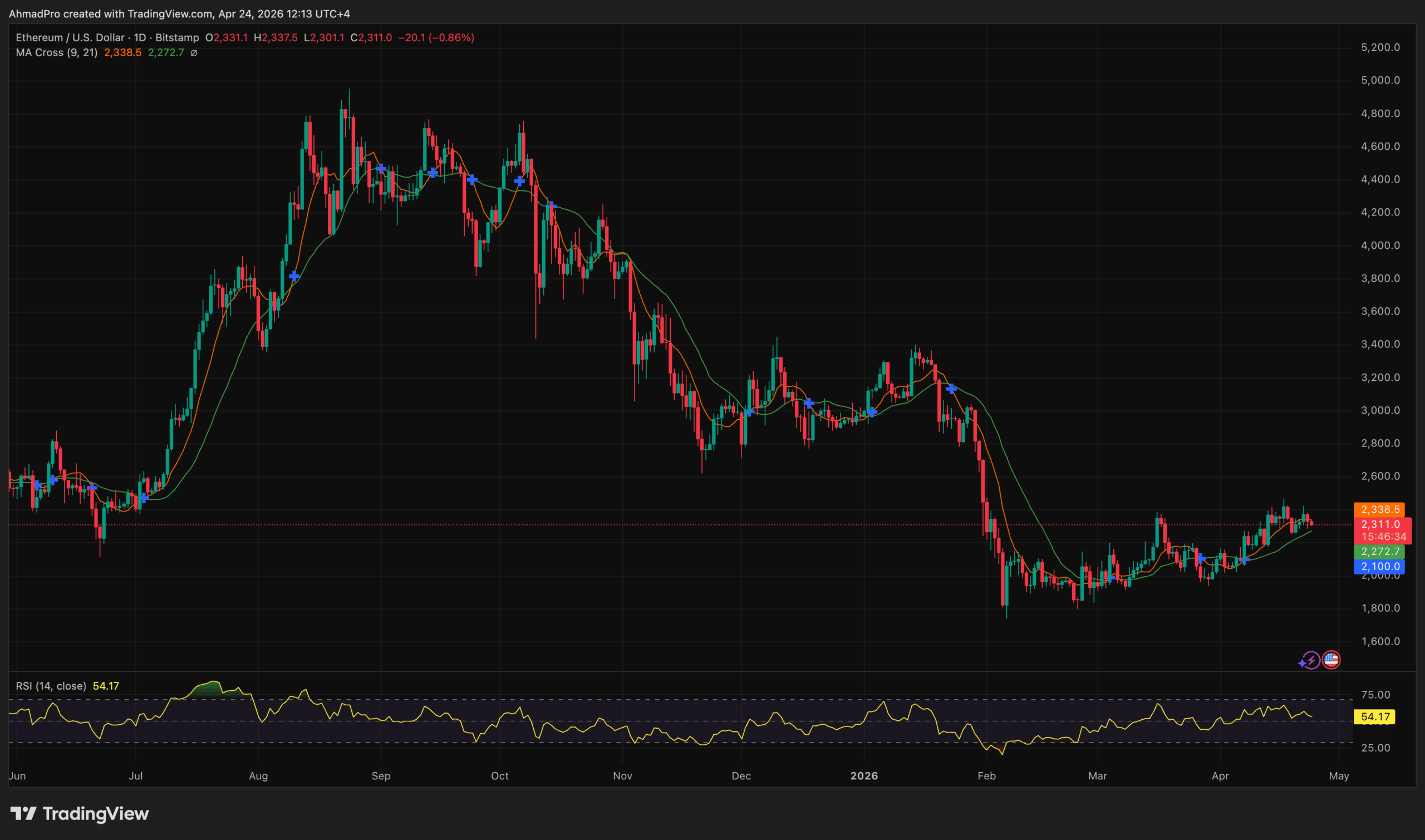
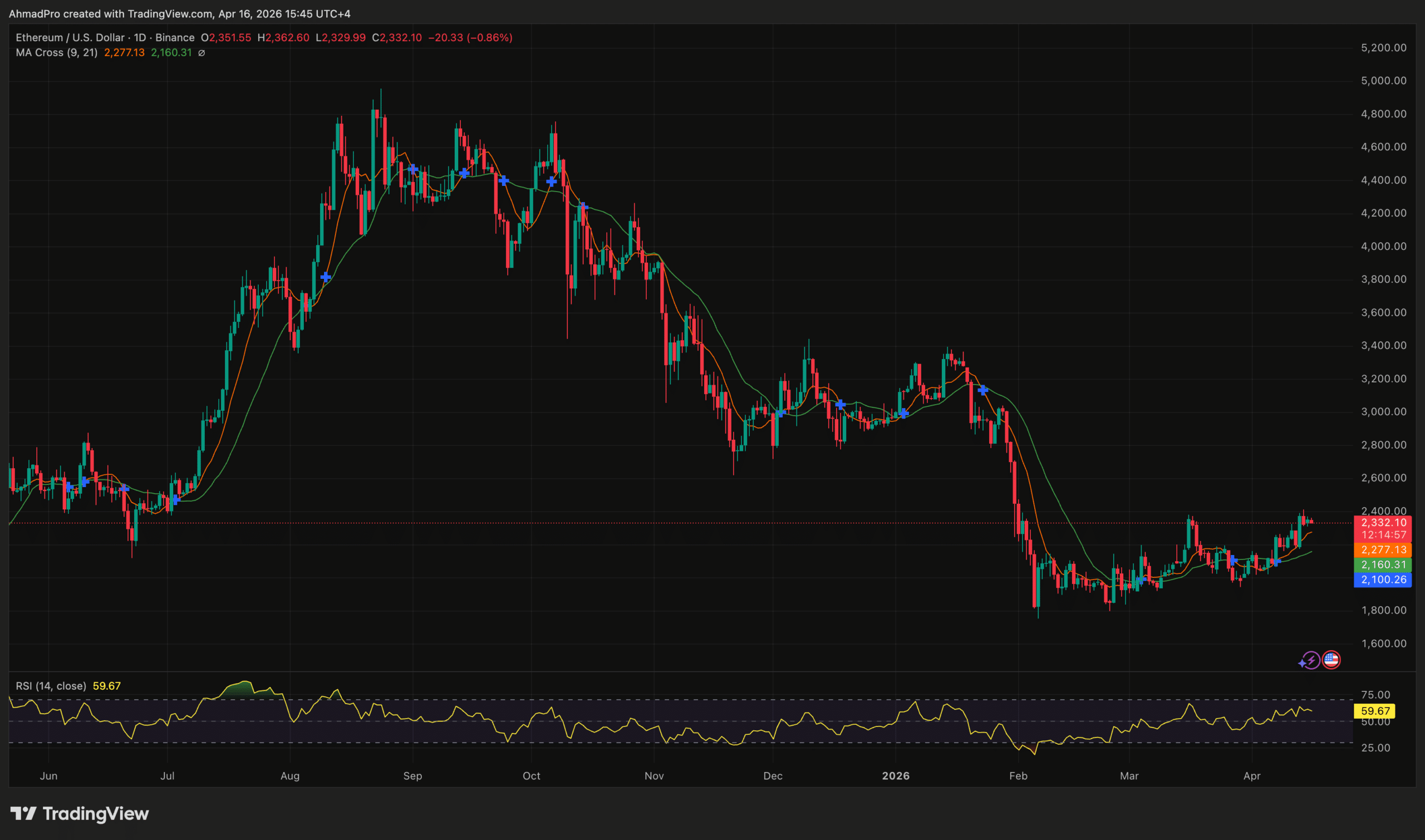
ETH is stuck in a contested zone, and $2,400–$2,200 is where the real battle is happening, because that is the range where demand needs to overpower supply to trigger a clean move.
ETF inflows are doing their job by holding the floor, but they are stabilizing ETH price, not pushing it higher yet. At the same time, sell pressure from exploit-linked ETH is getting absorbed without breaking structure, which is actually a quiet sign of strength.
On top of that, long-term accumulation from institutions is pulling supply out of circulation, and that kind of demand tends to be slower but more durable.
So the setup is building, but it is not there yet. If inflows keep coming and ETH pushes above $2400, that is where momentum can kick in fast, especially with derivatives positioning already building in the background.
More likely for now, it stays range-bound between roughly $2400 and $2,300 while the market resets and waits for a stronger trigger. The risk is if inflows fade and sell pressure picks up, because once that steady bid disappears, ETH can slip back below $2,200 quickly.
Disclaimer: Coinspeaker is committed to providing unbiased and transparent reporting. This article aims to deliver accurate and timely information but should not be taken as financial or investment advice. Since market conditions can change rapidly, we encourage you to verify information on your own and consult with a professional before making any decisions based on this content.
Daniel Frances is a technical writer and Web3 educator specializing in macroeconomics and DeFi mechanics. A crypto native since 2017, Daniel leverages his background in on-chain analytics to author evidence-based reports and deep-dive guides. He holds certifications from The Blockchain Council, and is dedicated to providing "information gain" that cuts through market hype to find real-world blockchain utility.
An onchain analyst – with subsequent corroboration from blockchain investigator ZachXBT, who flagged specific laundering paths via Telegram – has determined that the wallet associated with the Kelp DAO exploit is actively routing approximately $80 million worth of ETH through THORChain, a permissionless cross-chain liquidity protocol, with ZachXBT identifying early movements of roughly $1.5 million across three THORChain transactions and an additional $78,000 routed via Umbra, and the laundering activity driving THORChain’s 24-hour swap volume to $394 million – approximately eleven times its typical daily volume of under $35 million – as of late April 2026.
We suspect this is less a story about one exploiter’s laundering mechanics and more a structural signal about THORChain’s persistent role as the preferred exit infrastructure for large-scale DeFi theft, and the practical limits of protocol-level containment once stolen assets clear initial on-chain defenses and reach permissionless cross-chain venues.
🚨JUST NOW: KELP DAO EXPLOITER LAUNDERS $80M IN ETH VIA THORCHAIN
Kelp DAO attacker has laundered roughly $80MILLION in ETH, primarily through THORChain, after moving $175M funds off Ethereum on Tuesday after Arbitrum froze 30,766 ETH in stolen funds. pic.twitter.com/kguaN5h1r8
THORChain Kelp DAO Routing, Confirmed Wallet Flows, and What the On-Chain Record Establishes
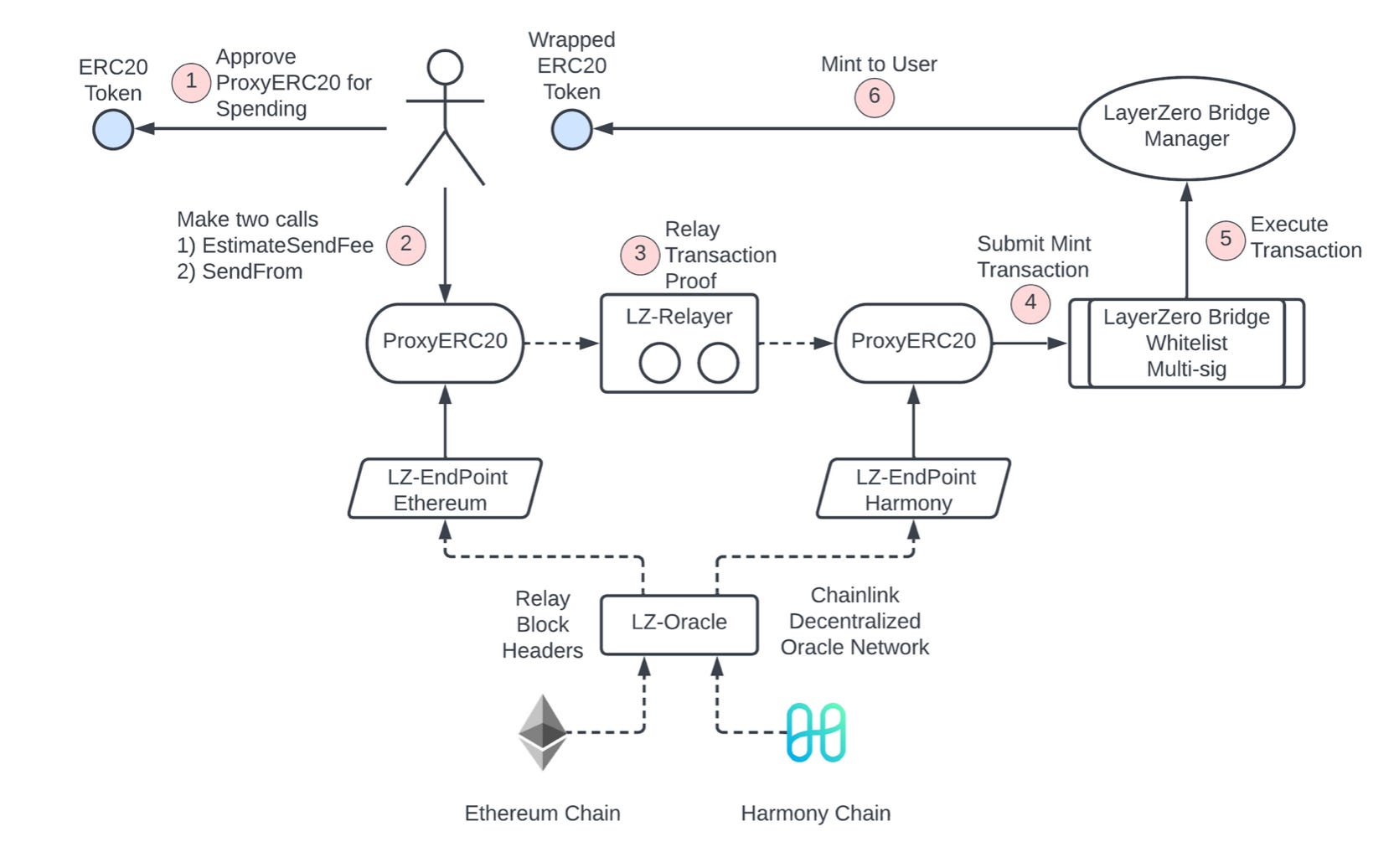
The mechanism functions as follows: following the April 19, 2026 exploit in which the attacker drained approximately 116,500 rsETH from Kelp DAO’s LayerZero-powered rsETH bridge adapter – funding initial gas fees via Tornado Cash before swapping stolen assets back into ETH – Arkham Intelligence tracked the exploiter moving 75,700 ETH, equivalent to roughly $175 million, across three discrete transactions on April 22, 2026, including a transfer of 25,000 ETH to one new address and 50,700 ETH to another, marking the beginning of a broader laundering dispersal.
From those intermediate wallets, funds have been routed through THORChain’s native asset swap infrastructure, which executes cross-chain conversions – primarily ETH to Bitcoin – without custodial intermediaries, without KYC checkpoints, and without any mechanism for node operators to freeze or reverse individual transactions once initiated.
ZachXBT’s tracing indicates the funds passed through Tornado Cash before the cross-chain splits, with some portion subsequently reaching the Bitcoin network via THORChain and additional fragmentation through Umbra, a privacy protocol built on Ethereum. It is necessary to flag the epistemic status of several details here: the precise total confirmed to have cleared THORChain versus still in transit is unverified at time of publication; the specific wallet addresses and transaction hashes tied to the $80 million figure have not been independently confirmed by a second forensic firm beyond ZachXBT’s Telegram disclosures; and the full scope of cross-chain destination addresses on the Bitcoin side has not been publicly enumerated.
What is confirmed: THORChain’s anomalous volume spike to $394 million over a 24-hour window is consistent with a large-volume directional flow rather than organic market activity, and Arbitrum separately froze 30,766 ETH linked to the exploiter – a portion of the broader stolen pool – which is documented in Arbitrum’s published governance action.
Disclaimer: Coinspeaker is committed to providing unbiased and transparent reporting. This article aims to deliver accurate and timely information but should not be taken as financial or investment advice. Since market conditions can change rapidly, we encourage you to verify information on your own and consult with a professional before making any decisions based on this content.
Daniel Frances is a technical writer and Web3 educator specializing in macroeconomics and DeFi mechanics. A crypto native since 2017, Daniel leverages his background in on-chain analytics to author evidence-based reports and deep-dive guides. He holds certifications from The Blockchain Council, and is dedicated to providing "information gain" that cuts through market hype to find real-world blockchain utility.
Bitmine Immersion Technologies disclosed on April 19, 2026 that its Ethereum treasury stands at 4,976,485 ETH – valued at $2,301 per token – with total crypto and cash holdings aggregating to $12.9 billion, up from the $10.7 billion reported in the company’s March 30 disclosure when holdings reached 4.732 million ETH. The increase reflects both continued accumulation and ETH price appreciation since that filing.
At 4.12% of the total ETH supply of 120.7 million tokens, the position places Bitmine within 23,515 ETH of its stated ‘Alchemy of 5%’ target – a threshold that, if crossed, would mean a single corporate treasury controls one in twenty ether tokens in circulation. That is not a liquidity metric. It is a structural one.
Bitmine ETH Treasury: Breaking Down the 4.976 Million Position
The balance sheet as of April 19, 2026 comprises 4,976,485 ETH as the primary holding, 199 Bitcoin, $1.12 billion in cash, a $200 million stake in Beast Industries, and a $107 million stake in Eightco Holdings (NASDAQ: ORBS), which provides indirect exposure to OpenAI. The ETH position alone, at spot, accounts for the bulk of the $12.9 billion aggregate – a concentration that reflects deliberate strategy rather than diversification failure.
Bitmine ( @BitMNR) bought 101,627 $ETH ($234.7M) last week.
Of the 4.976 million ETH held, 3,334,637 tokens – approximately 67% of the treasury – are currently staked, carrying a notional value of $7.7 billion at the April 19 price. That staked position generates annualized revenues of $221 million at present, with a projected run-rate of $330 million once the full treasury is deployed through MAVAN (Made in American VAlidator Network), Bitmine’s institutional-grade staking infrastructure launched earlier this year.
Bitmine’s staking program has been expanding steadily, and the MAVAN platform is now positioned to serve external institutional clients beyond Bitmine’s own treasury.
Bitmine’s 7-day staking yield stands at 2.88% annualized – modestly above the Composite Ethereum Staking Rate of 2.76%, as administered by Quatrefoil. The 12 basis-point outperformance over the benchmark rate is a data point the company attributes to operational efficiency in its validator infrastructure. The remaining 33% of ETH – approximately 1.64 million tokens – sits liquid, providing a balance between yield generation and balance sheet flexibility.
The pace of accumulation has accelerated. Bitmine acquired 101,627 ETH in the single week ending April 19 – the highest weekly purchase rate since December 15, 2025 – and has sustained elevated buying across four consecutive weeks. At that velocity, the 5% threshold is arithmetically close. Whether capital availability or market conditions determine the timeline is the remaining variable.
Disclaimer: Coinspeaker is committed to providing unbiased and transparent reporting. This article aims to deliver accurate and timely information but should not be taken as financial or investment advice. Since market conditions can change rapidly, we encourage you to verify information on your own and consult with a professional before making any decisions based on this content.
Daniel Frances is a technical writer and Web3 educator specializing in macroeconomics and DeFi mechanics. A crypto native since 2017, Daniel leverages his background in on-chain analytics to author evidence-based reports and deep-dive guides. He holds certifications from The Blockchain Council, and is dedicated to providing "information gain" that cuts through market hype to find real-world blockchain utility.
The Ethereum Foundation disclosed on Thursday that its six-month ETH Rangers Program – operated in conjunction with the Ketman Project and the Security Alliance (SEAL) – detected approximately 100 IT workers linked to the Democratic People’s Republic of North Korea embedded across 53 crypto projects, while simultaneously recovering $5.8 million in funds and surfacing more than 785 vulnerabilities, with the findings published the same week the U.S. Justice Department announced that two American nationals had been sentenced to at least seven years in prison for helping DPRK operatives pose as U.S.-based developers to infiltrate roughly 100 domestic companies.
We suspect this is less a story about one foundation’s security program and more a structural signal about how deeply state-sponsored labor infiltration has penetrated the crypto hiring pipeline – and how poorly equipped most projects remain to detect it.
The ETH Rangers Program has wrapped up and the results speak for themselves: $5.8M+ recovered, 785+ vulnerabilities reported, 100+ DPRK operatives identified, and so much more.
A decentralized defence for a decentralized network.
The industry’s exposure here is not primarily technical. It is procedural: verification gaps in remote hiring, insufficient background screening, and an absence of sanctions compliance infrastructure at the project level have collectively created the conditions under which DPRK workers can operate for months – or years – before detection.
ETH Rangers Program and the Ketman-SEAL Framework: Detection Mechanics, Confirmed Findings, and What the Ethereum Foundation Has Disclosed
The mechanism functions as follows: the Ethereum Foundation funded and coordinated the ETH Rangers Program with a mandate to surface active North Korea crypto IT worker presence inside Ethereum ecosystem projects, tasking the Ketman Project and SEAL with co-authoring an identification framework capable of flagging behavioral, technical, and identity-based indicators consistent with known DPRK worker patterns.
Over its six-month operating window, the program produced four headline results – $5.8 million recovered, 785-plus vulnerabilities reported, more than 100 DPRK operatives identified, and a documented trail of incident responses across dozens of affected projects. The Ethereum Foundation Ecosystem Support Program described the outcome as “a decentralized defence for a decentralized network.”
Blockchain investigator Nick Bax played a parallel role outside the formal program structure, independently identifying and notifying more than 30 project teams that DPRK-linked workers were on their active payrolls, and coordinating the freezing of hundreds of thousands of dollars in crypto already received by those operatives. The Foundation’s statement that the work “directly addresses one of the most pressing operational security threats facing the Ethereum ecosystem today” is notable for its framing: this is an ongoing threat requiring active detection infrastructure, not a historical anomaly that has been resolved.
It is necessary to flag the epistemic status of several details here: the specific identification methodology used by the Ketman Project and SEAL has not been publicly released in full, and the 53 affected projects have not been named. The $5.8 million recovery figure covers funds clawed back across all ETH Rangers activities, not exclusively DPRK-related cases. The 100-operative count represents detections within the Ethereum ecosystem scope of the program and should not be read as an upper bound on total DPRK crypto-industry infiltration.
The criminal enforcement dimension adds a separate evidentiary layer. The two convicted U.S. nationals – who pleaded guilty to wire fraud and money laundering conspiracy – received $700,000 for their roles routing millions in proceeds from victimized American companies to DPRK-controlled accounts. Eight additional defendants indicted in connection with the same scheme remain at large, according to the Justice Department. The DOJ announced the sentencing on April 16 – a date that coincided, the department noted, with the birthday of DPRK founder Kim Il Sung.
Disclaimer: Coinspeaker is committed to providing unbiased and transparent reporting. This article aims to deliver accurate and timely information but should not be taken as financial or investment advice. Since market conditions can change rapidly, we encourage you to verify information on your own and consult with a professional before making any decisions based on this content.
Daniel Frances is a technical writer and Web3 educator specializing in macroeconomics and DeFi mechanics. A crypto native since 2017, Daniel leverages his background in on-chain analytics to author evidence-based reports and deep-dive guides. He holds certifications from The Blockchain Council, and is dedicated to providing "information gain" that cuts through market hype to find real-world blockchain utility.
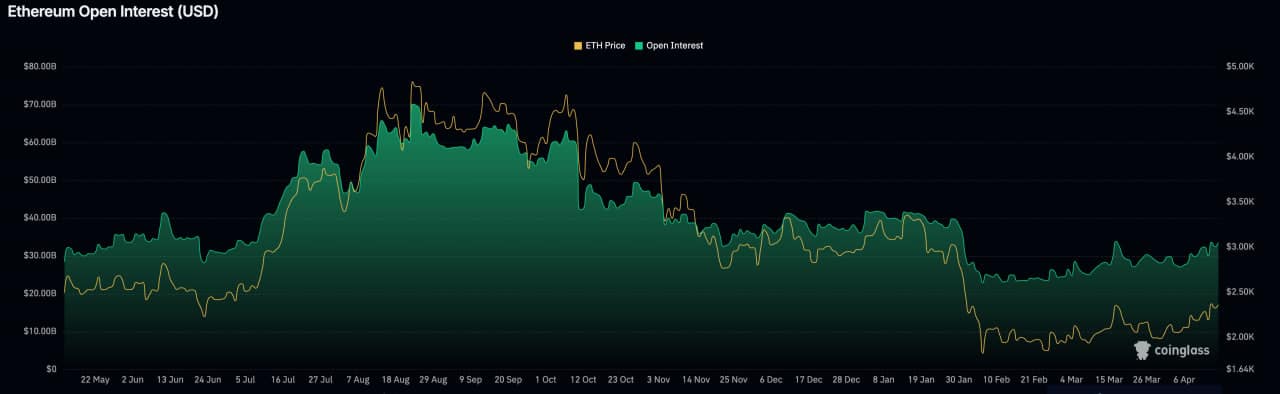
ETH crypto futures open interest climbed 26% to $25.4 billion, according to data aggregated via Coinglass – a move that places the current derivatives build-up among the more aggressive positioning surges of 2026 and arrives after open interest had already logged an 11.59% single-day gain to $34.165 billion across the broader derivatives complex.
ETH was trading in the $2,356–$2,395 range during the rally, with a 24-hour high of $2,384 pushing market cap to approximately $286 billion. The structural significance of this reading lies less in the absolute price level than in what concentrated futures positioning reveals about participant composition and near-term volatility exposure.
Context matters here: over the seven weeks into mid-April 2026, ETH open interest had already risen 45% alongside Bitcoin’s 59% gain – both assets recovering from February lows in what Santiment characterized as a rapid accumulation of margin positions. The 26% jump represents an acceleration within that broader trend, not an isolated event.
ETH Futures Open Interest: What the $25.4 Billion Build-Up Actually Represents
The mechanism functions as follows: open interest measures the total value of outstanding derivatives contracts – long and short – that have not been settled. A 26% surge in a compressed window does not, by itself, indicate directional bias; it indicates that net new capital is entering the derivatives market and taking on leveraged exposure, which amplifies both upside momentum and downside liquidation risk.
Exchange concentration data sharpens the picture. Binance alone accounts for $7.416 billion in ETH open interest – roughly 29% of the $25.4 billion futures total – followed by Gate at $4.36 billion, Bybit at $2.331 billion, and OKX at $1.943 billion. These four venues collectively control approximately 53.3% of global ETH derivatives share, concentrating liquidation risk on a small number of platforms where cascading margin calls can propagate rapidly if ETH tests key support.
This is notable precisely because the leverage build-up echoes a March 2026 pattern – a 9% daily open interest spike that preceded partial corrections as crowded leveraged trades unwound. Analysts tracking the data have flagged that the current configuration carries analogous structural fragility: surging open interest in a tightening price range is historically a precondition for volatility expansion in either direction, not a confirmation of trend sustainability.
Can ETH Crypto Hold Its Rally or Does Network Activity Become the Binding Constraint?
The derivatives surge has not been uniformly matched by on-chain fundamentals, and that divergence is where we suspect the rally faces its most credible structural test. Open interest expanding on leverage while network activity remains subdued is a recognizable pattern: it reflects speculative repositioning rather than demand-driven usage growth, which has historically proven insufficient to sustain multi-week price recoveries in ETH.
The immediate technical focal point is $2,400 resistance. If ETH fails to clear that level with conviction, the leveraged long overhang becomes a liquidation liability – particularly ahead of the April 2026 Ether futures expiry (ERJ26), which could trigger mechanical position unwinds regardless of spot sentiment. Earlier analysis flagging elevated odds of a drop toward $1,500 in ETH’s market structure remains a relevant baseline for positioning risk, even as the current derivatives data implies near-term bullish conviction.
Institutional behavior in spot markets will be the cleaner signal to monitor. A pattern of large-scale ETH accumulation and strategic selling by whales has introduced asymmetry into the market – some participants are using derivatives rallies to distribute spot holdings, a dynamic that can cap price appreciation even as open interest climbs.
Bull case: spot inflows confirm derivatives positioning and ETH crypto clears $2,400, triggering further short liquidations. Base case: open interest stabilizes as ERJ26 expiry approaches, volatility compresses.
Bear case: leverage unwinds through $2,312 support, replicating the March correction pattern at higher notional scale.
The 26% open interest increase is a concrete, measurable signal of renewed speculative participation – not a price target, not a fundamental endorsement. Whether it resolves as momentum confirmation or a liquidation setup depends on the network activity and spot flow data over the next two to three weeks.
Disclaimer: Coinspeaker is committed to providing unbiased and transparent reporting. This article aims to deliver accurate and timely information but should not be taken as financial or investment advice. Since market conditions can change rapidly, we encourage you to verify information on your own and consult with a professional before making any decisions based on this content.
Daniel Frances is a technical writer and Web3 educator specializing in macroeconomics and DeFi mechanics. A crypto native since 2017, Daniel leverages his background in on-chain analytics to author evidence-based reports and deep-dive guides. He holds certifications from The Blockchain Council, and is dedicated to providing "information gain" that cuts through market hype to find real-world blockchain utility.
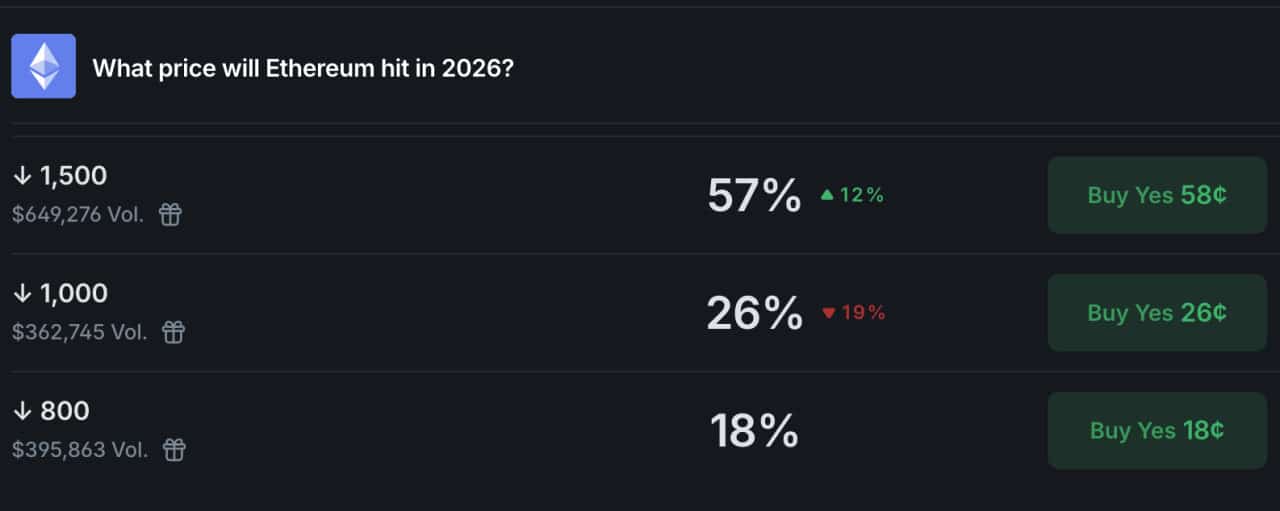
Ethereum price is trading near $2,200, down roughly 12% over the past week, as prediction market odds of a drop to $1,500 have climbed to levels that warrant structural attention.
Polymarket currently prices a 56% probability of ETH touching $1,500 at some point in 2026 – a figure that has risen in tandem with a broader collapse in speculative positioning.
That probability is not a price target from a research desk; it is a real-money bet from a decentralized prediction market, which gives it a different kind of weight.
The backdrop sharpening that number: ETH futures open interest has fallen to approximately $23 billion, the lowest reading since 2024 and roughly two-thirds below the 2025 peak of nearly $70 billion – signaling that leveraged demand has been effectively drained from the market.
ETH peaked near $4,960 in late 2025, meaning the asset has already shed close to 64% from its cycle high. What remains unresolved is whether $1,500 represents the next structural floor or whether the downside risk to key support levels has already been priced into current positioning.
Can Ethereum Price Hold $2,200 Support or Is a Deeper Correction Inevitable?
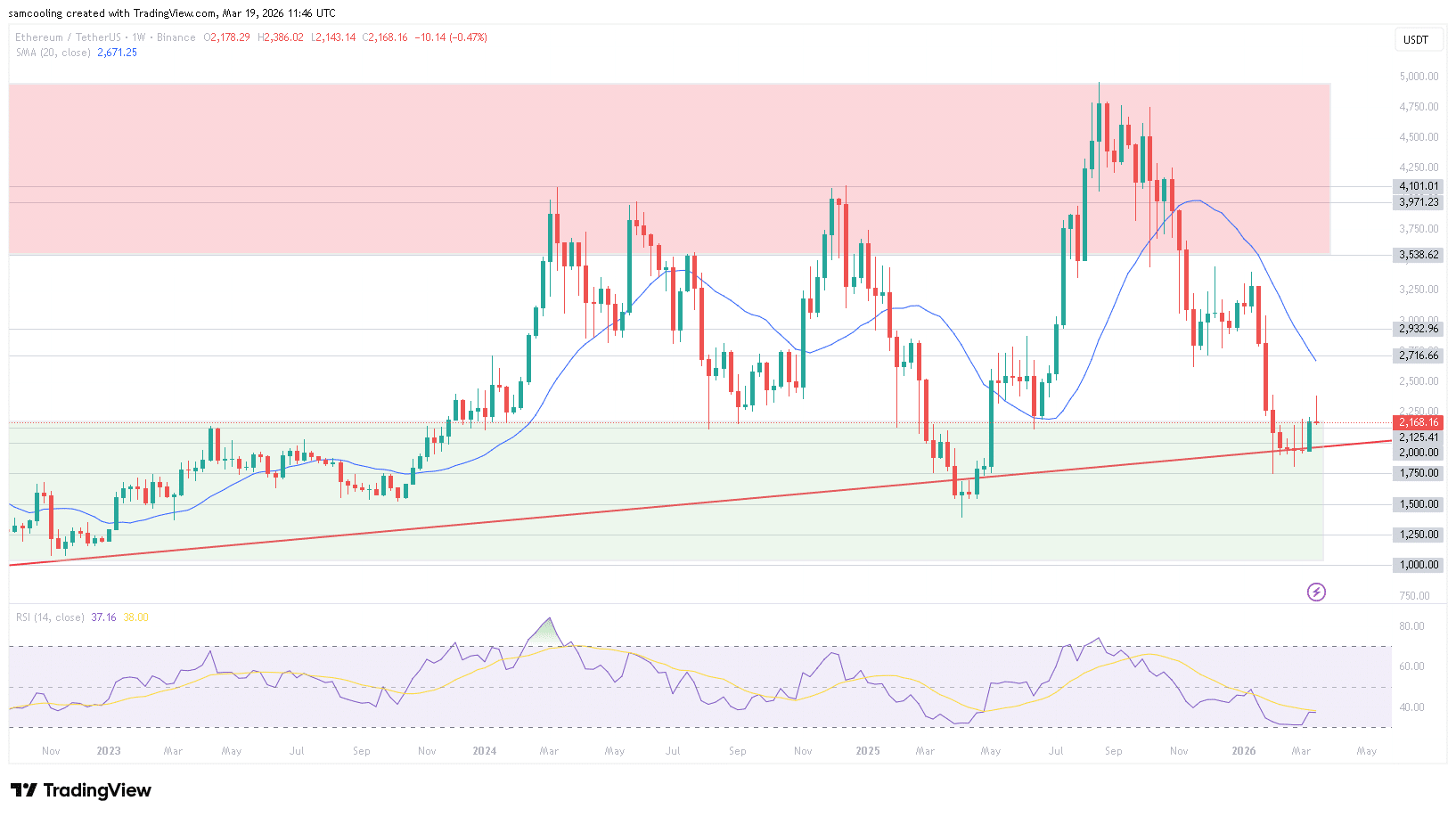
ETH is currently trading below its 200-day moving average, below the 78.6% Fibonacci retracement of the 2024–2025 rally, and below a series of Murrey Math Lines pivot levels that had previously provided technical footing.
The daily chart has been forming a bearish pennant pattern since February, when ETH failed to reclaim $2,400 after a brief weekend bounce – a failure that effectively confirmed the short-term trend had shifted from consolidation to distribution.
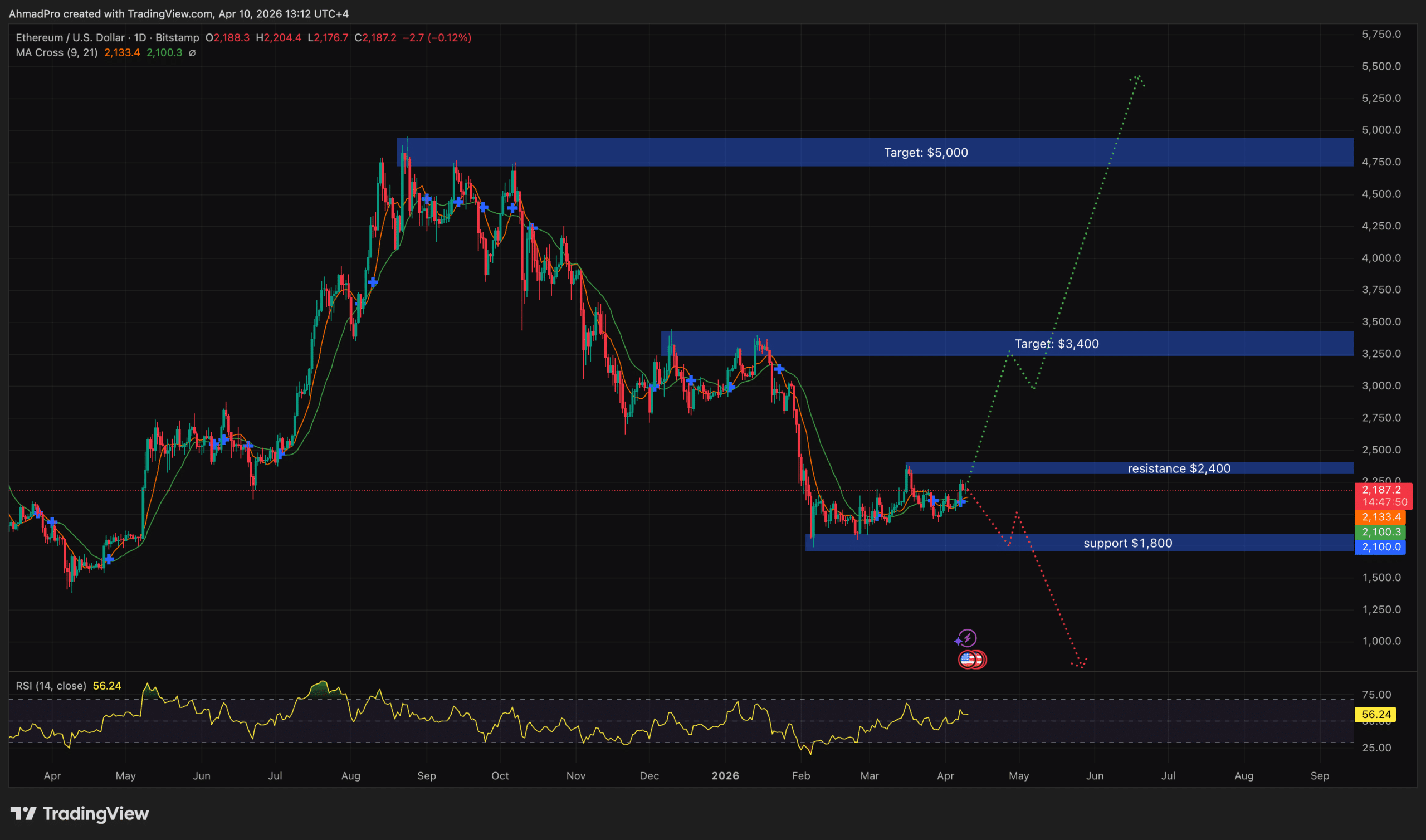
ETH is sitting right at a turning point, because reclaiming $2,400 on a weekly close is what shifts momentum, and once that happens, short covering can kick in fast and push price higher, with $2,800 as the next key zone before any bigger move starts coming into play.
For now, though, it still looks like a grind, with ETH likely stuck between $2,100 and $2,200 while the market waits for stronger signals like ETF inflows picking up again and real growth returning on Layer 2 activity, so recovery is there, but it is slow, not explosive.
The risk is that the bearish structure still plays out, because if momentum does not return and demand stays weak, price can slide toward $1,500, and that only gets invalidated if ETH can push and hold above the $2,300 area, which is the level that really flips the structure back in favor of buyers.
The Polymarket 72% probability figure should be read carefully: prediction markets reflect current sentiment and capital allocation, not fundamental valuation. They can overshoot. But at current readings, the market is not treating $1,500 as a tail risk – it is treating it as the base case.
Disclaimer: Coinspeaker is committed to providing unbiased and transparent reporting. This article aims to deliver accurate and timely information but should not be taken as financial or investment advice. Since market conditions can change rapidly, we encourage you to verify information on your own and consult with a professional before making any decisions based on this content.
Daniel Frances is a technical writer and Web3 educator specializing in macroeconomics and DeFi mechanics. A crypto native since 2017, Daniel leverages his background in on-chain analytics to author evidence-based reports and deep-dive guides. He holds certifications from The Blockchain Council, and is dedicated to providing "information gain" that cuts through market hype to find real-world blockchain utility.
Charles Schwab is rolling out direct Bitcoin and Ethereum crypto trading to its brokerage client base, a platform that encompasses 38.9 million active accounts and $12.22 trillion in client assets – in a phased launch beginning in the second quarter of 2026.
The offering, branded Schwab Crypto and operated through Charles Schwab Premier Bank, SSB, marks a structural departure from the firm’s prior crypto exposure model, which routed clients through ETFs, futures, and crypto-adjacent equities.
The significance is not merely product expansion. It is a test of whether direct digital asset ownership can integrate into the workflow of a mainstream brokerage customer at scale – and whether that integration generates the kind of demand signal that reshapes competitive dynamics across the retail brokerage industry.
🚨CHARLES SCHWAB TO LAUNCH SPOT BTC & ETH
Charles Schwab plans to roll out spot BTC and ETH trading in the first half of 2026 via its Premier Bank unit.
This enables the $11.9T platform's users to trade crypto alongside traditional assets as it competes with major exchanges. pic.twitter.com/eBBrO3lTJw
Schwab Crypto Structure: Breaking Down the Implementation Mechanics
Schwab Crypto does not live inside the existing brokerage account.
Qualifying clients will access direct BTC and ETH trading through a dedicated account tied to the firm’s affiliated banking subsidiary – a structural boundary that separates crypto holdings from the stocks, bonds, and ETFs clients already hold under SIPC coverage. Crypto assets held through the new product carry neither SIPC nor FDIC protection, a disclosure Schwab is making explicit in its rollout materials.
The initial cohort is narrow by design. The pilot begins with Schwab employees, followed by a small early-access group drawn from a waitlist currently open on Schwab’s crypto page, before broadening through the remainder of the first half of 2026.
Geographic restrictions apply at launch: the product is available across all U.S. states except New York and Louisiana. Asset scope is limited to Bitcoin and Ethereum only, with no additional cryptocurrencies announced.
Feature depth at launch is also deliberately constrained. Schwab currently accepts no external crypto deposits and does not support withdrawals to self-custody wallets, staking, recurring purchases, or limit orders – capabilities that distinguish native crypto platforms from this initial brokerage integration. Pricing and fee structure have not been publicly disclosed ahead of the pilot. The product, as structured, is a basic buy-and-sell interface sitting inside one of the largest financial institutions in the United States.
That simplicity is the point. Schwab is not competing with Coinbase on feature depth. It is testing whether the mere availability of direct ownership – inside a familiar brokerage interface, for a client base that already trusts Schwab with their retirement savings – generates measurable demand distinct from what ETF flows have already revealed.
Disclaimer: Coinspeaker is committed to providing unbiased and transparent reporting. This article aims to deliver accurate and timely information but should not be taken as financial or investment advice. Since market conditions can change rapidly, we encourage you to verify information on your own and consult with a professional before making any decisions based on this content.
Neil is a professional cryptocurrency content writer with years of experience. He has written for various cryptocurrency websites to report on breaking news, and been hired by all sorts of cryptocurrency projects, to create content that would increase their exposure and attract more potential investors.
The Ethereum Foundation staked an additional 22,517 ETH – valued at approximately $46.2 million at the time of execution – bringing its cumulative staked position to 24,623 ETH, or roughly $50 million, according to on-chain data from Arkham Intelligence.
The deposits were made in 11 uniform transactions of approximately 2,047 ETH each, executed through the Foundation’s multisig wallet directly to the Beacon Chain smart contract on March 30, 2026.
The action removes a meaningful tranche of ETH from liquid circulating supply and formally commits the Foundation’s own treasury to the validator economics it has long advocated – a structural signal distinct from any yield-seeking motivation.
🚨JUST IN: ETHEREUM FOUNDATION STAKES $46M ETH IN LARGEST MOVE TO DATE
The @Ethereum Foundation staked around $46.2 million worth of $ETH. This marks its largest staking event so far.
Ethereum Foundation Staking Position: What the $50M Commitment Represents
The latest batch accounts for the vast majority of the Foundation’s staked total – prior to March 30, only approximately 2,106 ETH had been deposited, including an initial 2,016 ETH staked on February 24, 2026, and a smaller 31 ETH deposit earlier in March.
The acceleration from a modest pilot to a $46.2 million single-event deposit marks the largest staking action the Foundation has undertaken to date, a point Arkham Intelligence noted explicitly in its on-chain alert.
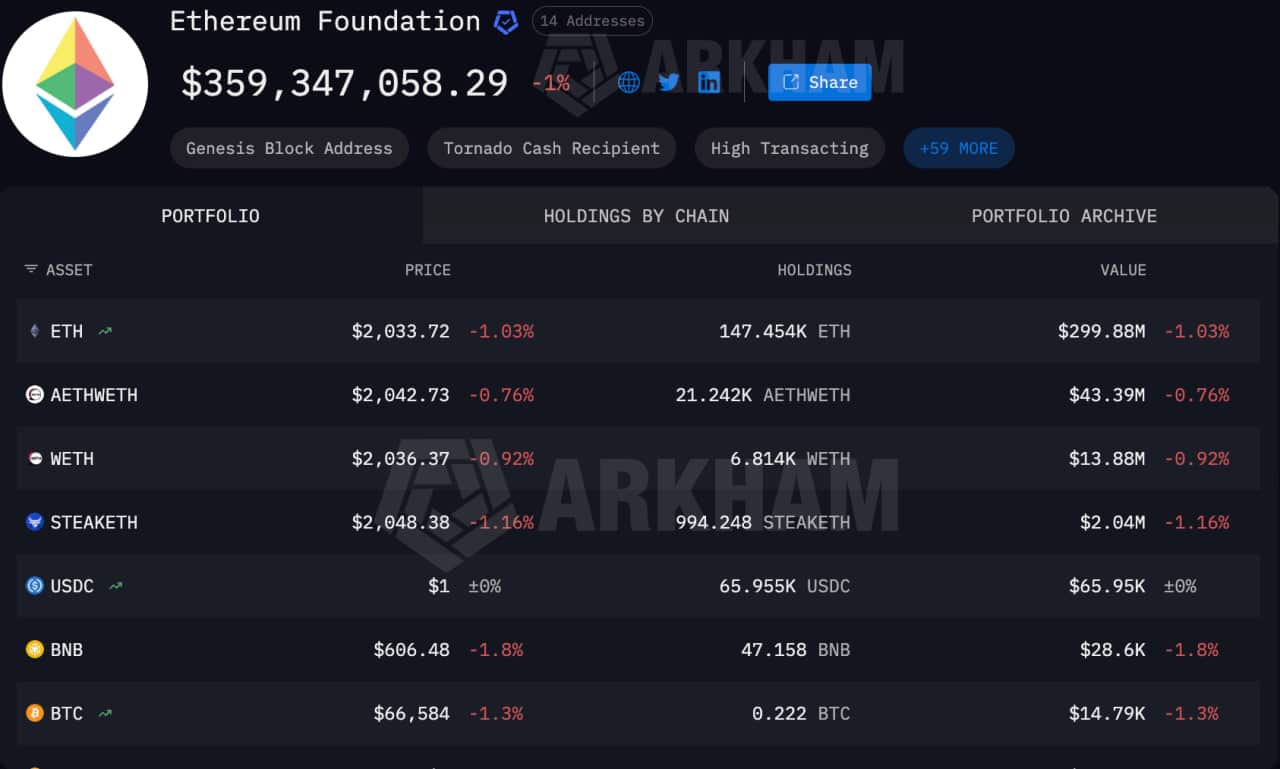
According to Arkham Intelligence data, the Foundation currently holds approximately 147,000 ETH in total, with a broader on-chain portfolio valued above $364 million. The staked 24,623 ETH represents roughly 16.7% of that ETH position now locked in the Beacon Chain – unavailable for sale, transfer, or OTC placement until withdrawal conditions are met.
The Foundation’s treasury strategy, outlined in a policy document published in June 2025, explicitly committed the organization to using staking and decentralized finance protocols to enhance financial sustainability rather than relying on periodic asset sales. Prior to this shift, the Foundation had conducted OTC transactions, including a 10,000 ETH sale to SharpLink Gaming and a 5,000 ETH sale to BitMine Immersion Technologies, using proceeds for research and grants. The staking program replaces that sell-pressure with yield generation.
The staked ETH earns consensus-layer rewards – current annualized rates sit near 2.7% to 3% per the CoinDesk Composite Ether Staking Rate – with all yield directed back to the Foundation to fund operations, grants, and research.
Ethereum Staking and Supply Dynamics: What Foundation Participation Changes
Approximately $78 billion worth of ETH is currently staked across the Ethereum network, representing a substantial share of total supply already committed to validator duties. The Foundation’s 24,623 ETH is a small absolute fraction of that figure, but its symbolic weight exceeds its proportional size: the organization that maintains and funds Ethereum’s core development is now an active participant in the security model it governs.
The yield economics reinforce the structural logic. At a 2.7% to 3% annual staking rate, the Foundation’s $50 million position generates roughly $1.35 million to $1.5 million per year in ETH-denominated rewards – capital that flows back into grants and R&D without requiring additional asset sales or external fundraising. That mechanism reduces sell-side pressure on ETH while simultaneously funding ecosystem development, a dual effect that no OTC sale structure could replicate.
The Foundation’s ultimate target is 70,000 ETH staked, equivalent to approximately $142 million at current prices. Roughly 45,000 ETH remains to be committed to reach that threshold, meaning the current $50 million position represents just under 35% of the planned total. Each subsequent tranche narrows the liquid float held by the Foundation and extends the runway for yield-funded operations.
Disclaimer: Coinspeaker is committed to providing unbiased and transparent reporting. This article aims to deliver accurate and timely information but should not be taken as financial or investment advice. Since market conditions can change rapidly, we encourage you to verify information on your own and consult with a professional before making any decisions based on this content.
Neil is a professional cryptocurrency content writer with years of experience. He has written for various cryptocurrency websites to report on breaking news, and been hired by all sorts of cryptocurrency projects, to create content that would increase their exposure and attract more potential investors.
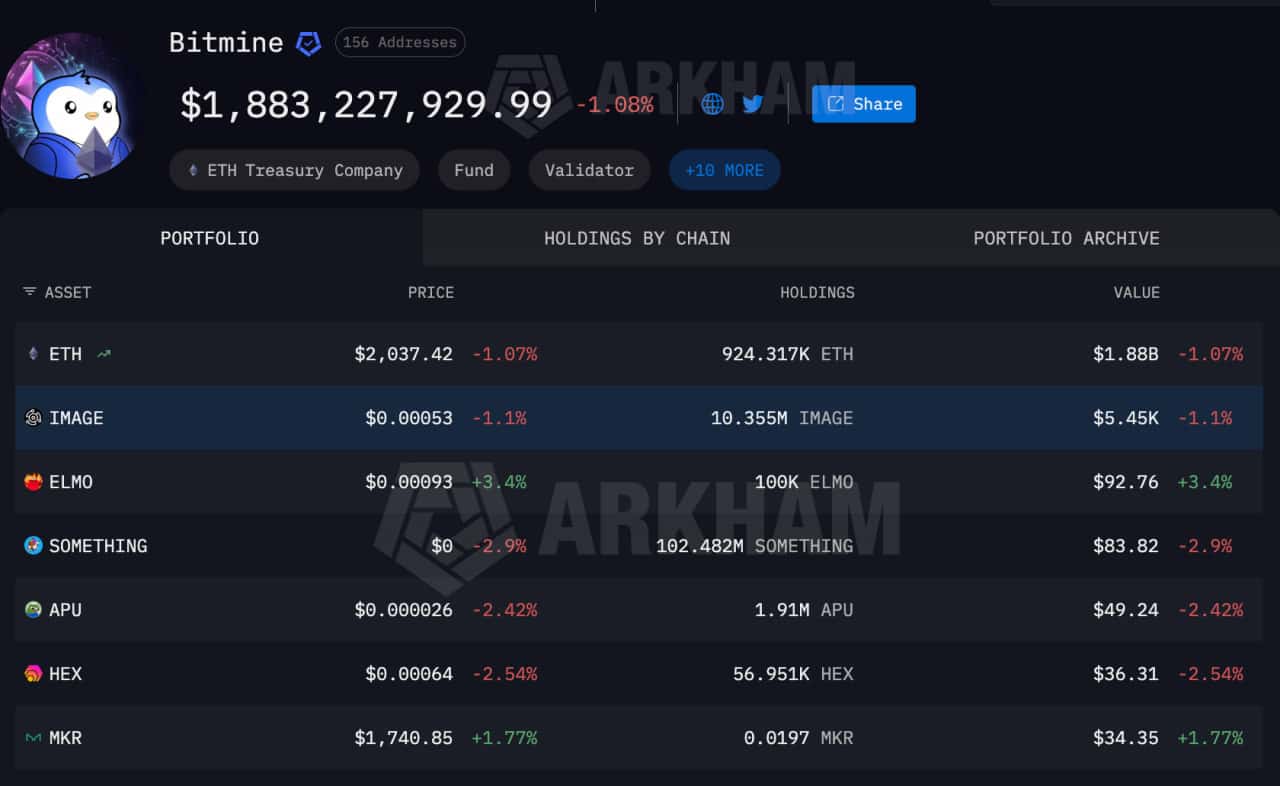
Bitmine Immersion Technologies (NYSE American: BMNR) disclosed on March 30, 2026 that its Ethereum treasury has reached 4.732 million ETH tokens, with combined crypto holdings, total cash of $961 million, and other positions – including “moonshot” assets – aggregating to $10.7 billion.
At the reference price of $2,005 per ETH, the company’s Ethereum stack alone carries a notional value exceeding $9.4 billion, placing Bitmine among the largest single corporate holders of Ether by token count. The disclosure confirms an accelerating accumulation cadence that has now removed a measurable fraction of Ethereum’s circulating supply from active market participation.
Bitmine states it now controls 3.92% of the total ETH token supply, which the company frames as being over 78% of the way toward its self-described “Alchemy of 5%” threshold – a target it set roughly eight months prior. The pace of that accumulation, given the scale of capital deployed in that window, represents one of the more aggressive single-entity ETH acquisition programs on record among publicly listed equities.
JUST IN:
TOM LEE AND BITMINE $BMNR BOUGHT 71.1K ETHEREUM THIS PAST WEEK … Here is Bitmine's updated holdings
– 4,732,082 $ETH, up from 4.66M on March 22nd (3.14M are currently staked) – 197 Bitcoin $BTC – $961M cash – $200M stake in Beast Industries – $102M stake in Eightco… pic.twitter.com/PcGqFtfNz2
— Tom Lee Tracker (Not actually Tom) (@TomLeeTracker) March 30, 2026
Bitmine ETH Treasury: Breaking Down the 4.732M Position
Of the 4.732 million ETH disclosed, Bitmine reports 3,142,643 tokens are actively staked – valued at approximately $6.3 billion at current prices – through MAVAN (Made in America VAlidator Network), the company’s proprietary institutional staking infrastructure launched on March 25, 2026.
Beyond ETH, Bitmine disclosed $102 million in ORBS holdings, which the company characterizes as providing investors direct public-equity exposure to OpenAI – a claim that warrants independent verification but signals the firm’s appetite for high-conviction asymmetric positions.
Total cash stands at $961 million, providing a meaningful liquidity buffer relative to a combined position book that is heavily concentrated in a single volatile asset. The balance sheet composition – approximately 88% crypto by notional value – leaves little ambiguity about the company’s strategic orientation.
Every ETH token moved into Bitmine’s staking infrastructure is withdrawn from the liquid circulating supply. At 4.732 million tokens, the company’s holdings exceed the daily trading volume of ETH on most centralized exchanges by a significant multiple, meaning any forced liquidation scenario would itself become a price-relevant market event.
Corporate Ethereum Treasury: The Structural Case Behind the Disclosure
Bitmine’s 3.92% supply ownership figure is not merely a vanity metric. Ethereum’s proof-of-stake architecture means that staked ETH earns protocol-level yield – currently in the 3%–4% annualized range – while simultaneously reducing the float available to spot and derivatives markets.
A single entity controlling nearly 4% of supply and directing the majority of that into a validator network creates a compounding supply floor: the position generates yield in additional ETH, which if retained, increases the ownership percentage without additional capital outlay.
The institutional backing Bitmine cites – ARK Investment Management’s Cathie Wood, Pantera Capital, Founders Fund, Galaxy Digital, Digital Currency Group, and Kraken among others – suggests the position is not speculative in the retail sense.
Source: Total Ethereum Spot ETF Net Inflow / SoSoValue
These are mandate-driven allocators whose involvement implies a due-diligence threshold has been cleared, a signal qualitatively distinct from retail-driven accumulation. The parallel to Strategy’s Bitcoin treasury playbook is structural: a public company uses equity market access to accumulate a scarce digital asset at scale, concentrating supply while maintaining a liquid stock for institutional entry.
Bitmine reports BMNR is currently the 100th most traded stock in the United States, averaging $920 million in daily volume over the prior five sessions – a liquidity profile that amplifies both the capital-raise capacity and the volatility risk inherent in a three-employee firm managing a $10.7 billion combined position.
The next material disclosure event – whether an 8-K update on ETH acquisition activity or Q1 fiscal 2026 earnings – will indicate whether Bitmine closes the remaining gap to 5% supply ownership before Ethereum’s market structure shifts again. At the current accumulation velocity, the threshold is within reach. The coins are not being sold.
Disclaimer: Coinspeaker is committed to providing unbiased and transparent reporting. This article aims to deliver accurate and timely information but should not be taken as financial or investment advice. Since market conditions can change rapidly, we encourage you to verify information on your own and consult with a professional before making any decisions based on this content.
Daniel Frances is a technical writer and Web3 educator specializing in macroeconomics and DeFi mechanics. A crypto native since 2017, Daniel leverages his background in on-chain analytics to author evidence-based reports and deep-dive guides. He holds certifications from The Blockchain Council, and is dedicated to providing "information gain" that cuts through market hype to find real-world blockchain utility.
In a significant shift for institutional participation, Bitmine Immersion Technologies Inc. has executed one of the largest recent staking transactions, locking approximately 94,670 ETH into the beacon chain.
This move, valued at roughly $204 million at the time of execution, brings Bitmine’s total staked holdings to a staggering 3,142,291 ETH. The transaction occurred as Ethereum (ETH) traded at $2,153.97, testing a crucial support zone following four consecutive days of losses.
This aggressive accumulation mirrors prior institutional behavior observed when BlackRock acquired a stake in Bitmine, suggesting a continued appetite for yield-bearing crypto assets despite broader market volatility.
Data from Arkham Intelligence confirms the lock-up, which effectively removes substantial liquidity from the circulating supply. With staking yields hovering between 3% and 4% per annum, the incentives for holding spot ETH are clashing with bearish technical indicators on shorter timeframes.
Can Ethereum News Hold the Critical $2,000 Support Level?
Ethereum is currently navigating a precarious technical setup. After sliding nearly 11% over a five-day period, the second-largest cryptocurrency by market cap has found temporary footing near $2,150.
Staking demand has surged, with volume growing between 5% and 7% in the last 72 hours alone. This creates a supply shock scenario—less liquid ETH available for sale—clashing with macro headwinds.
Ethereum (ETH)
24h7d30d1yAll time
If the $2,100 support level fails, analysts point to a potential slide toward the 2026 lows near $1,386, a downside scenario actively tracked by prediction markets on Robinhood. Conversely, a bounce here faces immediate friction.
The CME futures gap between $2,405 and $2,665 sits as a heavy resistance band, often acting as a magnet for price reversion but difficult to break without significant volume.
The massive Bitmine lock-up acts as a soft floor. By restraining sell-side pressure during instant volatility events, institutional staking provides a buffer, though it rarely reverses a trend single-handedly. Investors must now watch if spot buyers can defend the daily lows of $2,053.
Disclaimer: Coinspeaker is committed to providing unbiased and transparent reporting. This article aims to deliver accurate and timely information but should not be taken as financial or investment advice. Since market conditions can change rapidly, we encourage you to verify information on your own and consult with a professional before making any decisions based on this content.
Daniel Frances is a technical writer and Web3 educator specializing in macroeconomics and DeFi mechanics. A crypto native since 2017, Daniel leverages his background in on-chain analytics to author evidence-based reports and deep-dive guides. He holds certifications from The Blockchain Council, and is dedicated to providing "information gain" that cuts through market hype to find real-world blockchain utility.
A sophisticated crypto trading entity has aggressively purchased 50,706 ETH worth approximately $111.62 million across two wallet addresses, marking a significant return to the market after a prolonged period of dormancy. This large-scale acquisition, executed throughout Wednesday, represents a high-conviction bet on the asset’s current valuation range of $2,167.
The accumulation is particularly notable for its strategic timing. The same entity previously liquidated holdings in 2025 at an average price of $3,892, effectively sidestepping the subsequent market correction. By re-entering the market at an average price of $2,201, the investor has executed a calculated whale move, increasing their position size while significantly lowering their cost basis compared to the previous year’s exit.
Ethereum On-Chain Data Reveals the Buy-Back Strategy
According to on-chain analysisby Lookonchain, using Arkham Intelligence data, the accumulation was split across two distinct addresses. The unidentified whale utilised 111.62 million USDT to secure the 50,706 ETH at an average entry of roughly $2,201. Data indicates this was the first significant activity from these wallets after 7 months of dormancy, suggesting a patient capital-allocation strategy.
The analytics platform attributed the funds used for this purchase to a prescient sale executed approximately one year ago. During that period, the entity sold 28,683 ETH at an average price of $3,892. The contrast in volume is distinct: the capital preserved from the sale at near-peak prices has now allowed the trader to nearly double their ETH holdings at current levels. While this entity is buying, other market participants have shown different behaviours; for instance, a separate Ethereum whale recently offloaded significant ETH holdings, highlighting the divergence in strategy among large holders during this consolidation phase.
Some initial speculation linked the wallets to ShapeShift founder Erik Voorhees due to historical transaction clusters. However, Voorhees has publicly denied ownership of these specific addresses as recently reported by The Block. Consequently, the entity remains classified as an anonymous, high-net-worth trader.
The timing of this ETH accumulation suggests a ‘smart money’ reversal. By offloading assets near the $3,900 range in 2025 and re-accumulating near $2,200, the whale has effectively capitalized on a 43% price discount. This behavior is characteristic of sophisticated market participants who utilize high-volatility periods to distribute assets to retail buyers and re-accumulate during periods of capitulation or extended consolidation.
This move mirrors broader trends observed in recent weeks, where dormant wallets have reactivated to defend support levels. It indicates that despite Ethereum trading significantly below its August 2025 all-time high of $4,946, deep-pocketed investors view the current sub-$2,500 range as a value zone. This conviction persists even as Ethereum network activity hits record highs while price action lags, creating a divergence that value investors often seek to exploit.
As of press time, Ether is trading around $2,168, showing a -1.6% decline over the last 24 hours. The whale’s entry average of $2,201 aligns closely with the 50-day moving average, which currently acts as a dynamic support level around $2,100. A sustained daily close below $2,150 could invalid the immediate bullish thesis, potentially exposing lower liquidity zones.
Conversely, if the buying pressure from this whale and similar entities sustains the price above $2,200, bulls will likely target the immediate resistance at $2,500. The asset remains roughly 55% down from its peak, leaving substantial room for recovery if institutional investment flows continue to stabilize the market structure.
The removal of over 50,000 ETH from liquid circulation effectively reduces the immediate sell-side pressure on exchanges. When large entities move assets into cold storage or private wallets, it typically signals a long-term holding horizon rather than intent to trade short-term volatility. This accumulation coincides with a renewed interest in spot Ethereum exchange-traded funds, which saw inflows of over $138 million earlier this week.
Furthermore, regulatory clarity continues to improve, with recent SEC guidance reinforcing the commodity status of most digital assets. As institutional and private whale demand converges at these support levels, market participants will be monitoring on-chain data to see if follow-on buying occurs, or if this remains an isolated event of opportunistic re-entry.
Disclaimer: Coinspeaker is committed to providing unbiased and transparent reporting. This article aims to deliver accurate and timely information but should not be taken as financial or investment advice. Since market conditions can change rapidly, we encourage you to verify information on your own and consult with a professional before making any decisions based on this content.
Daniel Frances is a technical writer and Web3 educator specializing in macroeconomics and DeFi mechanics. A crypto native since 2017, Daniel leverages his background in on-chain analytics to author evidence-based reports and deep-dive guides. He holds certifications from The Blockchain Council, and is dedicated to providing "information gain" that cuts through market hype to find real-world blockchain utility.
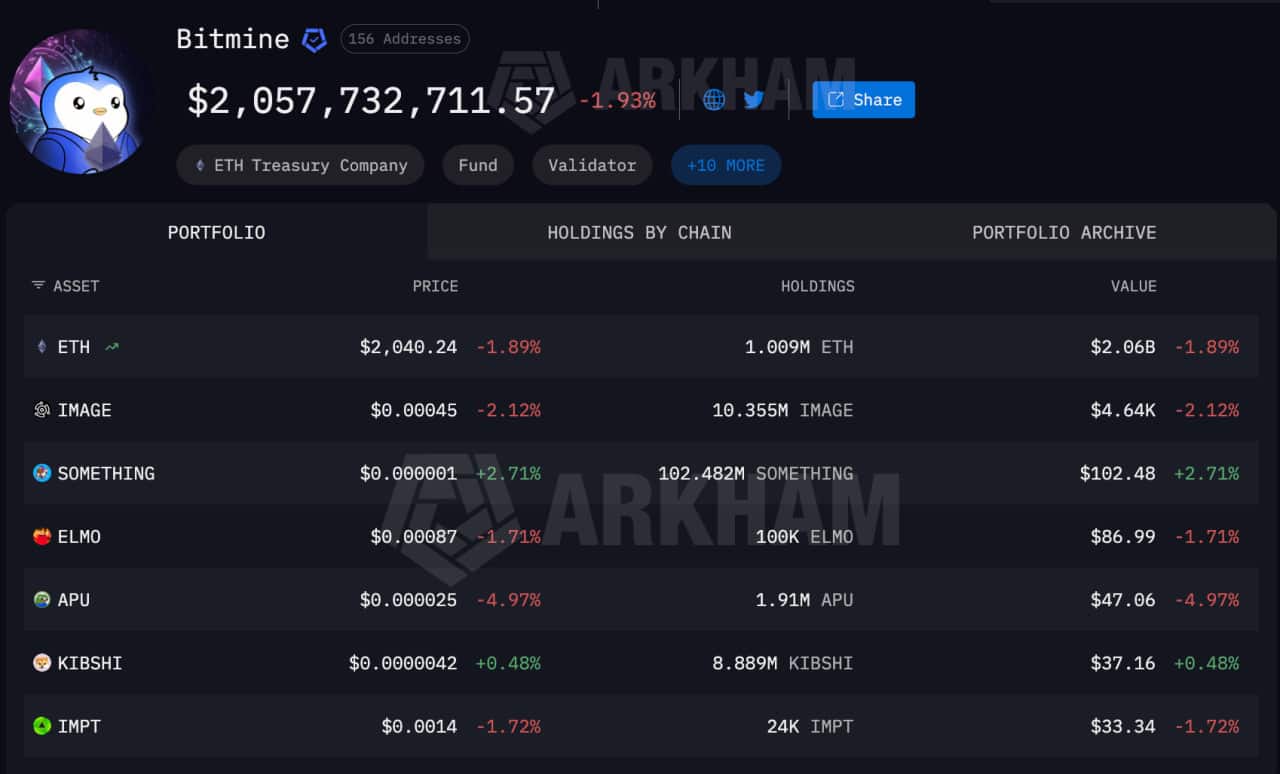
Bitmine Immersion Technologies (BMNR) purchased ETH 45,759 last week, valued at approximately $90 million, continuing its aggressive accumulation strategy despite ongoing market volatility. This acquisition marks the firm’s largest weekly purchase of the year in ETH$2 29924h volatility:1.7%Market cap:$277.27 BVol. 24h:$11.97 B
token terms, occurring as Fundstrat’s Tom Lee compares current investor sentiment to the depths of the 2018 and 2022 bear markets.
The purchase comes amid a period of bearish market activity that Lee characterizes as a “mini-winter.” For the Bitmine Chairman, current investor psychology reflects a level of “forlornness and dejection” reminiscent of the cyclical bottoms seen in November 2022 and during the prolonged crypto winter of 2018. However, Lee distinguishes the current environment from previous cycles, noting the absence of systemic collapses among major industry players.
Bitmine’s continued buying spree serves as a proxy for institutional conviction in Ethereum, even as price performance lags. Lee cited developments from the Consensus Hong Kong conference, specifically regarding tokenization and AI integration, as key growth drivers that the current market pricing ignores.
“The price of ETH is not reflective of the high utility of ETH,” Lee stated, reinforcing the decision to buy while sentiment remains at rock bottom. With significant cash reserves still on hand, Bitmine appears positioned to defend its stake and continue accumulation if prices remain suppressed.
This assessment aligns with broader technical indicators, suggesting the market may be oversold. Analysts have noted that Bitcoin hits deep value as RSI plummets, signaling potential support levels are forming across the damaging asset class. Despite the gloomy sentiment, Lee remains steadfast in his bullish outlook.
Bitmine Buys More ETH: Holdings and Strategic Losses
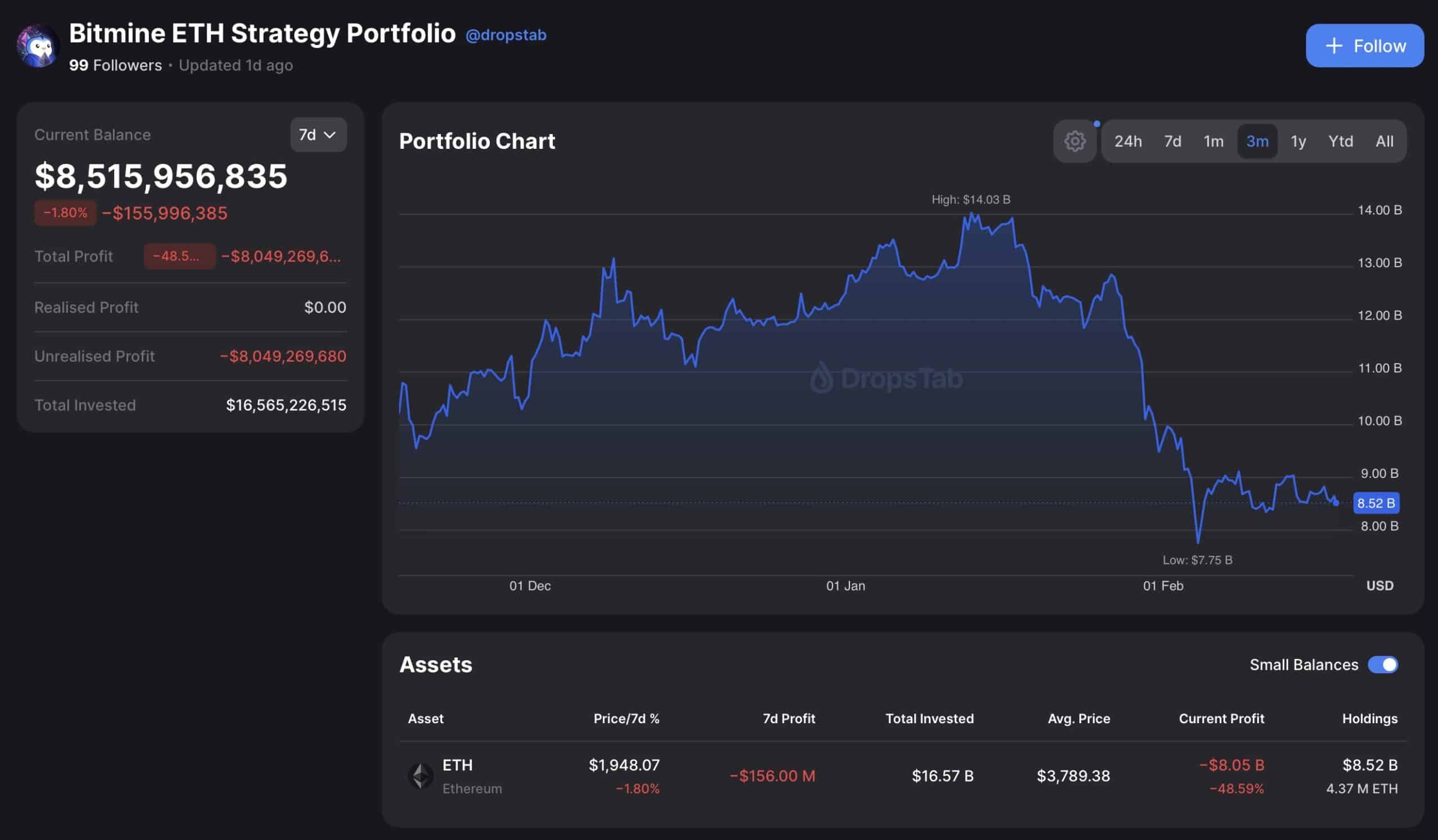
Following the latest acquisition, Bitmine’s total treasury has grown to 4,371,497 ETH, representing 3.62% of the total circulating supply. In a Tuesday update, the company reported total assets of $9.6 billion, including a growing cash pile of $670 million. The firm is steadfast in its “Alchemy of 5%” strategy, aiming to control one-twentieth of the total Ether supply, though this conviction comes at a cost; the company is estimated to be sitting on approximately $8 billion in paper losses.
Market headwinds haven’t deterred institutional support. Earlier this year, reports confirmed that BlackRock acquires Bitmine stake, signaling long-term validation of the treasury model. Similarly, asset managers looking for discounted exposure have been active, as Cathie Wood scoops crypto stocks like BMNR during recent dips.
Operationally, Bitmine is leveraging its massive hoard to generate yield. The firm has staked over 3 million ETH, roughly 69% of its holdings, generating approximately $176 million in annualized rewards at a 2.89% yield. Management expects these figures to improve with the launch of their proprietary MAVAN staking infrastructure in Q1 2026.
Disclaimer: Coinspeaker is committed to providing unbiased and transparent reporting. This article aims to deliver accurate and timely information but should not be taken as financial or investment advice. Since market conditions can change rapidly, we encourage you to verify information on your own and consult with a professional before making any decisions based on this content.
Daniel Frances is a technical writer and Web3 educator specializing in macroeconomics and DeFi mechanics. A crypto native since 2017, Daniel leverages his background in on-chain analytics to author evidence-based reports and deep-dive guides. He holds certifications from The Blockchain Council, and is dedicated to providing "information gain" that cuts through market hype to find real-world blockchain utility.
Ethereum ETH$2 29924h volatility:1.7%Market cap:$277.27 BVol. 24h:$11.97 B
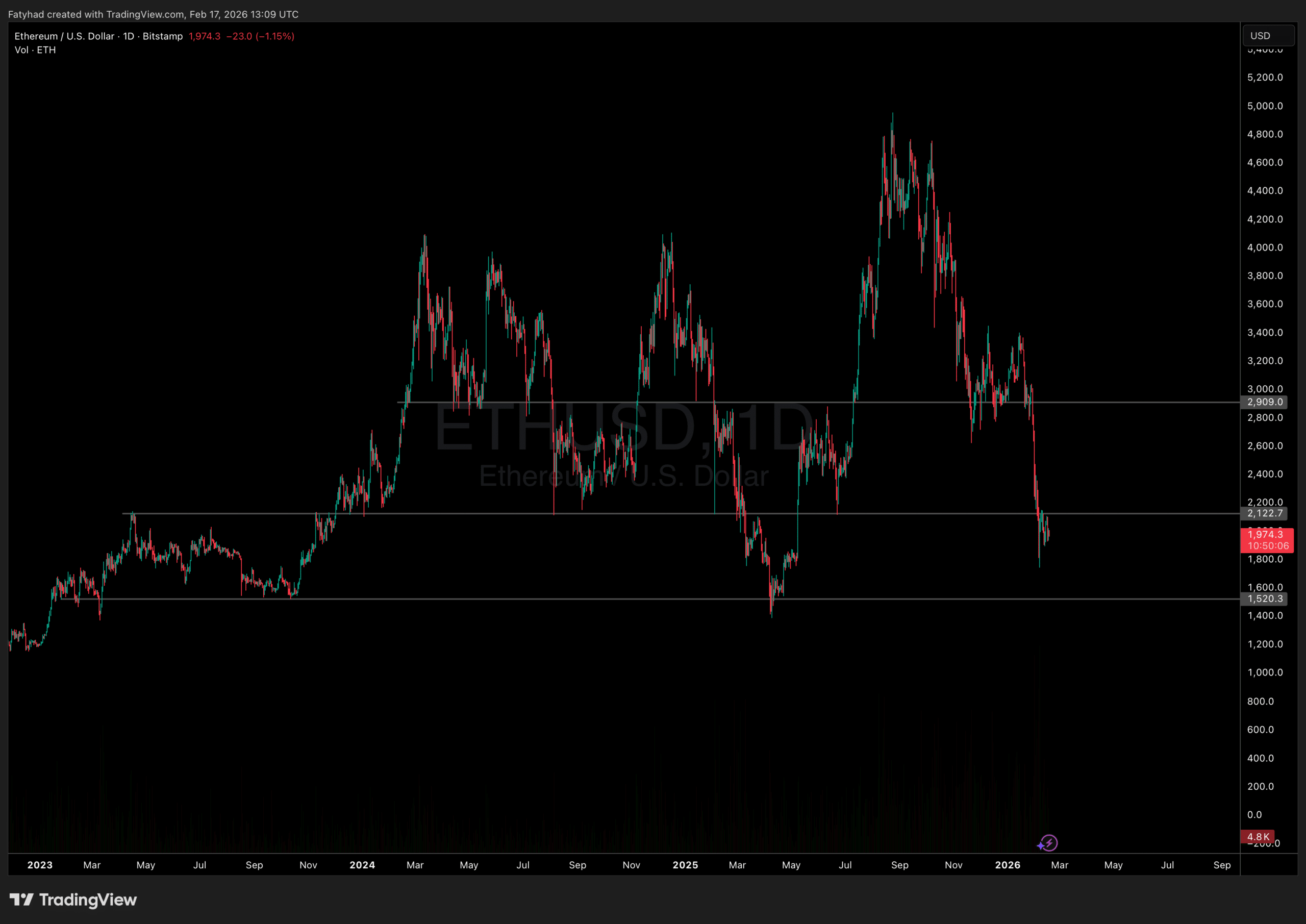
is showing potential signs of stabilisation following a strong decline in February, with price analysis indicators suggesting a reversal setup. ETH price is currently forming what analysts identify as an “Adam and Eve” bottom pattern near the $1,970 range. While short-term pressure persists, data suggests that if specific resistance levels are reclaimed, ETH could undergo a relief rally targeting $2,500.
ETH is now trading right above crucial support zones, and holding these levels is the necessary step to set up a potential run back. For now, it’s a red month.
Incase you don’t know, $ETH is about to close its 6th consecutive month red
Expect this to go on longer. Volume is really low and Vitalik keeps selling
Adam and Eve: Understanding the Technical Setup Underpinning ETH USD
The emerging market structure is centred on an Adam-and-Eve formation: a double-bottom pattern characterised by a strong, V-shaped rebound (Adam) followed by a broader, rounded consolidation (Eve). This setup typically indicates a shift from bearish distribution to accumulation. Despite Ether trading down approximately 20% in February, on-chain data reveals a divergence between price action and investor behaviour.
The critical invalidation level for the Adam and Eve pattern sits at the local low of $1,909. If support at $1,970 fails to hold, analysts warn that the setup could break down, favoring the bearish continuity seen in the broader 2025-2026 market cycle.
Based on other price analysis, for the projected rally to happen, ETH needs to overcome its immediate resistance levels. Currently, it’s consolidating within a range of $1,970–$2,000 with weak momentum. Key support lies at $1,850–$1,900 while resistance is at $2,100–$2,200. Breaking the support could potentially allow for lower levels like $1500.
Derivatives data show significant short-term liquidation clusters stacked near $2,200. A decisive break above this level could trigger a short squeeze, propelling the price toward the technical pattern’s implied target of $2,500. Additionally, Open Interest (OI)has cooled significantly to $23 billion, resetting the leverage ratio and potentially reducing the risk of a long-squeeze cascade.
However, downside risks remain prominent. Recent reports indicate that a major Ethereum whale offloaded $543 million in ETH, adding supply pressure that challenges the bullish outlook.
Furthermore, the broader sentiment is complicated by structural debates within the ecosystem. As Vitalik Buterin addresses Layer 2 scaling narratives, investors are weighing Ethereum’s long-term utility against immediate price performance. A reclaim of the $2,200 level with rising volume would be the primary signal for trend reversal.
Disclaimer: Coinspeaker is committed to providing unbiased and transparent reporting. This article aims to deliver accurate and timely information but should not be taken as financial or investment advice. Since market conditions can change rapidly, we encourage you to verify information on your own and consult with a professional before making any decisions based on this content.
Daniel Frances is a technical writer and Web3 educator specializing in macroeconomics and DeFi mechanics. A crypto native since 2017, Daniel leverages his background in on-chain analytics to author evidence-based reports and deep-dive guides. He holds certifications from The Blockchain Council, and is dedicated to providing "information gain" that cuts through market hype to find real-world blockchain utility.
BlackRock has acquired a stake in Bitmine, a move that aligns with its more recent tokenisation strategy and infrastructure investments. The asset management giant BlackRock has significantly expanded its exposure to Ethereum infrastructure, increasing its holdings in crypto mining and staking firm Bitmine by 165.5% during the fourth quarter of 2025.
This move supports CEO Larry Fink’s ongoing belief that real-world asset tokenisation (RWAs) will shape the future of global financial markets.
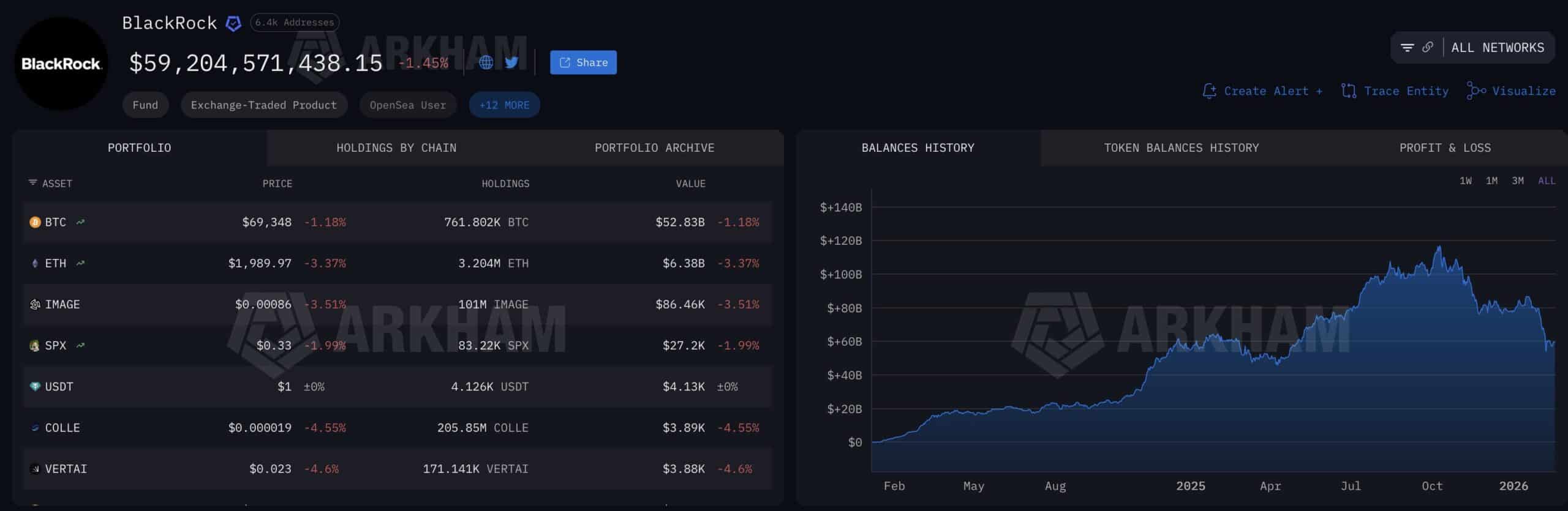
This acquisition deepens BlackRock’s institutional footprint in the crypto sector beyond its initial exchange-traded fund products. As of February 2026, the firm holds approximately $60 billion in crypto exposure, and now pivoting from pure asset holding to owning critical infrastructure layers.
The shift comes despite periods of market volatility, during which analysts like Fundstrat’s Tom Lee defended Bitmine as a vital proxy for Ethereum’s long-term utility.
The substantial increase in equity holdings signals a strategic alignment with BlackRock’s broader thesis on tokenization. CEO Larry Fink has frequently cited Ethereum as a primary ledger for this transition, and Bitmine, which pivoted substantially toward Ethereum staking and validator services, offers regulated exposure to yield-generating activities that traditional ETFs lack.
At the World Economic Forum in Davos, Fink said:
Tokenization, decimalization is necessary
This aggressive accumulation mirrors wider institutional trends where smart money is securing positions in blockchain infrastructure. Cathie Wood’s ARK Invest recently scooped up BMNR shares, positioning various funds to capture value from blockchain validation revenue.
BlackRock CEO Larry Fink told the World Economic Forum he thinks the movement toward tokenization and digitization is necessary. We need to move very rapidly to doing that. With one common blockchain, we can reduce corruption.
Unlike BlackRock’s previous commitment to pure-play Bitcoin miners like Marathon Digital, the Bitmine stake specifically targets the programmable finance layer. The move validates the narrative that, as Vitalik Buterin has noted regarding infrastructure, the value of blockchain networks is increasingly defined by their utility in automated and AI-driven financial systems.
Institutional Divergence in Crypto Assets: Bitcoin And Ethereum Are Serving Different Purposes
BlackRock’s maneuver suggests a growing decoupling of institutional strategies, where BTC$78 38324h volatility:2.6%Market cap:$1.57 TVol. 24h:$39.87 B
is treated as a reserve asset while Ethereum-linked equities are viewed as technology plays. This distinction is crucial as the ecosystem’s governance evolves, evidenced by recent shifts such as Tomasz Stanczak stepping down from the Ethereum Foundation.
As traditional finance seeks to integrate blockchain rails, reliable infrastructure providers like Bitmine are becoming critical acquisition targets for asset managers looking to control the “plumbing” of the next-generation financial system.
Disclaimer: Coinspeaker is committed to providing unbiased and transparent reporting. This article aims to deliver accurate and timely information but should not be taken as financial or investment advice. Since market conditions can change rapidly, we encourage you to verify information on your own and consult with a professional before making any decisions based on this content.
Neil is a professional cryptocurrency content writer with years of experience. He has written for various cryptocurrency websites to report on breaking news, and been hired by all sorts of cryptocurrency projects, to create content that would increase their exposure and attract more potential investors.