StarkWare chief product officer Avihu Levy has proposed a crypto scheme that he claims would render Bitcoin transactions quantum computing-safe today – without requiring a soft fork, a hard fork, or any modification to the existing protocol.
Published Thursday on GitHub, the Quantum Safe Bitcoin (QSB) proposal operates entirely within Bitcoin’s legacy script constraints and is designed to remain secure, Levy argues, even against an adversary running Shor’s algorithm on a large-scale quantum computer.
The catch is substantial: each transaction would cost the sender between $75 and $150 in GPU compute, making the scheme impractical for routine use and limiting its relevance, at least initially, to large-value transfers.
Hash-to-Sig Puzzle Mechanism: What the Proposed Bitcoin Quantum Scheme Actually Does
Bitcoin’s current signature scheme – the elliptic curve digital signature algorithm, or ECDSA – derives its security from the computational hardness of the elliptic curve discrete logarithm problem. That hardness does not hold against a sufficiently powerful quantum computer running Shor’s algorithm, which can solve the problem in polynomial time.
As recent research from Google Quantum AI has made increasingly concrete, the hardware threshold for executing such an attack may be closer than previously modeled – with estimates suggesting ECDLP-256 could be broken using roughly 500,000 physical qubits, a 20-fold compression from prior projections.
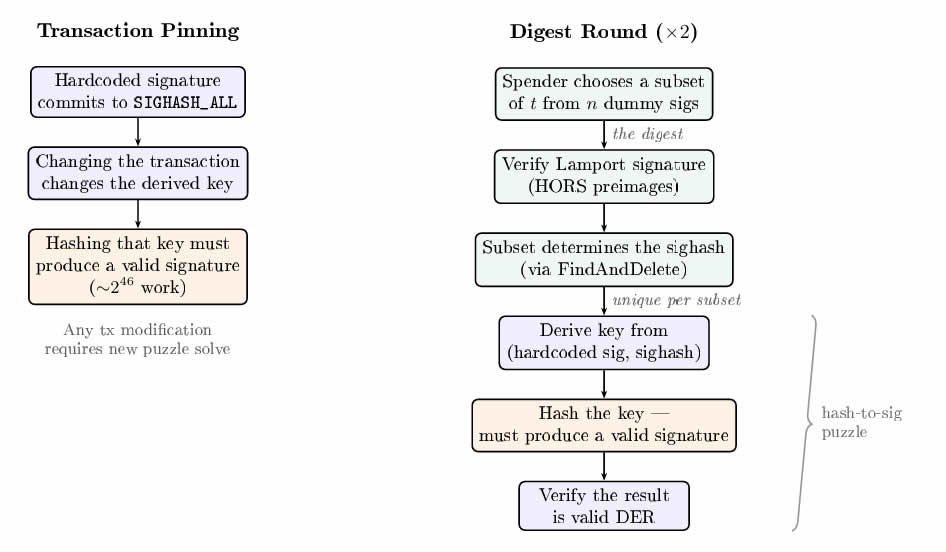
Levy’s proposal sidesteps ECDSA entirely by replacing the proof-of-work signature-size puzzle with what he terms a hash-to-sig puzzle.
Rather than proving knowledge of a private key through elliptic curve math, the spender must find an input whose hash output randomly resembles a valid ECDSA signature – a brute-force search task that offers no shortcut to quantum computing algorithms. The security model, in other words, shifts from a mathematical structure that Shor’s algorithm can exploit to hash preimage resistance, which it cannot.
Far more computing power is required for QSB. Source: GitHub
The key implication: QSB does not patch ECDSA – it replaces the cryptographic assumption underlying the spending condition, while leaving Bitcoin’s transaction format, consensus rules, and script engine untouched.
The QSB Proposal: Claims, Methodology, and What Remains Unverified
Levy’s proposal, which has not been peer-reviewed or formally published through an academic venue at time of writing, outlines a transaction construction that encodes the hash-to-sig puzzle within existing Bitcoin script primitives. No new opcodes are required.
No miner coordination is needed. From the network’s perspective, a QSB transaction is indistinguishable from a legacy transaction – it simply spends an output using a scriptSig that satisfies an unusually constructed scriptPubKey.
The computational burden falls entirely on the sender. Finding a hash preimage that mimics a valid ECDSA signature requires significant brute-force GPU work – Levy estimates $75 to $150 per transaction at current compute prices. That cost figures to be irrelevant for, say, a treasury-scale cold storage transfer; it is prohibitive for coffee. Levy acknowledges this directly, framing QSB as a stop-gap for large BTC positions while the community deliberates a longer-term protocol-level solution.
THIS IS HUGE. Bitcoin is Quantum-Safe TODAY.
Even if a quantum computer appeared, one that breaks the conventional Bitcion signatures, it shows a practical way to create safe Bitcoin transactions. WITH NO CHANGE TO BITCOIN PROTOCOL!!! https://t.co/ireGc3ai7W
— Eli Ben-Sasson | Starknet.io (@EliBenSasson) April 9, 2026
StarkWare CEO Eli Ben-Sasson characterized the proposal in stark terms on X, stating that it “essentially makes Bitcoin quantum-safe today.” That framing is doing significant argumentative work – the scheme makes specific large-value crypto transactions quantum computing resistant under its defined threat model, which is not equivalent to Bitcoin-the-network becoming quantum-safe in any comprehensive sense. The proposal has not been independently verified, and no Bitcoin Improvement Proposal has been filed to formalize or standardize the approach.
Disclaimer: Coinspeaker is committed to providing unbiased and transparent reporting. This article aims to deliver accurate and timely information but should not be taken as financial or investment advice. Since market conditions can change rapidly, we encourage you to verify information on your own and consult with a professional before making any decisions based on this content.
Daniel Frances is a technical writer and Web3 educator specializing in macroeconomics and DeFi mechanics. A crypto native since 2017, Daniel leverages his background in on-chain analytics to author evidence-based reports and deep-dive guides. He holds certifications from The Blockchain Council, and is dedicated to providing "information gain" that cuts through market hype to find real-world blockchain utility.
Bitcoin recovers to $69,000 with a 3.18% 24-hour gain as geopolitical risk drives BTC-gold correlation. Key support at $70,500, resistance at $72,500 — here’s what the charts say.
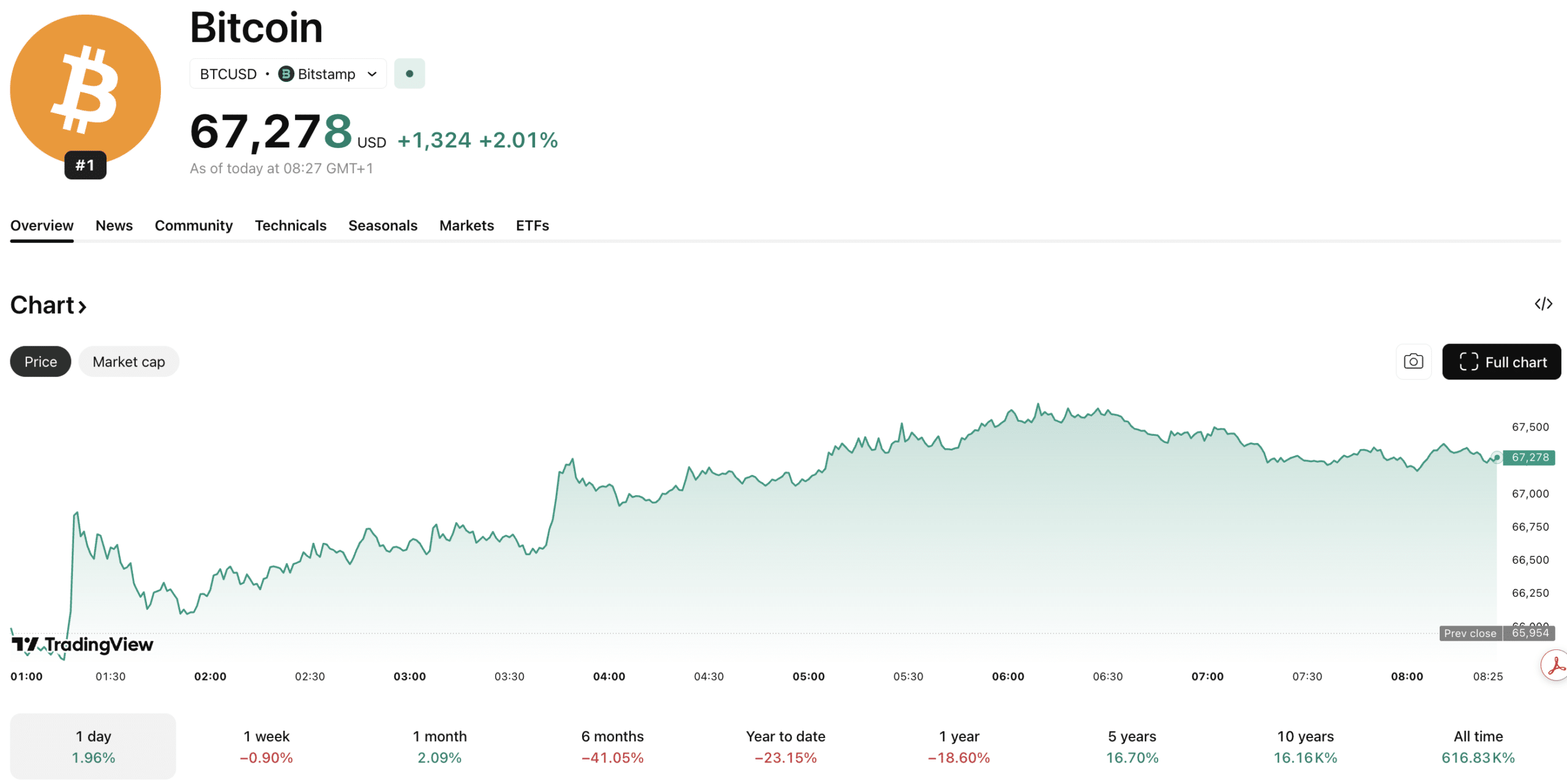
The Bitcoin price has climbed back over $67,000, posting a 24-hour gain of roughly +1% as geopolitical risk sends investors reaching for hard assets, both traditional and digital. The move mirrors gold’s own bid, a correlation that has sharpened considerably since the Middle East conflict entered its fifth week.
The catalyst this time was a simultaneous escalation on multiple fronts. Iran-backed Houthi forces opened a new front in the conflict, US ground troops arrived in the region, and The Wall Street Journal reported President Trump is weighing a military operation to remove enriched uranium from Iran, though no decision has been made.
Brent crude surged +2.5% to around $115 a barrel, now up roughly +-90% year-to-date, while Asian equities fell sharply, with Japan’s Nikkei dropping -3.4% and South Korea’s benchmark shedding -3.2%.
The broader crypto market followed, with the total market cap rising +1.2% and back over $2.4 trillion, while ETH USD recovered +2% to $2,044 and XRP added +1.5% to $1.35. BTC’s relationship with gold has become a recurring theme for macro analysts tracking safe-haven rotation this quarter.
BITCOIN IS COPYING GOLD'S CHART PERFECTLY.
And gold just exploded to new highs.
Long consolidation. Fake breakdowns. Sentiment destroyed. Then violent breakout.
Can Bitcoin Price Reclaim $72,000 Before Month-End?
The Bitcoin price sits in a technically significant zone. Trading volume reached $30Bn over the past 24 hours, down significantly from the end of last week, potentially signaling falling demand for BTC USD, even if the price remains range-bound.
Key technical levels are well-defined. Support clusters near $65,000–$65,500, with resistance capping at $68,500 and $69,200. The 24-hour range has been narrow (a consolidation pattern that historically precedes expansion), and multiple analysts flagged the BTC USD chart for a potential breakout at the close of March.
Three scenarios present themselves. Bull case: a volume spike breaks resistance at $68,500, opening a run toward prior highs. Base case: consolidation continues near $66,000–$68,000 pending a macro catalyst. The bear case and the invalidation level are clear: a sustained break below $65,000 would reopen the February lows.
At the current market cap, Bitcoin’s upside from $67,000 to $72,000 represents a roughly +8% move, meaningful, but modest for investors seeking asymmetric exposure to Bitcoin-ecosystem growth. That gap between spot BTC performance and early-stage opportunity is precisely where projects like Bitcoin Hyper ($HYPER) are positioning themselves.
As institutional Bitcoin demand grows, infrastructure capable of making BTC programmable and fast becomes increasingly relevant. Bitcoin Hyper claims to be the first Bitcoin Layer 2 integrating the Solana Virtual Machine, delivering, per the project, lower latency than Solana itself alongside a decentralized canonical bridge for BTC transfers and high-speed smart contract execution.
The presale has raised over $32M at a current token price of $0.0136778, with staking available at a high APY for early participants. Those are verifiable hard numbers, not projections, and are making HYPER one of the most in-demand crypto presales in 2026.
Disclaimer: Coinspeaker is committed to providing unbiased and transparent reporting. This article aims to deliver accurate and timely information but should not be taken as financial or investment advice. Since market conditions can change rapidly, we encourage you to verify information on your own and consult with a professional before making any decisions based on this content.
Daniel Frances is a technical writer and Web3 educator specializing in macroeconomics and DeFi mechanics. A crypto native since 2017, Daniel leverages his background in on-chain analytics to author evidence-based reports and deep-dive guides. He holds certifications from The Blockchain Council, and is dedicated to providing "information gain" that cuts through market hype to find real-world blockchain utility.
MicroStrategy (MSTR) has signaled an ambitious target to accumulate 1 million Bitcoin (BTC) by the end of 2026, a milestone that requires acquiring approximately 239,000 additional coins at an estimated cost of $22.2 billion. The Bitcoin treasury firm, led by Executive Chairman Michael Saylor, plans to finance this aggressive expansion through a combination of “Stretch” (STRC) perpetual preferred shares and at-the-market equity offerings, despite current holdings slipping below their cost basis amid recent market volatility.
“The Orange March Continues” — Michael Saylor, Executive Chairman of Strategy, hinting at continued accumulation via X (formerly Twitter).
MicroStrategy Accumulation Mechanics: The Path to 1 Million BTC
To achieve the 1 million coin target, Strategy must maintain a purchasing velocity of nearly $540 million per week through December 2026. Data from recent filings indicates the company currently holds 761,068 BTC, representing roughly 3.6% of the asset’s total fixed supply. The accumulation plan effectively removes these assets from the active trading float, transferring them into deep cold storage custody where they are excluded from daily market liquidity.
The cost of this acquisition strategy is rising. Strategy’s average cost basis now sits at approximately $75,696 per Bitcoin. With spot prices trading near $68,100, the company’s Bitcoin treasury is currently underwater by roughly 10%, marking a period of unrealized losses for the corporate giant. Despite this, Saylor’s recent social media activity suggests the firm views price dips as liquidity events allowing for high-volume execution without aggressive slippage.
Acquiring the remaining 238,932 BTC needed to hit the seven-figure mark will require capital issuance on a scale rarely seen for a single asset class. Previous purchase milestones utilized convertible debt notes; however, the scale of the 2026 target has necessitated a shift toward more complex equity instruments.
Financing Structure: The ‘Digital Credit’ Innovation
Strategy has pivoted its funding model to rely heavily on “Stretch” (STRC) perpetual preferred shares, a financial instrument described by analysts as “digital credit.” distinctive for its high yield. These shares carry an 11.5% annual dividend, committing the company to pay investors approximately $0.09 annually for every dollar raise. This structure allows Strategy to raise recurring capital without immediately diluting MSTR common shares to the same extent as a direct equity offering.
The mechanics involve ring-fencing proceeds specifically for Bitcoin acquisition, utilizing a $2.25 billion reserve to service the dividend obligations. This approach theoretically allows the firm to arbitrage the difference between the 11.5% cost of capital and Bitcoin’s annualized appreciation. However, the model faces headwinds; the company reportedly halted STRC funding last week after facing difficulties raising fresh capital through the instrument, highlighting the market’s sensitivity to yield sustainability.
Market observers note that while convertible notes pose a risk of maturing debt, preferred shares create a perpetual dividend obligation that weighs on cash flow. The sustainability of the 1 million BTC plan depends heavily on the firm’s ability to refinance these obligations or cover them through the appreciation of the underlying asset.
1 million Bitcoin inside a single corporate entity changes the market structure permanently.
That holding represents 4.76% of the total 21 million supply. Adjust for lost coins and the percentage of actual circulating supply is significantly higher. Strategy has historically bought through corrections without flinching, which analysts say creates a structural supply floor beneath the market.
Bitcoin (BTC)
24h7d30d1yAll time
This is different from ETF inflows. ETFs depend on retail and advisor demand. Strategy buys on executive mandate. That means the firm can absorb sell-side pressure during periods of market apathy when nobody else is stepping in.
The whole machine runs on the MSTR premium. Shares trade above the Net Asset Value of the Bitcoin on the balance sheet, which lets the company issue equity at a high valuation and buy Bitcoin at market price. Sell high, buy lower. The gap is the edge.
But that edge is under pressure. Bitcoin dropped 3.8% over the weekend and Strategy’s position slipped into the red. A contracting NAV premium shrinks the capacity to raise funds through ATM offerings. The infinite money glitch only works while the premium holds.
There is another wrinkle. While the corporation is accumulating aggressively, Saylor has been selling his personal holdings. Corporate conviction and executive profit-taking moving in opposite directions is a detail the market is not ignoring.
The next 8-K filing tells the real story. Either the STRC funding pause is temporary and the march to 1 million BTC continues, or something structural has shifted in how Strategy plans to fund the final leg.
Disclaimer: Coinspeaker is committed to providing unbiased and transparent reporting. This article aims to deliver accurate and timely information but should not be taken as financial or investment advice. Since market conditions can change rapidly, we encourage you to verify information on your own and consult with a professional before making any decisions based on this content.
Neil is a professional cryptocurrency content writer with years of experience. He has written for various cryptocurrency websites to report on breaking news, and been hired by all sorts of cryptocurrency projects, to create content that would increase their exposure and attract more potential investors.
Bitcoin struggles to hold $70,000 as geopolitical tension regarding Iran outweighs regulatory wins. Analysis of BTC price targets and new Layer 2 infrastructure.
Bitcoin price is struggling to hold the psychological $70,000 threshold as geopolitical tensions involving Iran exacerbate global inflation fears, effectively overshadowing a significant regulatory victory for cryptocurrencies in the US earlier this week. The asset has retraced for three consecutive days—falling from a six-week peak of nearly $76,000 on Tuesday, signaling that macro headwinds are currently dictating market liquidity.
Trading data from late trading hours in Singapore places the token at around $70,500, showing little net change week-over-week despite the intra-week volatility. While fears of an oil price frenzy traditional equities, digital assets are not proving immune to the risk-off sentiment. High selling pressure has been observed across major exchanges, with 24-hour volumes spiking as traders de-risk portfolios ahead of the weekend.
Can Bitcoin Price Defend the $70,000 Support Level?
The immediate technical outlook suggests a precarious consolidation. As of March 20, Bitcoin (BTC) is trading down approximately 4.30% over the last 24 hours, testing lows near the $72,000 equivalent (IDR 1.20 billion) according to regional data from Bittime. The price action is currently confined within a descending channel, with the asset slipping below key moving averages that had previously supported the rally to $76,000.
If the $70,000 support fails to hold, where is the floor? Prediction markets are pricing in localized pessimism. Data from Robinhood’s derivatives desk shows betting clusters forming around the $60,600 to $60,800 range for late March settlements, implying that a break below current supports could trigger a cascade of liquidations. Conversely, a rebound would need to clear overhead resistance at $73,500 to invalidate the short-term bearish structure. Analysts note that while the threat to the $70k support level is real, broader institutional flows remain stickier than retail sentiment suggests.
While the legacy Bitcoin asset chops within established ranges, capital often rotates into early-stage infrastructure plays that promise to solve the network’s underlying utility constraints. The logic is simple: volatility is temporary, but scalability issues are permanent without technological intervention. This rotation is evident in the traction surrounding Bitcoin Hyper (HYPER), a new protocol designed to address Bitcoin’s lack of programmability.
Bitcoin Hyper positions itself as the first-ever Bitcoin Layer 2 to integrate the Solana Virtual Machine (SVM). By leveraging SVM, the project claims to deliver sub-second finality and smart contract capabilities that the base Bitcoin layer cannot support natively. The data indicates the market is receptive to this narrative; the project has raised exactly $32,033,734.37 to date, with the current presale stage pricing the token at $0.0136773.
The protocol aims to bridge the gap between Bitcoin’s security and the execution speed required for modern DeFi applications. For investors weathering the current macro storm, high-yield staking options within the ecosystem offer a potential hedge against price stagnation. However, users should note that Layer 2 solutions carry smart contract risks distinct from holding the underlying asset. Those interested in the technical specifics can check the Bitcoin Hyper price and features here.
Disclaimer: Coinspeaker is committed to providing unbiased and transparent reporting. This article aims to deliver accurate and timely information but should not be taken as financial or investment advice. Since market conditions can change rapidly, we encourage you to verify information on your own and consult with a professional before making any decisions based on this content.
Daniel Frances is a technical writer and Web3 educator specializing in macroeconomics and DeFi mechanics. A crypto native since 2017, Daniel leverages his background in on-chain analytics to author evidence-based reports and deep-dive guides. He holds certifications from The Blockchain Council, and is dedicated to providing "information gain" that cuts through market hype to find real-world blockchain utility.
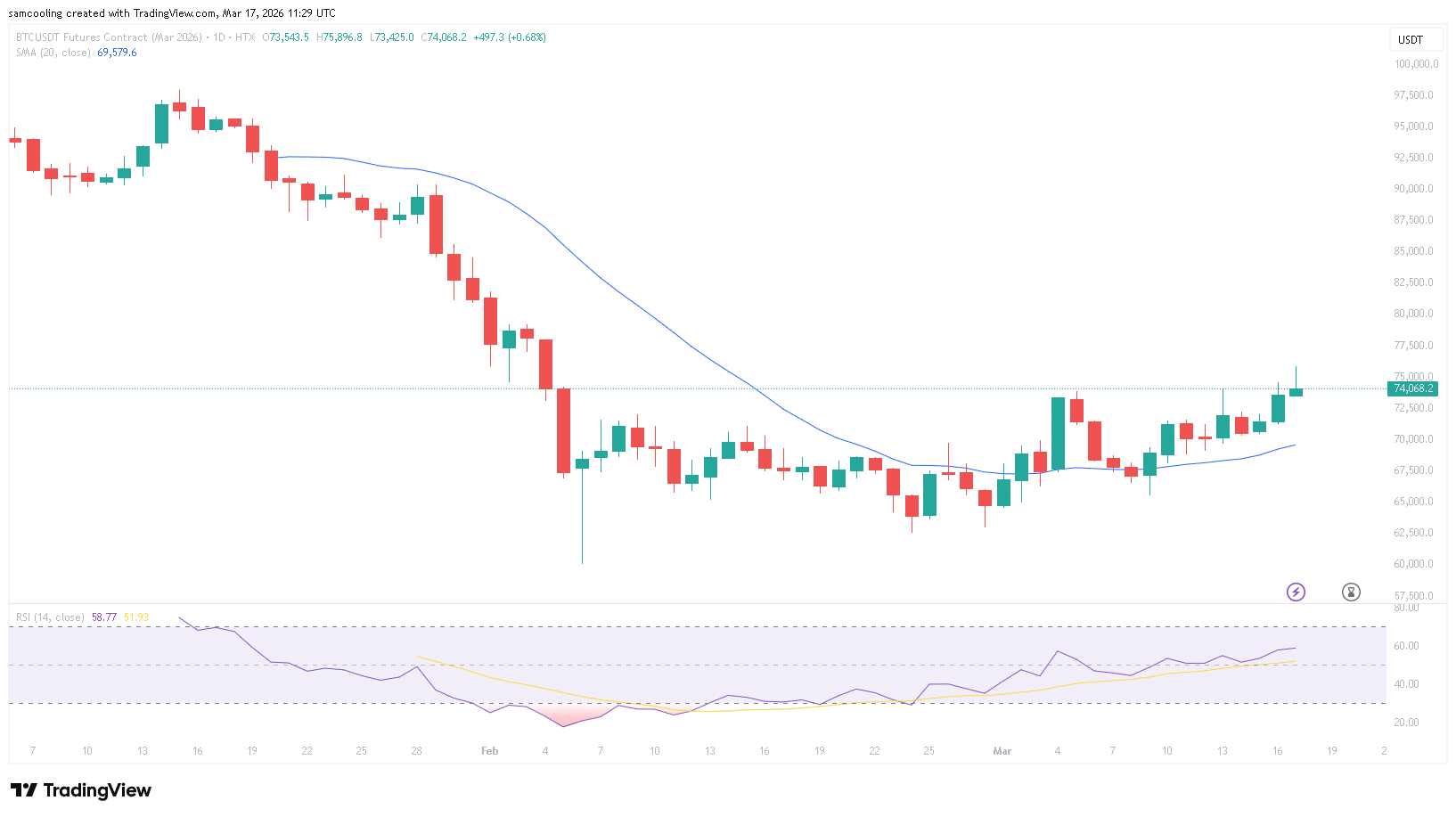
Bitcoin (BTC) is trading near $73,900, consolidating below the psychological $75,000 threshold as the executive branch intensifies public pressure on the Federal Reserve. The catalyst is President Donald Trump’s demand for an immediate “special meeting” to slash interest rates, a political challenge to central bank independence that is forcing markets to reprice the probability of premature liquidity expansion ahead of the March FOMC.
While the Federal Reserve has maintained a restrictive stance to combat sticky inflation, the President’s insistence that cuts occur “right now” introduces volatility into risk assets. Markets are currently weighing the likelihood of the Fed capitulating to executive pressure against the backdrop of steady economic data, a dynamic that directly impacts the cost of capital and, by extension, the net liquidity available for speculative assets like crypto.
President Trump’s recent comments, delivered at a White House meeting and amplified on social media, explicitly target Fed Chair Jerome Powell’s data-dependent approach. Trump argued that a “third-grade student” would understand the need for cuts, framing the current 3.50% to 3.75% target range as a national security threat. For crypto markets, the mechanism of action here is the implied cost of leverage. Trump’s push for lower rates aims to reduce debt-service costs on the $39 trillion national debt, but it also signals a potential shift toward fiscal dominance, a scenario in which monetary policy is forced to accommodate government spending.
Despite the political rhetoric, the data does not yet support an immediate pivot. The CME FedWatch Tool currently indicates a 99% probability that rates will remain unchanged at this week’s FOMC meeting. The probability for the subsequent April 29 meeting is similar at 97% for a hold. This disconnect between the President’s demands and market pricing creates a binary risk environment: if the Fed holds firm as expected, liquidity remains tight; however, any dovish signal from Powell would likely be interpreted as a capitulation, triggering a rapid repricing of the dollar and a surge in risk assets.
The tension is further complicated by the fiscal landscape. With the proposed “One Big Beautiful Bill Act” projecting massive injections into the economy, inflation risks remain elevated at 2.4%. Bankrate economist Michael Nguyen notes that such injections typically spur GDP growth but simultaneously drive inflation higher. Should the Fed cut rates prematurely into this fiscal stimulus, real rates could turn deeply negative—a historically bullish condition for hard assets like Bitcoin.
Bitcoin’s price action currently reflects its status as a high-beta proxy for global liquidity rather than a pure safe-haven asset. The 30-day correlation between BTC and the Nasdaq 100 remains tight, suggesting that crypto markets are trading primarily on the discount rate mechanism. If Trump’s pressure campaign succeeds in forcing yields lower, the resulting liquidity expansion would disproportionately benefit growth-sensitive assets.
However, a decoupling scenario exists. If the bond market interprets a potential rate cut as a policy error that will reignite inflation, the 10-year Treasury yield could spike in anticipation of long-term devaluation. In this environment, some analysts argue Bitcoin could diverge from equities, behaving more like digital gold amid sovereign debt concerns. Currently, however, the primary driver remains the immediate cost of money, with Bitcoin reacting sharply to any shifts in the federal funds futures curve.
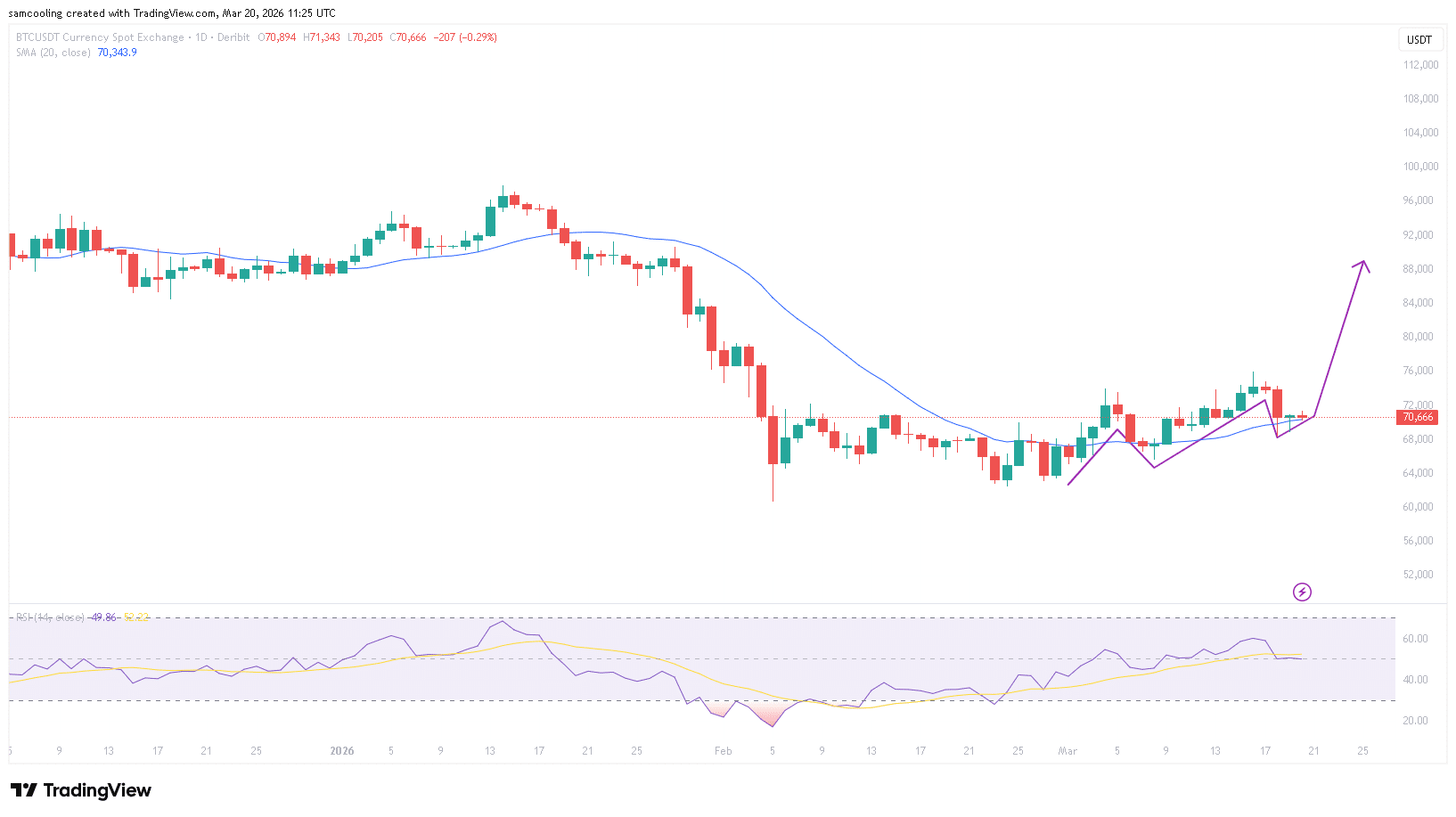
To the upside, the critical resistance level remains $72,000. Reclaiming this level on spot volume would confirm a breakout from the current accumulation phase. Technical indicators suggest neutrality, with the RSI hovering near 50, indicating the market is waiting for a definitive macro trigger—likely the FOMC’s statement or dot plot update—to choose a direction.
Institutional flows appear to be pausing in anticipation of the Fed’s next move. While spot Bitcoin ETFs, including BlackRock’s IBIT and Fidelity’s FBTC, have seen consistent inflows year to date, the pace has decelerated as Treasury yields remain elevated. Institutional allocators are essentially earning a risk-free 3.5% to 4% in short-term government paper, raising the opportunity cost of holding non-yielding assets like Bitcoin.
Analytics firm Glassnode data indicates that long-term holder supply remains resilient, suggesting that conviction buyers are ignoring the short-term political noise. However, for a sustained move higher, the market requires net new capital inflows, which are historically correlated with periods of monetary easing. If the Fed signals that it will ignore executive pressure and maintain a “higher for longer” stance, we could see a temporary rotation of capital out of risk assets and back into fixed income.
Until the Federal Reserve clarifies its stance vis-à-vis the administration’s pressure, the probability of range-bound volatility remains elevated, effectively capping Bitcoin’s immediate upside near resistance levels.
Disclaimer: Coinspeaker is committed to providing unbiased and transparent reporting. This article aims to deliver accurate and timely information but should not be taken as financial or investment advice. Since market conditions can change rapidly, we encourage you to verify information on your own and consult with a professional before making any decisions based on this content.
Daniel Frances is a technical writer and Web3 educator specializing in macroeconomics and DeFi mechanics. A crypto native since 2017, Daniel leverages his background in on-chain analytics to author evidence-based reports and deep-dive guides. He holds certifications from The Blockchain Council, and is dedicated to providing "information gain" that cuts through market hype to find real-world blockchain utility.
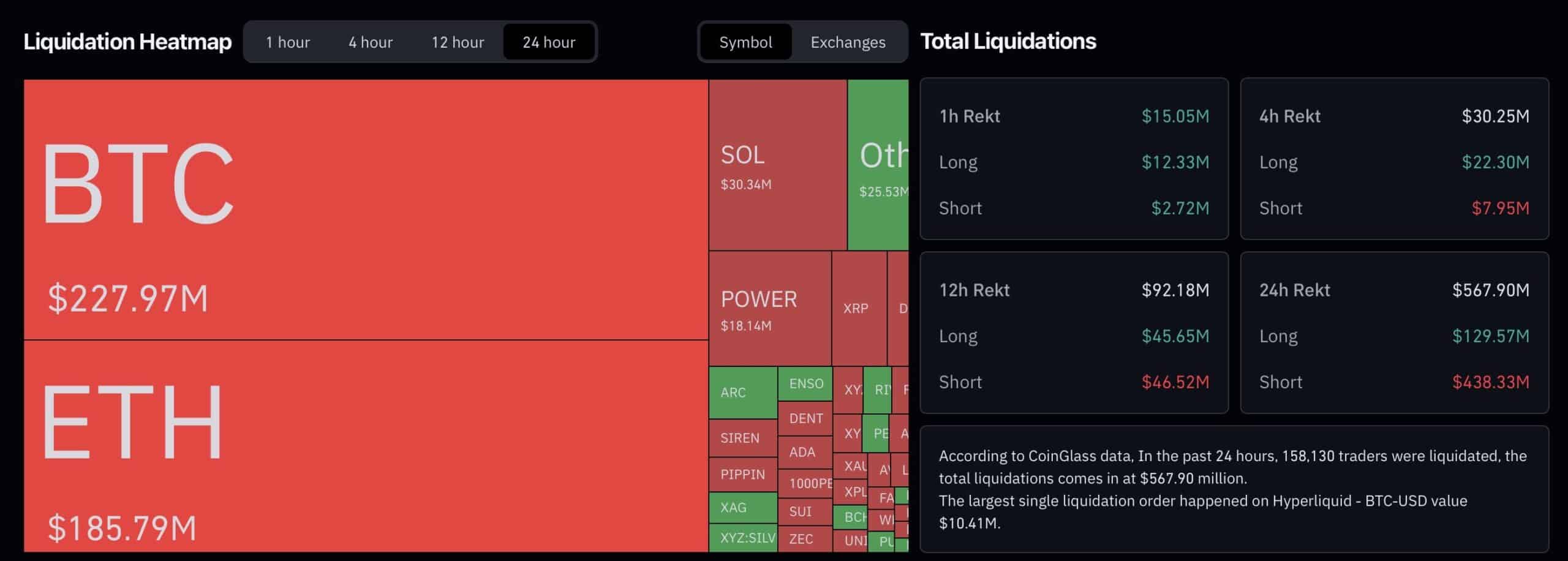
BTC USD price rebounded over 7% to touch an intraday high of $69,487 on Thursday, driven by a cascade of short liquidations and renewed risk-on sentiment following Nvidia Corp.’s blockbuster earnings report. The strong reversal comes just 48 hours after BTC dipped below $63,000, creating a volatile environment that has wiped out over half a billion dollars in leveraged positions.
$NVDA just had its biggest Q/Q revenue growth in history and it says that data center revenue is now up 13x since ChatGPT was released pic.twitter.com/6H3DNh0jEJ
The swift recovery to the $68,000 level signals a potential shift in market structure, as the leading cryptocurrency closely tracks surging tech stocks. Analysts suggest the move has cleared significant bearish leverage, potentially opening the path for a sustained BTC breakout toward the psychological $70,000 barrier.
The sudden crypto market rally caught highly leveraged bearish traders off guard, triggering a massive liquidity flush. As prices rose, short sellers were forced to buy back assets to cover their losing positions, creating a feedback loop known as a short squeeze. Approximately $576 million worth of futures positions were liquidated across the market within 24 hours.
Of this total, roughly $470 million stemmed from short positions, with Bitcoin-specific derivatives accounting for $227 million of the carnage. The magnitude of these short liquidations suggests that traders had aggressively positioned for further downside following the earlier dip to $62,000.
While derivatives mechanics fueled the velocity of the move, the primary macro catalyst appears to be the ‘wealth effect’ spilling over from traditional equity markets. Nvidia Corp. (NVDA), largely viewed as the bellwether for the global AI trade, reported record-breaking earnings for Q4 of Fiscal Year 2026. The chipmaker posted quarterly revenue of $68 billion, a 73% year-over-year increase, calming investor fears regarding the sustainability of AI infrastructure spending.
The report lifted the Nasdaq 100 by 351 points and the S&P 500 by 56 points, reigniting a risk-on environment that historically benefits Bitcoin price action. With Bitcoin frequently serving as a liquidity proxy for global tech sentiment, the correlation remains a critical factor for short-term traders.
Nvidia’s performance has seemingly validated the broader tech structural thesis. As noted in recent market analysis, the company’s results acted as a barometer for the AI-fueled trade, restoring confidence in capital allocation across the tech sector and indirectly supporting risk assets like cryptocurrencies.
Bitcoin Technical Analysis: Can BTC USD Price Sustain $70K?
From a technical perspective, the reclaim of $68,000 is a significant development. The asset has established a higher low structure following the defense of the $60,000 support zone, a level that technical analysts have flagged as critical for the long-term bull trend. By holding above $68,000, Bitcoin is now testing the upper bounds of its multi-week consolidation range.
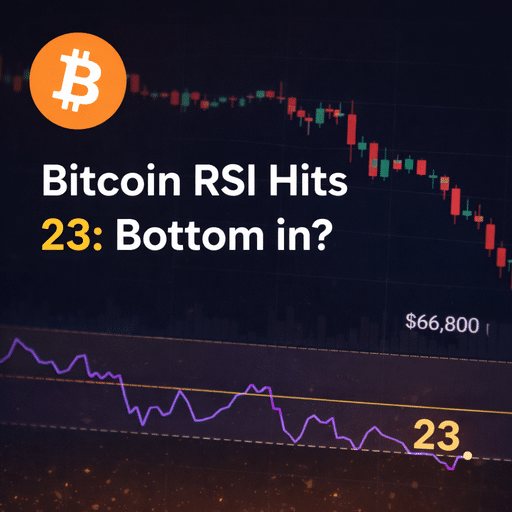
Momentum indicators are also recovering from oversold conditions. Just days ago, BTC USD price metrics suggested an exhausted sell-side, with some oscillators flashing deep value signals. As noted in previous analysis, when Bitcoin RSI hits deep value levels, it often precedes a mean reversion, which appears to be materializing in the current session.
The immediate resistance now lies between $69,500 and $70,000. A daily close above this zone would confirm a BTC breakout, invalidating the bearish thesis of a lower-high formation. Conversely, failure to hold $68,000 could see the price retest the liquidity grab around $65,000.
BTC USD Rebounds Toward $70,000 on Nvidia Earnings Boost, Lifting Layer 2 Presales Like Bitcoin Hyper
Finally Bitcoin staged a strong recovery, surging over 7% after dipping below $63,000 earlier in the week. The rally cleared heavy bearish leverage and signaled a potential shift in structure. BTC USD now hovers around $67,000–$68,500, testing the psychological $70,000 barrier. Breaking above this level could provide some relief to bulls towards the end of February 2026.
The primary catalyst stemmed from Nvidia’s blockbuster Q4 FY2026 earnings report released February 25, posting record revenue of $68.1 billion (up 73% year-over-year) and adjusted EPS of $1.62, beating estimates. Data center revenue hit $62.3 billion (up 75%), reinforcing confidence in sustained AI infrastructure demand. This lifted tech indices and spilled over into crypto, where Bitcoin often acts as a high-beta proxy trade.
Benefitting from this renewed hype in the market are plays like Bitcoin Hyper (HYPER). HYPER is advancing as a pioneering Bitcoin Layer 2 solution, integrating Solana Virtual Machine (SVM) for high-throughput scalability while preserving Bitcoin’s security. The project enables rapid, low-cost BTC transactions, staking with up to 37% APY rewards, DeFi tools like DEXs, and on-chain dApps for payments, meme coins, and NFTs.
It uses rollups (optimistic and ZK) and sidechains to batch transactions, with a canonical bridge for trustless BTC deposits/withdrawals: verifying via SVM smart contracts and settling on Bitcoin L1.
The HYPER has raised over $31 million, with tokens at $0.0136762 in the current stage and planned increases ahead. Exchange listings are eyed for 2026.
As Nvidia’s results validate tech growth and Bitcoin clears bearish overhang, Layer 2 innovations like Bitcoin Hyper offer early exposure to enhanced Bitcoin utility before broader adoption.
Disclaimer: Coinspeaker is committed to providing unbiased and transparent reporting. This article aims to deliver accurate and timely information but should not be taken as financial or investment advice. Since market conditions can change rapidly, we encourage you to verify information on your own and consult with a professional before making any decisions based on this content.
Daniel Frances is a technical writer and Web3 educator specializing in macroeconomics and DeFi mechanics. A crypto native since 2017, Daniel leverages his background in on-chain analytics to author evidence-based reports and deep-dive guides. He holds certifications from The Blockchain Council, and is dedicated to providing "information gain" that cuts through market hype to find real-world blockchain utility.
Michael Saylor, chairman of the Bitcoin treasury firm Strategy, has signaled the company’s impending 100th Bitcoin purchase, marking a significant operational milestone in an accumulation campaign that began in August 2020.
The firm currently holds 717,131 BTC according to official stats and has executed purchases for 12 consecutive weeks, continuing its aggressive acquisition strategy despite recent market volatility.
On Saturday, Saylor suggested the transaction was imminent by sharing portfolio tracking data on X, a communication method he frequently employs prior to filing official acquisition disclosures with the Securities and Exchange Commission.
In his social media post, Saylor shared a screenshot captioned “The Orange Century,” alluding to the 100th transaction count.
According to firm data, Strategy has completed 99 distinct Bitcoin acquisitions to date.
Since its initial $250 million capital allocation nearly six years ago, the company has transformed its corporate structure to become the world’s largest public holder of the digital asset.
The journey to this milestone has not been without significant volatility. Recent market movements have placed pressure on the firm’s balance sheet.
While Strategy reports $12.4B Bitcoin loss Q4 2025 highlighted the risks associated with mark-to-market accounting during drawdowns, the company has maintained its “accretion” strategy without deviation.
The firm aims to increase the amount of Bitcoin per share, prioritizing this metric over short-term fiat valuations.
First time I’ve seen Saylor look nervous speaking publicly.
He can’t say anything else, but deep down he knows extreme downside scenarios aren’t impossible.$BTCpic.twitter.com/PS3NDZhYao
The impending 100th purchase comes as Strategy navigates a challenging price environment. Official data indicates the firm’s average cost basis currently stands at approximately $76,027 per Bitcoin.
With the asset trading below this threshold in recent weeks, the treasury is technically in an unrealized loss position, reminiscent of the crypto winter of 2022.
Despite the price action, the firm has utilized capital raised through convertible debt and preferred stock to expand its holdings, recently acquiring over 2,400 BTC in mid-February 2026.
This unwavering commitment mirrors the approach of other corporate adopters. For instance, the resolve seen as Metaplanet to continue Bitcoin buying despite the crash illustrates a similar high-conviction thesis among corporate treasuries in Asia.
Strategy’s issuance of preferred stock and debt to fund these purchases has effectively leveraged its position, though it introduces risks related to interest obligations.
JUST IN: 🇺🇸 Eric Trump says Bitcoin will reach $1 million.
Market Implications of Continued Institutional Demand
Strategy’s persistence signals its strong conviction that volatility is an accumulation opportunity rather than a distress signal.
The corporate sector is increasingly active, creating a floor of demand. Recently, Tron founder Justin Sun eyed a $100 million Bitcoin purchase, reinforcing the trend of high-net-worth liquidity continuing to enter the market alongside public entities.
Furthermore, the scope of adoption has widened beyond corporations to sovereign entities.
Disclaimer: Coinspeaker is committed to providing unbiased and transparent reporting. This article aims to deliver accurate and timely information but should not be taken as financial or investment advice. Since market conditions can change rapidly, we encourage you to verify information on your own and consult with a professional before making any decisions based on this content.
Daniel Frances is a technical writer and Web3 educator specializing in macroeconomics and DeFi mechanics. A crypto native since 2017, Daniel leverages his background in on-chain analytics to author evidence-based reports and deep-dive guides. He holds certifications from The Blockchain Council, and is dedicated to providing "information gain" that cuts through market hype to find real-world blockchain utility.
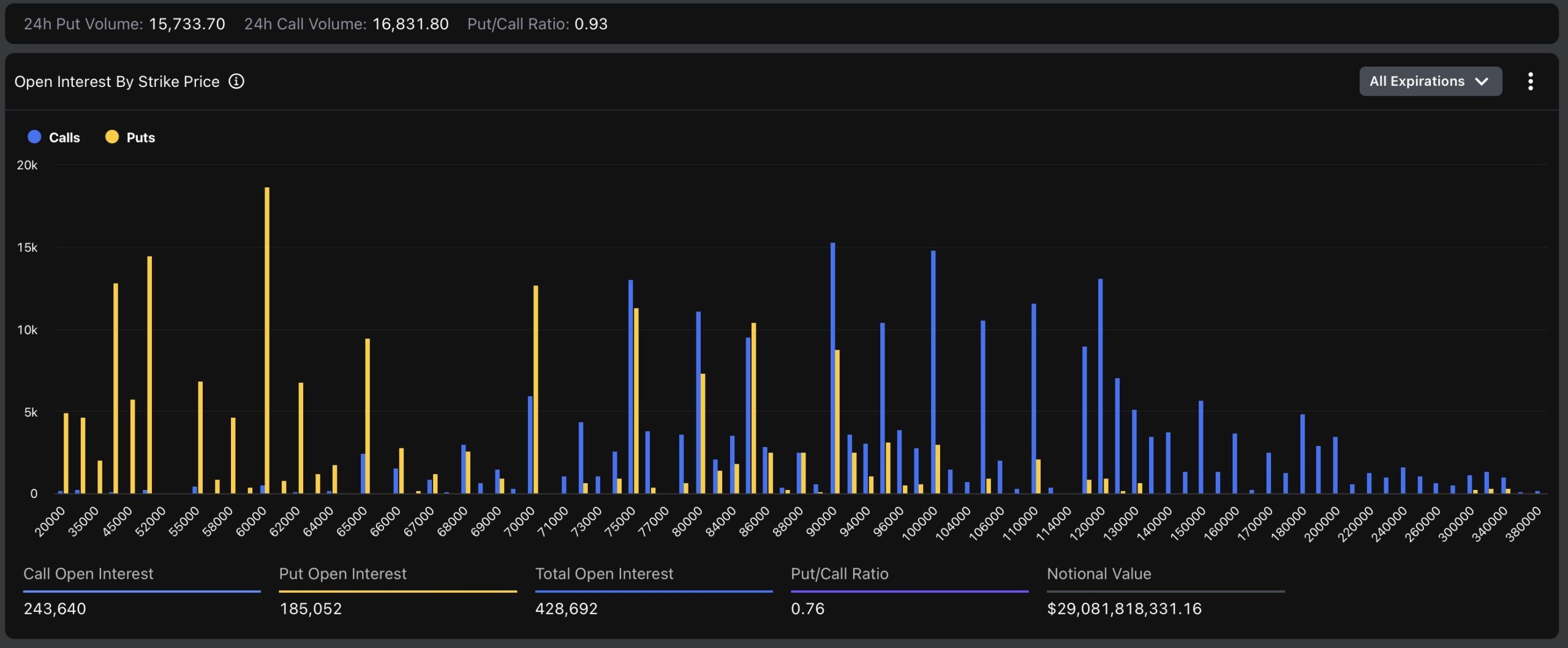
Bitcoin options traders are increasingly positioning for a downside move, paying a significant premium for protection as the asset struggles to reclaim the $70,000 mark. New derivatives data indicates a structural shift that could point to a retest of the $60,000 support level in the coming weeks alongside continued spot market weakness.
It has been 35 days since the Bitcoin Coinbase Premium was positive.
Professional traders are currently paying a 13% premium for put options relative to calls, a metric that signals elevated caution. Under neutral market conditions, the delta skew typically hovers between -6% and +6%. The persistence of this premium over the last four weeks suggests institutional sentiment has shifted decisively to a defensive stance. This aligns with recent spot market patterns, where analysts have warned that Bitcoin could drop towards lower support levels amid institutional selling.
The technical structure of the options market reveals specific strategies being deployed on exchanges like Deribit. Data indicates that traders are favoring bear diagonal spreads and short straddles, strategies that typically profit from stagnation or moderate downside. The options market structure implies short gamma buildup that could impact spot liquidity, particularly if support at $66,000 fails to hold.
Prediction markets are also responding to the shifting sentiment. Current odds suggest a higher probability of Bitcoin’s price testing $65,000, though it may be lower. Another bearish indicator is the demand for stablecoins in Asia; the USDT premium against the Chinese Yuan has flipped to a 0.2% discount, signaling a lack of urgent buy-side pressure. While some analysts note that a $40,000 BTC put stands out in open interest, this likely represents deep out-of-the-money hedging rather than a primary price target for the majority of the market.
For semi-professional investors, the convergence of negative spot flows and defensive options positioning warrants caution. The effective bet by market makers appears to be a test of $60,000 rather than an immediate rebound. Traders should monitor ETF flow data closely; a reversal there is likely required to neutralize the current bearish options skew.
On Feb. 19 (ET), spot Bitcoin ETFs recorded a total net outflow of $166 million, marking the third consecutive day of net outflows. Spot Ethereum ETFs saw total net outflows of $130 million, with BlackRock’s ETHA leading at $96.80 million in net outflows. https://t.co/Hj2Gs49bWapic.twitter.com/fNPHmfvyVJ
Despite the short-term negative price action, the infrastructure for institutional derivatives continues to mature. Recent developments, such as Ripple Prime’s integration with Hyperliquid, highlight the growing sophistication of on-chain trading access. As these platforms evolve, they may offer traders more granular tools to manage standard deviation risks during corrective phases like the current one.
Disclaimer: Coinspeaker is committed to providing unbiased and transparent reporting. This article aims to deliver accurate and timely information but should not be taken as financial or investment advice. Since market conditions can change rapidly, we encourage you to verify information on your own and consult with a professional before making any decisions based on this content.
Daniel Frances is a technical writer and Web3 educator specializing in macroeconomics and DeFi mechanics. A crypto native since 2017, Daniel leverages his background in on-chain analytics to author evidence-based reports and deep-dive guides. He holds certifications from The Blockchain Council, and is dedicated to providing "information gain" that cuts through market hype to find real-world blockchain utility.
Abu Dhabi government-linked investment funds have reportedly acquired over $1 billion in Bitcoin exposure through United States spot ETFs, marking a significant entry of sovereign capital into the digital asset market.
The disclosure, revealed in recent 13F filings for the period ending December 31, 2025, signals that state-backed entities are utilizing market corrections to build long-term positions in cryptocurrency.
Abu Dhabi’s sovereign wealth fund, Mubadala, has acquired $437 million worth of Bitcoin!
Sovereign Wealth Enters Bitcoin: Treasury Allocation Shift
The entry of Abu Dhabi’s sovereign-linked capital represents a notable evolution in institutional Bitcoin adoption, moving beyond private asset managers to state-level treasury strategies. While data from late 2025 showed Bitcoin price drops and ETF outflows weakening institutional interest in the short term, these sovereign funds appear to have utilized the drawdown to accumulate assets. This contrarian approach suggests a view of Bitcoin as a diversification tool similar to gold, rather than a purely speculative vehicle.
This influx of “oil money” defies the broader market slump, echoing moves by major trading firms. For instance, recent filings revealed that Jane Street boosted its Bitcoin exposure in its own significant bet on the asset class, holding over $790 million in ETF shares.
The filings detail specific allocations across two primary entities. Mubadala Investment Company, with over $300 billion in assets under management, reported holding approximately 12.7 million shares of the BlackRock iShares Bitcoin Trust (IBIT), valued at roughly $630.7 million. Concurrently, Al Warda Investments disclosed a position of 8.2 million shares, valued near $408.1 million. Combined, these holdings represent a stake exceeding $1 billion, positioning these funds among the largest holders of Bitcoin ETFs globally.
The strategic change also reinforces the United Arab Emirates’ status as a jurisdiction favorable to digital asset innovation. This comes at a time when other regions face regulatory friction; recently, US lawmakers launched a probe into a $500 million deal involving World Liberty Financial, highlighting the complex regulatory landscape institutional investors must navigate.
The allocation of state-backed capital into Bitcoin ETFs introduces a new dynamic to the supply-demand equation. Unlike retail traders or short-term hedge funds, sovereign wealth funds typically operate with multi-decade time horizons. This suggests that a significant portion of the Bitcoin supply acquired by Abu Dhabi funds effectively leaves the liquid market, potentially tightening supply.
Furthermore, this move may catalyze a competitive response among other sovereign wealth funds seeking to hedge against fiat currency debasement or diversify away from traditional energy markets. As Bitcoin hovers near critical support levels in the mid-$60,000 range, the presence of sovereign buyers provides a floor of high-conviction capital that differs fundamentally from speculative retail flows.
While the market continues to grapple with immediate resistance near $70,000, the underlying structure is being reinforced by these large-scale acquisitions. The sustained accumulation by sovereign entities supports the narrative of Bitcoin transitioning into a recognized global reserve asset. Investors will now look to the upcoming 13F filings in May to see if this trend of state-level accumulation persisted through the first quarter of 2026.
Disclaimer: Coinspeaker is committed to providing unbiased and transparent reporting. This article aims to deliver accurate and timely information but should not be taken as financial or investment advice. Since market conditions can change rapidly, we encourage you to verify information on your own and consult with a professional before making any decisions based on this content.
Daniel Frances is a technical writer and Web3 educator specializing in macroeconomics and DeFi mechanics. A crypto native since 2017, Daniel leverages his background in on-chain analytics to author evidence-based reports and deep-dive guides. He holds certifications from The Blockchain Council, and is dedicated to providing "information gain" that cuts through market hype to find real-world blockchain utility.
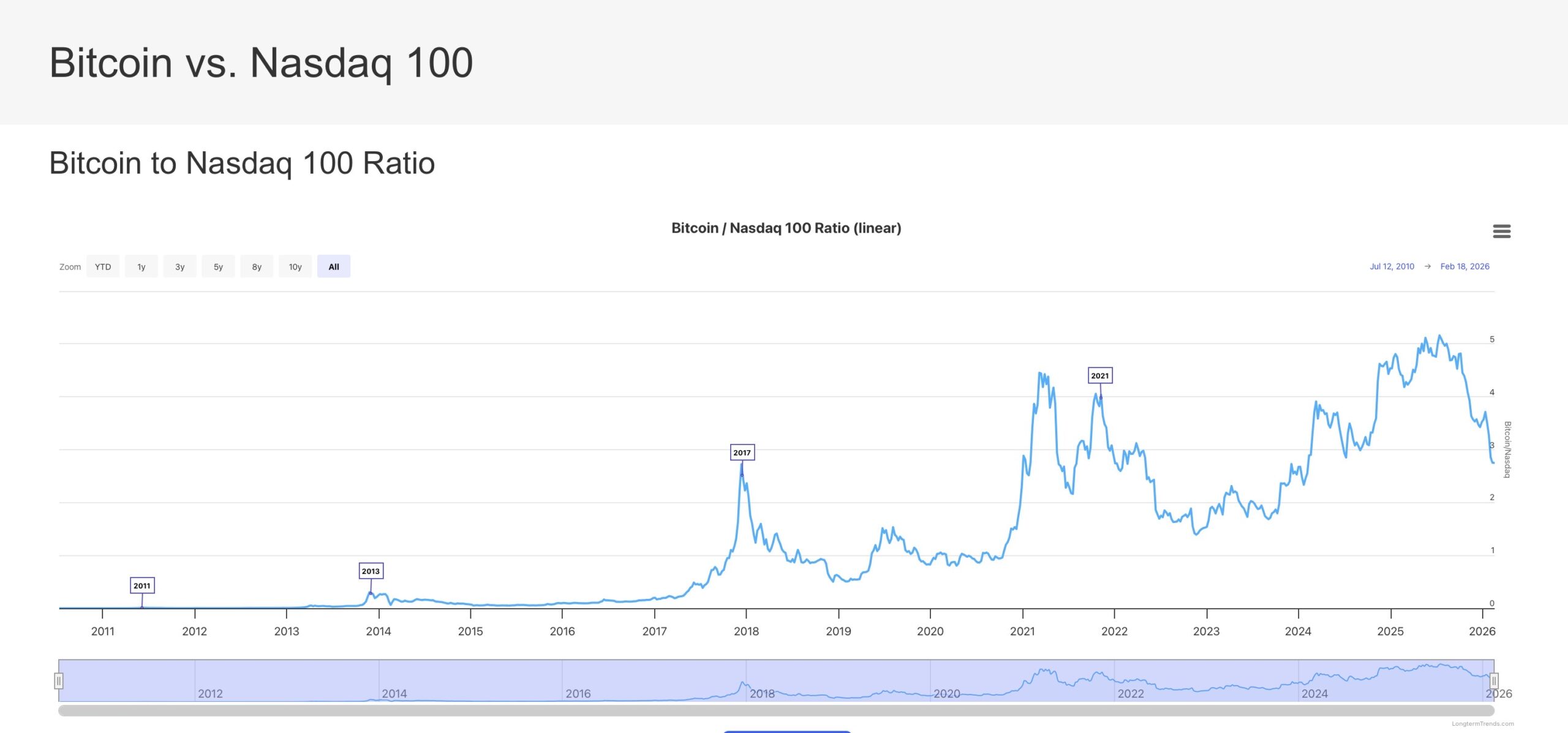
BitMEX co-founder Arthur Hayes has issued a measured warning about the Bitcoin-Nasdaq divergence suggesting imminent stress in dollar liquidity. Hayes argues this divergence, exacerbated by declining institutional flows since the asset’s October 2025 highs, serves as a leading indicator for a broader credit crunch driven by AI-related economic shifts.
The chart above shows the ratio of Bitcoin’s price to the Nasdaq 100 index value. A rising ratio indicates Bitcoin is outperforming the Nasdaq 100 while a falling ratio suggests the opposite.
He describes Bitcoin as the “global fiat liquidity fire alarm,” meaning it tends to react more quickly and sensitively to shifts in fiat credit conditions than traditional equities do.
The current split, he argues, points to tightening dollar liquidity and an impending deflationary credit event.
Bitcoin-Nasdaq Divergence: The Correlation Breakdown
For much of the post-2020 era, Bitcoin has traded in lockstep with technology equities, serving as a proxy for risk propensity. However, the current separation, where the Nasdaq remains buoyant while Bitcoin trends downward, signals a potential fracture in underlying market mechanics. Hayes posited in his latest essay ironically titled “This Is Fine” that crypto often reacts first to changes in fiat credit conditions.
While equities effectively price in forward earnings, crypto is more sensitive to net dollar liquidity, referring to the availability of cash in the banking system versus assets drained by facilities like the Federal Reserve’s reverse repo program. This divergence suggests that while the stock market has not yet priced in credit tightening, the crypto market is already reacting to the removal of monetary cushions.
What Arthur Hayes’ Liquidity Warning Signals for Bitcoin Institutional Flows
The Bitcoin and Nasdaq divergence is stark: Bitcoin has struggled to regain momentum, while big tech remains resilient. Hayes attributes this to early tremors of an AI-driven credit contraction affecting job stability and loan defaults.
Despite the short-term negative price action, not all cohorts are capitulating. Analysis indicates that Bitcoin ETF holders have suffered a 44% crash yet maintained “diamond hands”, refusing to sell into the dip. This bifurcation between short-term liquidity flows and long-term holder conviction complicates the bearish signal.
Traders are now eyeing critical technical zones to gauge the validity of Hayes’ bearish liquidity outlook. If the disconnect persists, Bitcoin could face further downside pressure testing the $60,000 support level. A breach below this psychological floor could open the path toward summer lows around $50,000.
Conversely, supply dynamics offer a mixed picture. While Bitcoin exchange reserves have surged in certain venues indicating potential sell-side pressure, the persistent calmness of long-term holders suggests a floor may be near. The outcome likely depends on whether the “AI-driven” credit stress Hayes anticipates materializes in broader banking metrics.
Until correlation allows for a clearer directional bias, a break below current consolidation levels would act as confirmation of the liquidity stress scenario.
Disclaimer: Coinspeaker is committed to providing unbiased and transparent reporting. This article aims to deliver accurate and timely information but should not be taken as financial or investment advice. Since market conditions can change rapidly, we encourage you to verify information on your own and consult with a professional before making any decisions based on this content.
Daniel Frances is a technical writer and Web3 educator specializing in macroeconomics and DeFi mechanics. A crypto native since 2017, Daniel leverages his background in on-chain analytics to author evidence-based reports and deep-dive guides. He holds certifications from The Blockchain Council, and is dedicated to providing "information gain" that cuts through market hype to find real-world blockchain utility.
Harvard Management Company (HMC) has reduced its stake in BlackRock’s iShares Bitcoin Trust (IBIT) by roughly 21%, pointing to a strategic rebalancing within its crypto portfolio. The university’s endowment simultaneously allocated approximately $86.8 million to Ethereum ETFs, a move occurring alongside broad institutional outflows totaling over $1.1 billion across the sector. The Bitcoin price analysis suggests investors are closely watching institutional positioning for clues about the next market direction.
A Bigger Trend: Institutional Investors Cool on Bitcoin Exposure
The tactical adjustment by Harvard arrives as the market faces cooling demand from institution with some exceptions. Following Bitcoin’s rapid decline in late 2025, market data indicates that many institutional investors began reducing exposure to lock in profits. This trend has been reflected in recent fund flows, where crypto investment products recorded significant net outflows, totaling nearly $1.7 billion in recent weeks.
While Harvard reduction in Bitcoin ETF holdings might appear bearish, analysts suggest it reflects standard portfolio management rather than a complete market exit. Despite the heavy selling pressure and negative flow data in early 2026, the baseline demand for regulated crypto exposure remains intact, albeit at lower volumes than the peak frenzy seen the previous quarter.
Strategy (prev. #MicroStrategy) has bought 2,486 $BTC for $168.4M at an average price of $67,710 per #Bitcoin.
Harvard’s Strategy: Partial Rotation From Bitcoin To Ethereum
Harvard trimmed its IBIT position from 6.81 million shares in Q3 to 5.35 million shares by December 31. Even after this sale, the endowment’s remaining Bitcoin position is valued at approximately $265.8 million, maintaining its status as a major holder. However, the capital was not entirely removed from the ecosystem; HMC established a new position of 3.87 million shares in the iShares Ethereum ETF (ETHA), valued at roughly $86.8 million.
This strategy contrasts with the behavior of retail and smaller institutional cohorts, as recent data suggests that most Bitcoin ETF holders have maintained positions despite significant price volatility. Harvard’s move appears to be a calculated rotation rather than a panic sell, diversifying their bet into the second-largest cryptocurrency which had underperformed Bitcoin for much of the previous year.
The decision also tracks with broader industry movements where traditional finance giants are deepening their involvement with smart contract platforms. For instance, BlackRock itself has continued to expand its footprint, having recently acquired stakes in Ethereum-focused infrastructure, validating the asset class beyond just simple store-of-value propositions.
Such institutional adjustments point to relative-value considerations, where allocators anticipate potential mean reversion, with Ethereum gaining ground against Bitcoin in the near to medium term. This strategy maintains overall crypto allocation while addressing perceived risks tied specifically to Bitcoin’s performance.
Bitcoin’s limitations in speed and cost remain evident, creating room for Layer-2 solutions to expand its utility. But one hot new project, Bitcoin Hyper (HYPER) addresses these constraints through its Layer-2 architecture, which integrates the Solana Virtual Machine (SVM) to enable sub-second transactions, minimal fees, and full smart contract functionality. It bridges native Bitcoin securely via zero-knowledge proofs, preserving BTC’s security while adding programmability for DeFi, gaming, and other applications.
Smart money investors are clearly taking note, with a flurry of whales piling in to the rapidly accelerating HYPER presale, which has raised over $31.4 million, with the token priced at $0.0136757 for this stage (and rising soon!).
The project offers market-beating staking rewards of around 37% APY, which has drawn sustained participation. Audits from firms like Coinsult and SpyWolf support its technical foundation.
In a market where rotations favor assets with enhanced utility, Bitcoin Hyper positions itself to extend Bitcoin’s role beyond a store of value.
Disclaimer: Coinspeaker is committed to providing unbiased and transparent reporting. This article aims to deliver accurate and timely information but should not be taken as financial or investment advice. Since market conditions can change rapidly, we encourage you to verify information on your own and consult with a professional before making any decisions based on this content.
Daniel Frances is a technical writer and Web3 educator specializing in macroeconomics and DeFi mechanics. A crypto native since 2017, Daniel leverages his background in on-chain analytics to author evidence-based reports and deep-dive guides. He holds certifications from The Blockchain Council, and is dedicated to providing "information gain" that cuts through market hype to find real-world blockchain utility.
BTC$75 50824h volatility:0.8%Market cap:$1.51 TVol. 24h:$41.63 B
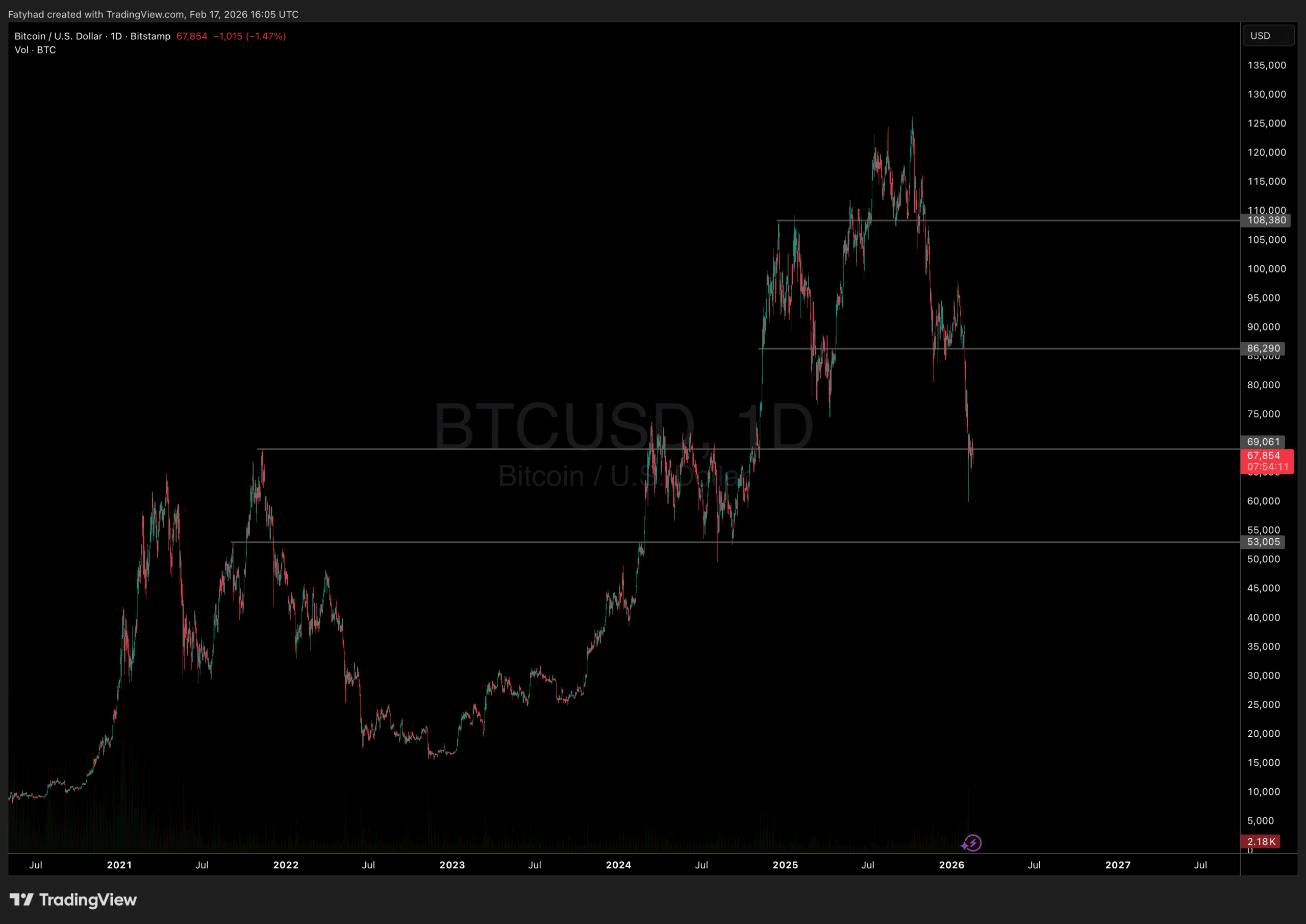
has extended its recent slide, shedding more than 25% over the past month as net outflows from spot exchange-traded funds (ETFs) suggest a cooling in institutional interest. Bitcoin price is currently trading near $69,000, significantly below its record high of over $126,000 set last October.
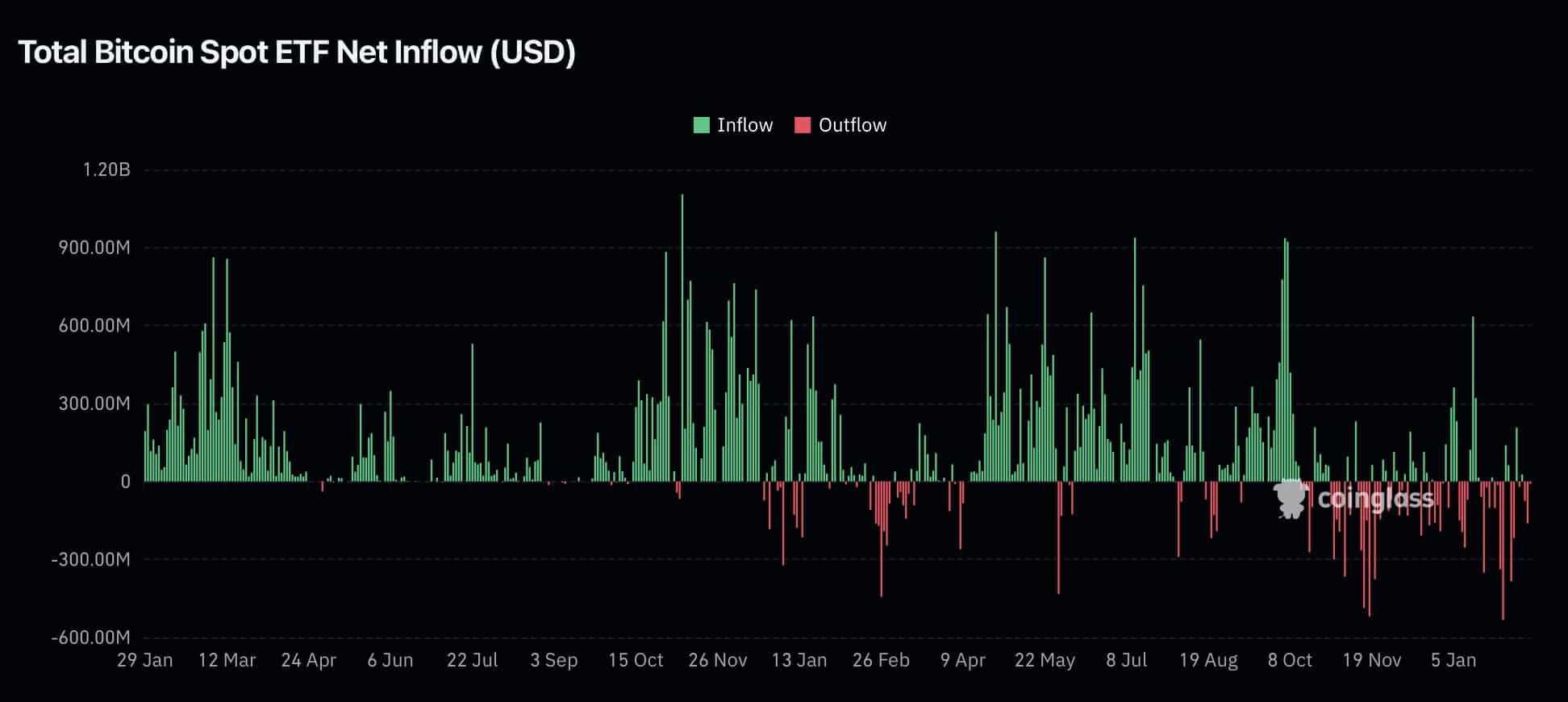
However, it’s overall stabilising above the $60,000 level. The iShares Bitcoin Trust (IBIT) has experienced approximately $2.8 billion in net outflows over the last quarter. While substantial, this figure contrasts with the nearly $21 billion in net inflows recorded over the past year. The broader spot ETF category mirrors this trend, registering roughly $5.8 billion in exits over three months.
Bitcoin ETF Outflows Signal Institutional Retreat, For Now
Matt Hougan, CIO at Bitwise Asset Management, noted that the current selling pressure is likely not driven by long-term ETF allocators but rather by short-term traders and hedge funds utilizing liquid products to manage momentum.
It’s really a tale of two sides,
Hougan stated, emphasizing that financial advisors are largely holding steady despite the volatility.
However, the shift in market structure is palpable. Amberdata analysis indicates that year-to-date flows in 2026 have turned negative for the first time since inception. This aligns with broader market data where crypto products recorded a net outflow of $1.7 billion at the start of February, highlighting a pause in the relentless accumulation regime.
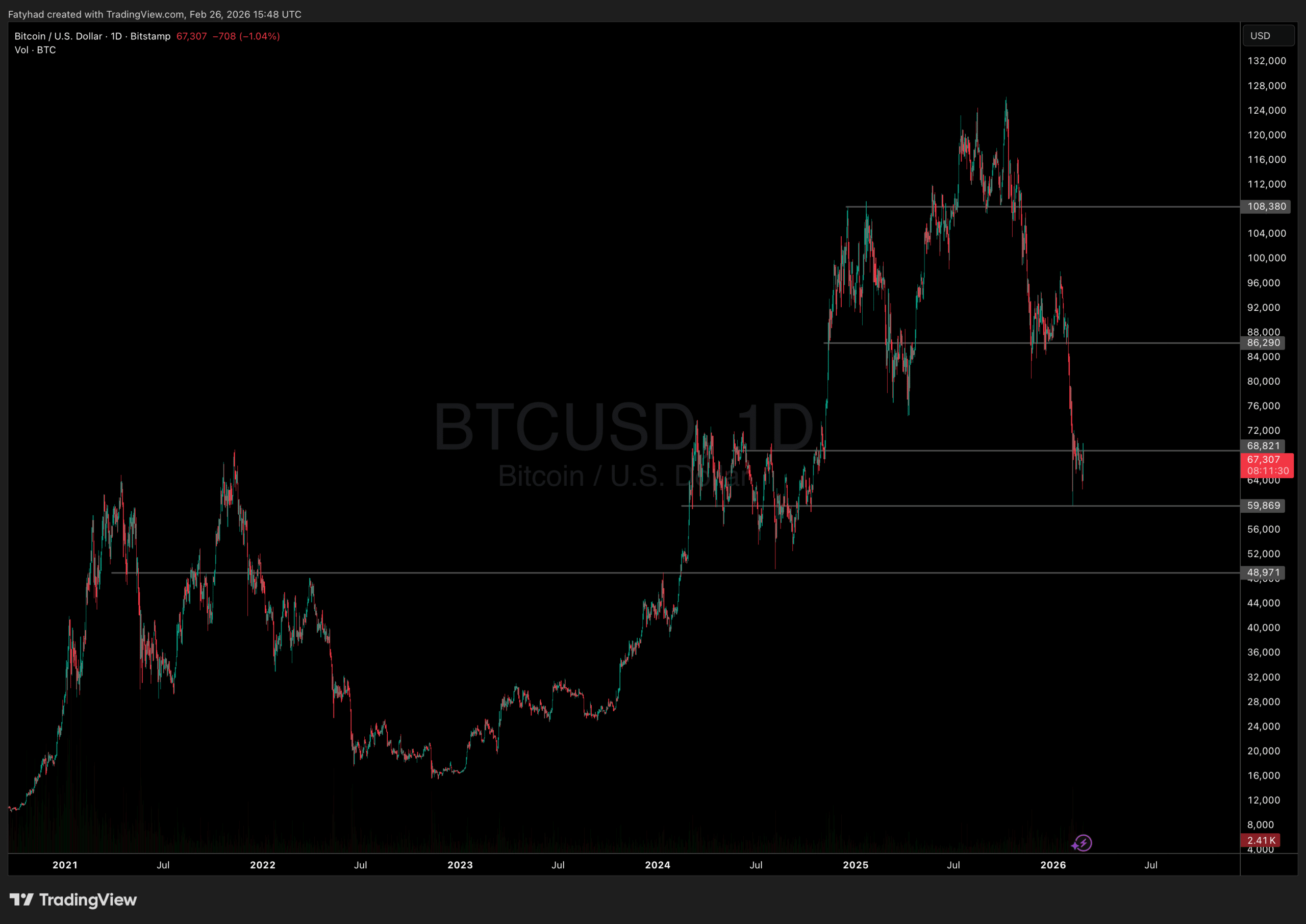
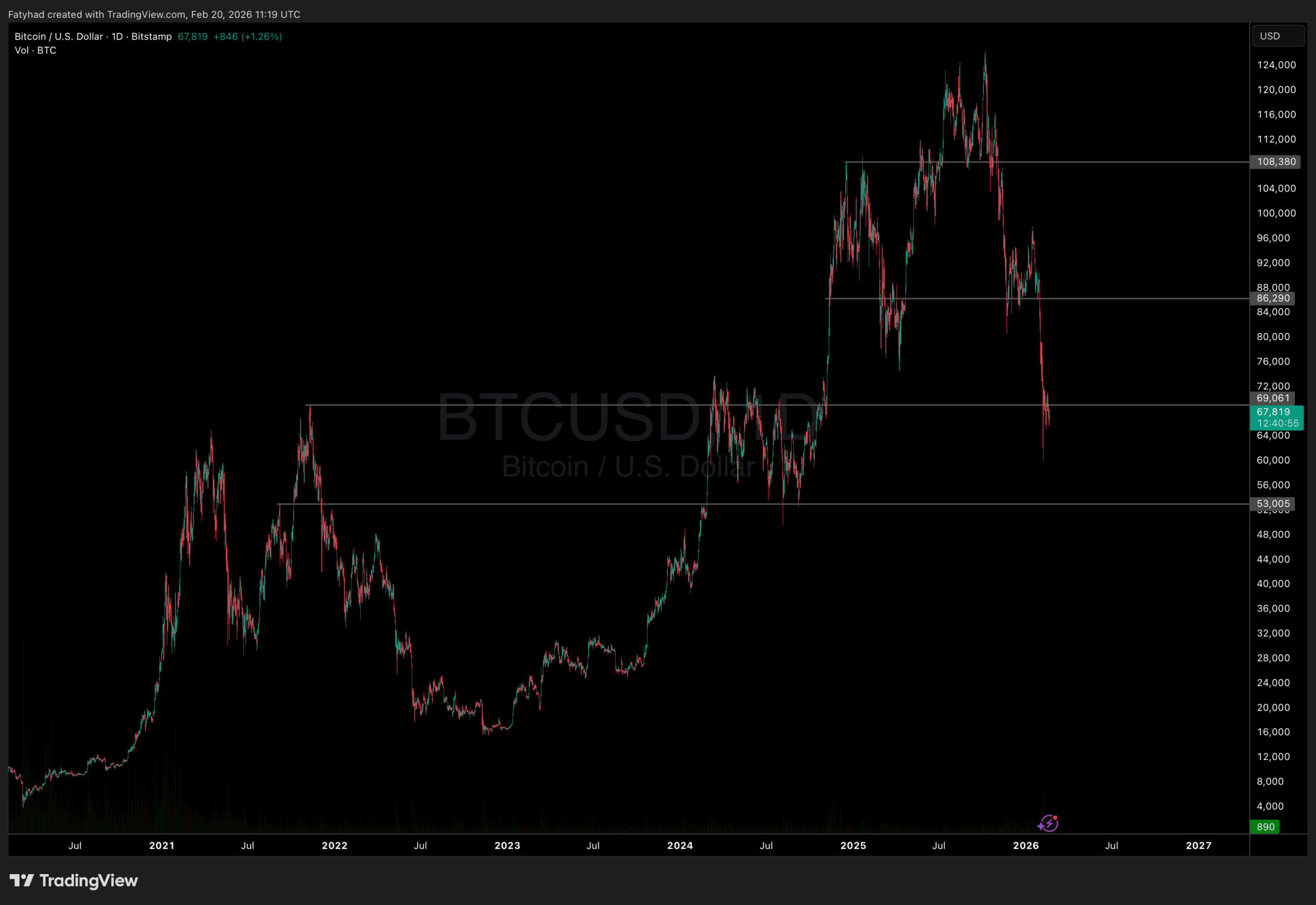
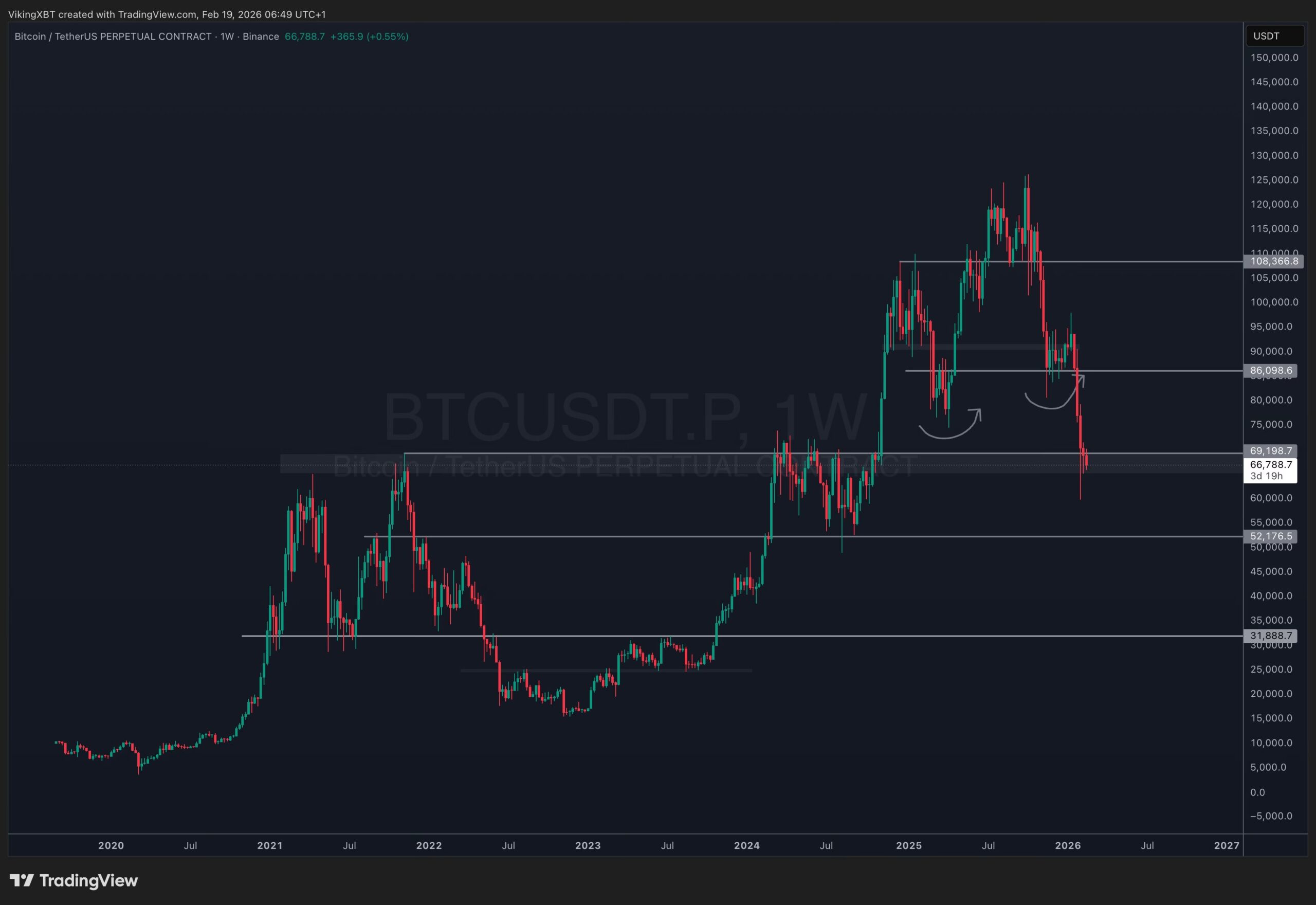
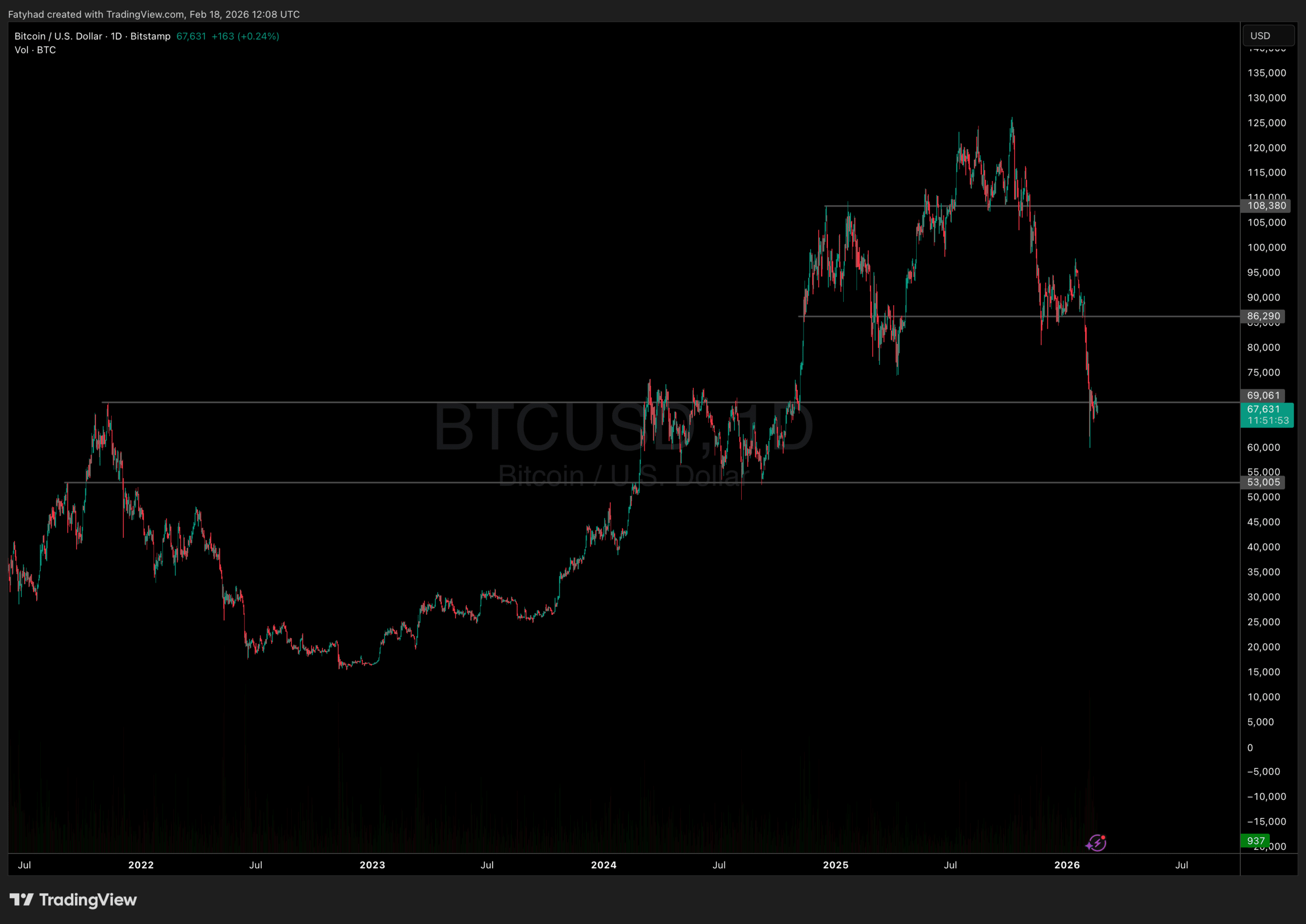
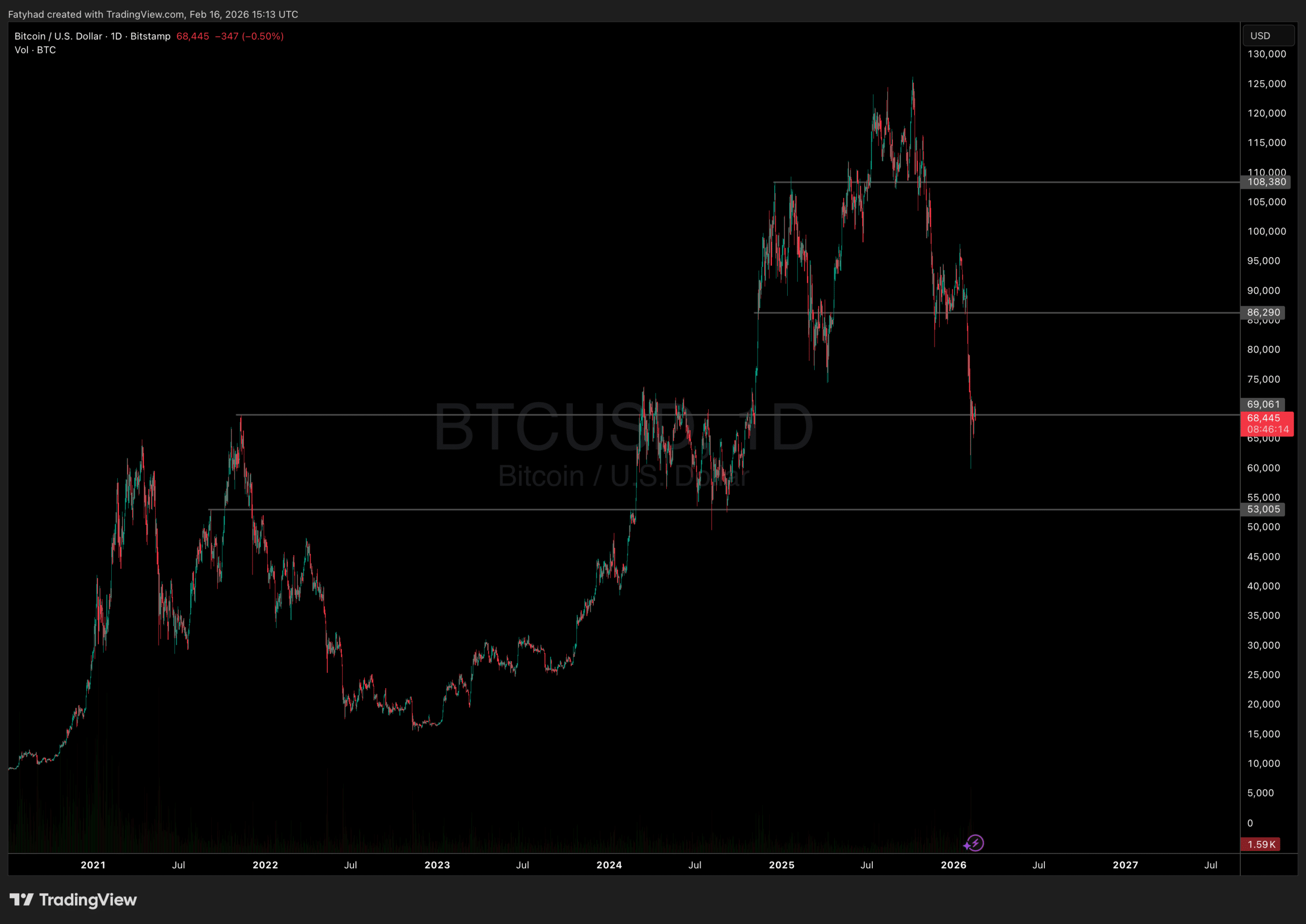
For Bitcoin, the next major support sits near $53,000–$55,000, if it fails to hold $60,000 while $69,000 and $86,0000 now act as resistance.
The divergence between Bitcoin and traditional safe havens has rattled investors. While gold pushes toward new highs, the Bitcoin crash has hit strategy and spot ETFs hard, leaving many recent entrants underwater.
Looking ahead, crypto traders are watching for signs of capitulation or a demand floor. Although Bitcoin ETFs see sporadic inflows as investors accumulate assets during dips, sustained selling pressure raises fears of a “crypto winter.”
If the $60,000 support level fails to hold, analysts warn that the correction could deepen as institutional leverage continues to reset.
Disclaimer: Coinspeaker is committed to providing unbiased and transparent reporting. This article aims to deliver accurate and timely information but should not be taken as financial or investment advice. Since market conditions can change rapidly, we encourage you to verify information on your own and consult with a professional before making any decisions based on this content.
Neil is a professional cryptocurrency content writer with years of experience. He has written for various cryptocurrency websites to report on breaking news, and been hired by all sorts of cryptocurrency projects, to create content that would increase their exposure and attract more potential investors.
Bitcoin fell below $100,000 while Ethereum neared the $3,000 mark.
Crypto liquidations got over $1.7 billion, with Ethereum leading the chart.
Binance saw a net inflow of 8,400 BTC over the past 24 hours.
The crypto market is stuck in a highly volatile zone that’s been negatively affecting not only small-cap tokens but also the leading assets. The market-wide volatility triggered a flash crash as the global crypto market cap dropped by another 2%, reaching $3.39 trillion, according to CoinMarketCap data. Moreover, the total value lost from the digital assets market reached $840 billion over the past 30 days.
Consequently, the selloff brought $1.73 billion in liquidations ($1.32 billion belongs to long positions) over the past 24 hours, CoinGlass data shows.
Ethereum ETH$2 23424h volatility:2.5%Market cap:$269.67 BVol. 24h:$18.38 B
is leading the chart with $573.91 million in liquidations ($485.86 million in longs) due to its 4.5% price fall over the past day. ETH is currently trading at $3,330, slightly up from its plunge to the $3,000 mark.
BTC is hovering close to $102,000 at the time of writing. Its market cap is sitting just above the $2 trillion mark.
Coinglass data shows that the total number of traders who have been liquidated is over 430,000.
Hopes of a Recovery
With the latest market crash, some investors might be planning to sell their digital assets before a further price fall.
According to CoinGlass, Binance, the largest crypto exchange by trading volume, recorded a net inflow of 8,403 BTC, worth roughly $855 million, over the past day. The inflow shows that investors are preparing to sell Bitcoin due to market volatility.
According to Santiment, the social sentiment around the market has shifted from selling to “buying dips with confidence.”
😱 Bitcoin's drop to $98.9K and Ethereum's to $3.09K may have your timeline showing fellow traders left in shambles. But social data indicates there are still many buying dips with confidence. We look at $BTC, $ETH, & $XRP sentiment after the bloodbath. 👇https://t.co/smG1LYyI77pic.twitter.com/SdEusnzXUv
The market intelligence platform shows that the calls for a market “bottom” and “buy” signals have significantly increased after Bitcoin fell below $100,000.
It’s important to note that large investors continued their selloff on Nov. 4, but the sentiment shift could trigger a buying spree.
Disclaimer: Coinspeaker is committed to providing unbiased and transparent reporting. This article aims to deliver accurate and timely information but should not be taken as financial or investment advice. Since market conditions can change rapidly, we encourage you to verify information on your own and consult with a professional before making any decisions based on this content.
Wahid has been analyzing and reporting on the latest trends in the decentralized ecosystem since 2019. He has over 4,000 articles to his name and his work has been featured on some of the leading outlets including Yahoo Finance, Investing.com, Cointelegraph, and Benzinga. Other than reporting, Wahid likes to connect the dots between DeFi and macro on his newsletter, On-chain Monk.